Trees taking drastic measures to survive climate-driven heat / Photo: © AFP

 US House targets data centers as midterm backlash grows

 French ex-minister Dati goes on trial in Renault-Nissan corruption case
 'Being Heumann' captures joy in fight for disability rights
 Retired great Nadal to play in exhibition matches

 IR-MED and Dice Technologies Announce collaboration to Evaluate and Advance Pressure-Injury Prevention Platform in Japan
 Watts, Pitt, Cruz to light up Spain's top film festival
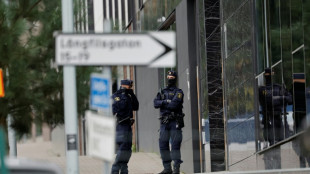 Sweden expels Iran embassy employee over anti-Jewish threats
 Toogood Gold's Table Mountain Sits in the Shadow of a Nevada Gold Rush

 MEXC July–August Security Report: 38.66M USDT in Risk Funds Intercepted, Futures Insurance Fund Hits 792M USDT

 'Breathing toxin every day': Indonesians choked by haze feel helpless
 Stocks edge higher ahead of US Fed rate call

 Philippines ex-leader Duterte makes first in-person ICC appearance

 2027 Formula One calendar includes Monaco sprint race

 Palestinians are the real victims, Thunberg tells Ed Sheeran

 Hashim Thaci: From 'George Washington of Kosovo' to Hague convict

 Amnesty says Iran committed 'crimes against humanity' in crackdown on 2022 protests

 EU to ban social media for under 13s, curb access until 15

 Philippines ex-leader Duterte makes first appearance at ICC
 EU chief pitches 'associate member' status for Canada

 English village votes to 'secede' from UK over asylum centre plan

 Wildfires push endangered Sumatran elephants to brink: Indonesian NGO

 Stocks head higher as traders prepare for Fed decision
 English village votes to 'secede' from UK over asylum centre
 Hong Kong unveils plan to align economy with China's goals
 Brazilian voters the latest to eye Bukele security model with envy

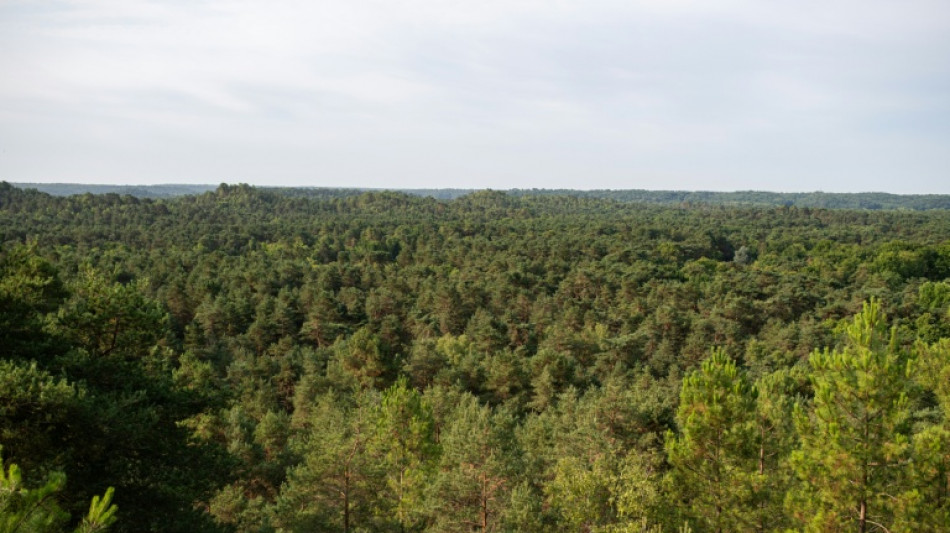
The once-majestic oak tree is all but dead: battered by repeated heatwaves, it has shut down vital functions to conserve water and is slowly dying in a French forest.
It is one of countless trees across Europe's forests adopting drastic -- and often fatal -- strategies to survive worsening heat and drought linked to climate change.
As France endures a record-breaking early season heatwave, scientists warn that many of Europe's forests are already bearing the scars of years of rising temperatures and intense drought.
Like humans cooling themselves through sweat, trees regulate temperature through transpiration, drawing water from the soil and releasing it as vapour through tiny pores in their leaves.
As temperatures rise, water loss from leaves and soils accelerates, forcing trees into dire straits to conserve moisture.
Manuel Nicolas, from France's National Forestry Office, has studied this phenomenon across the country's public forests for decades.
All trees are "suffering" but their response to heat stress varies depending on species and location, said Nicolas, who heads the national forest ecosystem monitoring programme.
- 'Dying of thirst' -
Some trees reduce water loss by rapidly closing their stomata -- microscopic pores on leaves or needles that regulate gas exchange and water vapour release.
Closing the stomata conserves water but slows or even halts photosynthesis, the process that converts sunlight, carbon dioxide and water into sugars needed for growth and survival.
Over time, the tree can effectively starve.
Another strategy favoured particularly by trees with deep root systems is to draw water from the soil and keep their stomata open as long as possible, said Nicolas.
"But the risk this time is dying of thirst," he told AFP in Fontainebleau, a vast forest roughly 60 kilometres (37 miles) south of Paris.
"A tree is a column of water" that can absorb up to 200 litres per day, Nicolas said, transporting moisture from the ground to the canopy. But this system can become overwhelmed from heat or drought, and break down entirely.
"Air bubbles enter the vessels and prevent the sap from circulating to the tips of the branches. This is called gas embolism," said Nicolas.
"And when the embolism affects too many vessels, the entire tree dies from dehydration."
- Adapt or die -
Scientists say that as heatwaves and droughts become more frequent, trees are increasingly being pushed to these limits.
In France, home to some of Europe's most diverse forests, government figures show tree mortality has doubled over the past decade.
Projections suggest that around 30 percent of tree species could be at risk of decline by 2050.
Experts say that forests are being forced to quickly adapt to climatic changes that normally unfold over millennia.
The world has warmed by around 1.4C since the pre-industrial era mostly because of the burning of fossil fuels for energy.
But scientists say the current period is likely the hottest the Earth has experienced in 125,000 years.
The impact on trees is visible to the naked eye in Fontainebleau, where some giants have shed their branches and leaves in a hopeless bid to cling on.
Among them is oak number 37 -- still standing, but limbless and ragged, its fate sealed.
Nicolas and his team have been tagging and observing trees on this plot for 34 years and know its time is near.
But others nearby remain tall and healthy for reasons scientists are still deciphering.
An intense heatwave in 2018 scorched a cluster of pines in Fontainebleau but other conifers in the woodland thrived for reasons that are still not well understood.
Some trees, such as Mediterranean species, can be more resilient against heat, Nicolas said.
They are better suited to drought conditions because they "limit water loss through transpiration with small, leathery leaves covered in hairs or an impermeable cuticle, as in the holm oak", he said.
Understanding "which species will be suitable 100 years from now" will be crucial to safeguarding forests from the heat to come, Nicolas said.
"Against heatwaves, there's not much we can do. But we can try to help the forest adapt," Nicolas said.
L.Wyss--VB