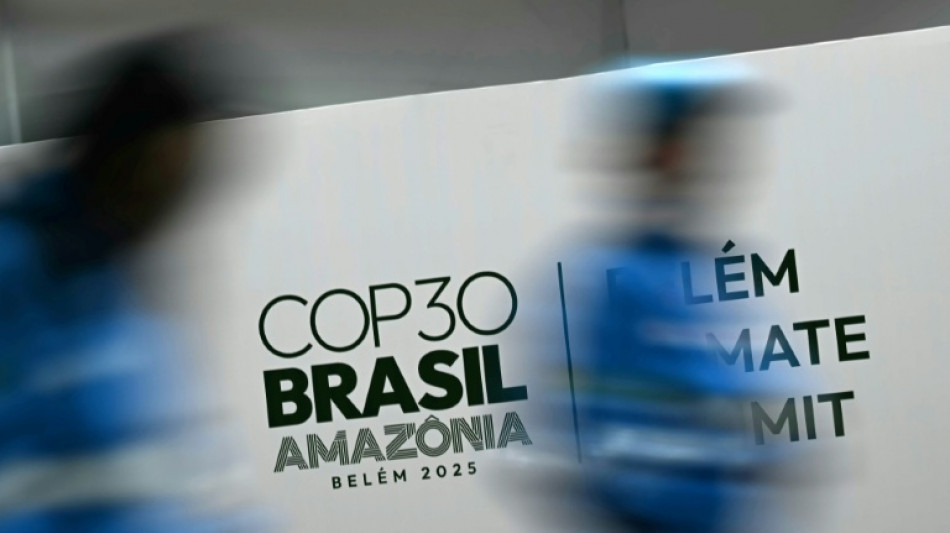
What did countries agree to at COP30? / Photo: © AFP/File

 Hashim Thaci: From 'George Washington of Kosovo' to Hague convict

 Amnesty says Iran committed 'crimes against humanity' in crackdown on 2022 protests

 EU to ban social media for under 13s, curb access until 15

 Philippines ex-leader Duterte makes first appearance at ICC
 EU chief pitches 'associate member' status for Canada

 English village votes to 'secede' from UK over asylum centre plan

 Wildfires push endangered Sumatran elephants to brink: Indonesian NGO

 Stocks head higher as traders prepare for Fed decision

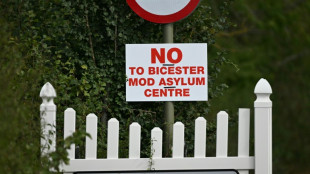 English village votes to 'secede' from UK over asylum centre
 Hong Kong unveils plan to align economy with China's goals
 Brazilian voters the latest to eye Bukele security model with envy

 EU chief hosts Canada's Carney in push to 'deepen' alliance
 EU chief to unveil social media, gaming curbs for under-15s
 Saudi says Houthis target Mecca, warn of 'red line'

 Asian stocks stutter as traders prepare for Fed decision

 US touts its power, avoids Iran war at G20 Energy meeting
 Dead animals, barren fields, and hunger - El Nino chokes Central America
 In hydropowered Bhutan, solar starts to rise

 Brazil's Supreme Court clashes over handling of probe involving judge

 Trump threatens to keep Kennedy Center shut if his name not added

 i-payout Expands U.S. Money Transmitter Licensing Footprint and Advances European EMI Strategy

 Artists exit Sheeran tour in solidarity with Macklemore pro-Palestinian comments
 Espi saves Real Madrid with late winner at Elche

 Liverpool pile on misery for Spurs in League Cup, Dowman dazzles for Arsenal

 Trump blasts Supreme Court justices over 'horrible' mail vote ruling

The COP30 climate summit has drawn to a close after two weeks in the Amazonian city of Belem where protests, street marches and even a fire caused unexpected moments of drama.
But beneath enormous tents erected over a former airport at the edge of the rainforest, nations also adopted some decisions on how to battle climate change.
Here are the main negotiated outcomes, and the voluntary commitments, made during the summit attended by nearly 200 nations:
- Fossil fuels -
The thorniest issues were bundled into a "mutirao" pact -- the summit's slogan, drawn from the Tupi-Guarani word for "collective effort."
The agreement included an initiative for countries to collaborate on a voluntary basis to reduce carbon emissions and strive to limit global warming to 1.5C relative to pre-industrial levels.
It also noted a commitment made by all nations at COP28 in Dubai to "transition away from fossil fuels" -- but this exact phrase, which has become politically sensitive, was not included.
Despite pressure from more than 80 nations from Europe to Latin American to the Pacific, the conference did not adopt a "roadmap" to phase out fossil fuels.
Instead, COP30 president Andre Correa do Lago offered to create one for countries willing to join on a voluntary basis, and another plan to halt deforestation.
- Finance -
The world's poorest nations have long complained they lack the finance for "adaptation" -- measures to protect their economies from rising seas, such as building sea walls, and other impacts of climate change.
In a win for developing countries at COP30, the final agreement "calls for efforts to at least triple adaptation finance by 2035."
In 2024, rich countries agreed to provide $300 billion a year by 2035 in climate finance to developing nations, with no specific amount earmarked for adaptation.
Most of that goes to projects that reduce greenhouse gas emissions, such as renewable energy, and not to adaptation -- something developing nations have long complained puts them at a disadvantage.
The "tripling" goal agreed in Belem could mean $120 billion from that $300 billion is earmarked for adaptation, but close observers said clarity was still needed around that target.
- Trade -
For the first time, trade has been included as a pillar of the final text, with a three-year dialogue to take place under the climate framework.
This reflected concerns from countries including China that trade measures -- like taxes on carbon-intensive goods -- could erode export revenues or throw up barriers to green technology sales.
- Forests -
At COP30, Brazil launched a new global investment vehicle that proposes paying out a share of profits to forest-rich countries for every hectare of trees they leave standing.
Brazilian President Luiz Inacio Lula da Silva announced during a leaders' summit in Belem last week -- even before COP30 officially started -- the launch of the Tropical Forests Forever Facility.
The TFFF attracted $5.5 billion in pledges from Norway, Germany, Indonesia, France and Brazil -- the biggest contributors.
Ultimately, Brazil is seeking to raise $125 billion in public and private investment, but said the fund could start working even without the full $25 billion in startup capital from governments.
- Methane pledges -
Slashing methane emissions -- the second-largest contributor to climate change after carbon dioxide -- is considered one of the fastest ways to curb global warming.
Although it remains in the atmosphere for about 12 years, the "super pollutant" is roughly 80 times more potent than CO2 over a 20-year period.
At COP30, seven countries -- Britain, France, Canada, Germany, Norway, Japan and Kazakhstan -- signed a statement vowing to achieve "near zero" methane emissions across the fossil fuel sector.
E.Gasser--VB