Massive march in Brazil marks first big UN climate protest in years / Photo: © AFP

 Hashim Thaci: From 'George Washington of Kosovo' to Hague convict

 Amnesty says Iran committed 'crimes against humanity' in crackdown on 2022 protests

 EU to ban social media for under 13s, curb access until 15

 Philippines ex-leader Duterte makes first appearance at ICC
 EU chief pitches 'associate member' status for Canada

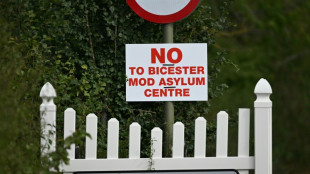 English village votes to 'secede' from UK over asylum centre plan

 Wildfires push endangered Sumatran elephants to brink: Indonesian NGO

 Stocks head higher as traders prepare for Fed decision

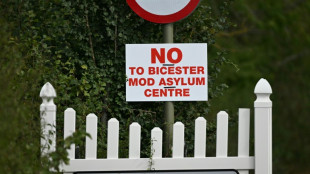 English village votes to 'secede' from UK over asylum centre
 Hong Kong unveils plan to align economy with China's goals
 Brazilian voters the latest to eye Bukele security model with envy

 EU chief hosts Canada's Carney in push to 'deepen' alliance
 EU chief to unveil social media, gaming curbs for under-15s

 Saudi says Houthis target Mecca, warn of 'red line'

 Asian stocks stutter as traders prepare for Fed decision

 US touts its power, avoids Iran war at G20 Energy meeting

 Dead animals, barren fields, and hunger - El Nino chokes Central America
 In hydropowered Bhutan, solar starts to rise

 Brazil's Supreme Court clashes over handling of probe involving judge

 Trump threatens to keep Kennedy Center shut if his name not added

 i-payout Expands U.S. Money Transmitter Licensing Footprint and Advances European EMI Strategy

 Artists exit Sheeran tour in solidarity with Macklemore pro-Palestinian comments
 Espi saves Real Madrid with late winner at Elche

 Liverpool pile on misery for Spurs in League Cup, Dowman dazzles for Arsenal

 Trump blasts Supreme Court justices over 'horrible' mail vote ruling

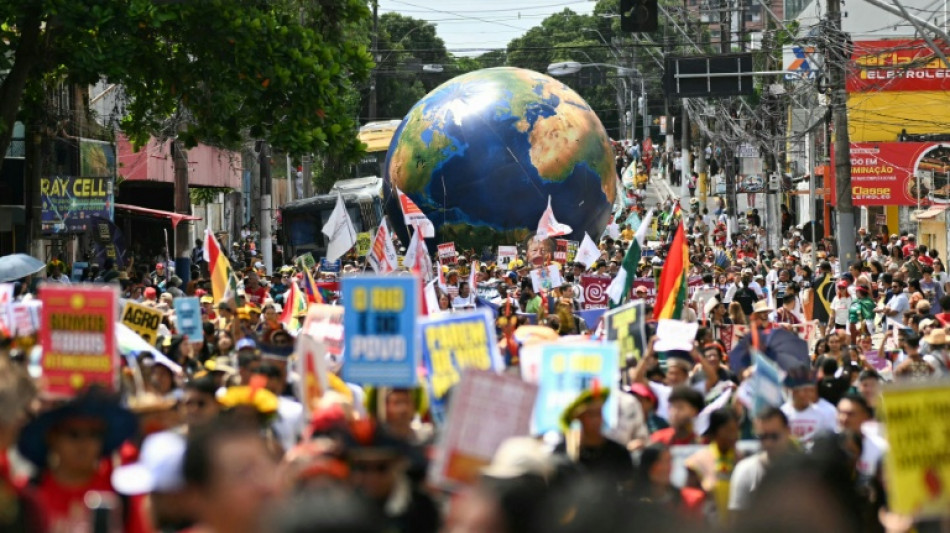
Tens of thousands of people thronged the streets of the Amazonian city hosting COP30 talks on Saturday, dancing to thumping speakers in the first large-scale protest at a UN climate summit in years.
Under a searing sun, Indigenous people and activists sang, chanted and whirled to blasting music as they pushed along a giant beach ball of Earth and held a flag of Brazil emblazoned with the words "Protected Amazon."
Others held a mock funeral procession for fossil fuels, dressed in black and pretending to be grieving widows as they carried three coffins marked with the words "coal," "oil" and "gas."
"We are here to try to apply pressure so that countries fulfill their promises and we don't accept a regression," Txai Surui, a prominent 28-year-old Indigenous leader, told AFP.
It was the first major protest outside the annual climate talks since COP26 four years ago in Glasgow, as the last three gatherings were held in locations with little tolerance for demonstrations -- Egypt, Dubai and Azerbaijan.
Called the "Great People's March" by organizers, the Belem rally comes at the halfway point of contentious negotiations and follows two Indigenous-led protests that disrupted proceedings earlier in the week.
- Forest 'massacre' -
"Today we are witnessing a massacre as our forest is being destroyed," Benedito Huni Kuin, a 50-year-old member of the Huni Kuin Indigenous group from western Brazil, told AFP.
"We want to make our voices heard from the Amazon and demand results," he said. "We need more Indigenous representatives at COP to defend our rights."
Tyrone Scott, a 34-year-old Briton from the anti-poverty group War on Want, said it was an "Indigenous-led, movement-led, people-powered march."
"It's just really exciting and a little bit of a nice antidote to the staleness and sterileness of the inside of the COP," Scott told AFP.
Their demands include "reparations" for damage caused by corporations and governments, especially to marginalized communities.
A giant Palestinian flag and "free Palestine" banners appeared throughout the crowds.
One protester on stilts dressed as a greedy Uncle Sam denouncing "imperialism," while other artwork took aim at Donald Trump, the US president who denigrates climate science and champions fossil fuels.
"Here we are talking about agroecology, feminism, we are talking about how trade unions are defending the life and better employment," 33-year-old Giovani Del Prete told AFP.
"These are the politics that we must move forward to defeat the climate crisis."
After a 4.5-kilometer (2.8-mile) march through the city, the demonstration stopped a flew blocks from the COP30 venue, where authorities deployed soldiers to protect the site.
Ultimately, the crowd -- which organizers put at 50,000 -- dispersed peacefully.
On Tuesday, Indigenous protesters forced their way into the Parque da Cidade -- the COP30 compound built on the site of a former airport -- clashing with security personnel, some of whom sustained minor injuries.
Then on Friday, dozens of Indigenous protesters blocked the entrance for roughly two hours to spotlight their struggles in the Amazon, prompting high-level interventions to defuse the situation.
- Love letters and therapy -
Inside the venue, talks are delicately poised.
At the close of the first week of negotiations, the Brazilian presidency of COP30 is expected to unveil its strategy on Saturday for reconciling countries' demands.
The top issues include how to address weak climate goals and how to improve financial flows from rich to poor countries to build resilience against a warming world and transition to low-emission economies.
Several participants believe that negotiators are holding firm to their positions while awaiting the arrival next week of government ministers, who must reach an agreement by the conference's end on November 21.
A Western diplomat said the Brazilian presidency had urged countries to treat their consultations as "therapy sessions" -- a safe space to air concerns.
Delegations were also encouraged to send private submissions describing how they felt the talks were progressing, which the Brazilians referred to as "love letters."
E.Gasser--VB