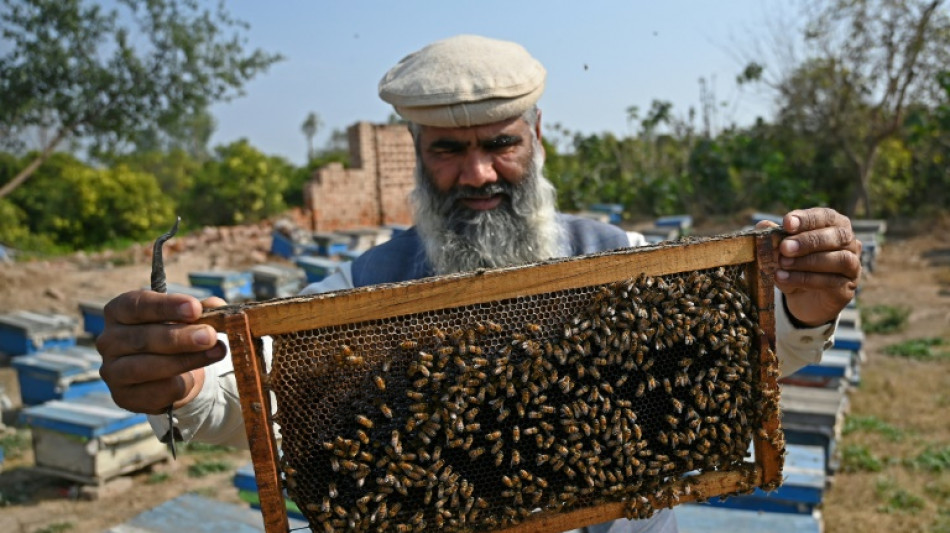
Plan B: Pakistan beekeepers widen pursuit of flowers / Photo: © AFP

 Arsenal face depleted Aston Villa, Spurs seek return on £300m spend

 Werro edges ever closer to elusive women's 800m world record

 Callaway cuts ties with golf media firm over violent ad

 Trump says Putin won't attack NATO territory

 Labor Day 2026: Complete Starter Tool Kit Under $375

 Tamil Nadu Govt Assigns Ministers to Oversee Chennai Monsoon Preparedness

 Alfred gets revenge on Jefferson-Wooden in Zurich 100m

 US Open men's singles: Three talking points

 Michael Strahan Welcomes Fifth Child with Girlfriend Kayla Quick

 Kuminga’s Timberwolves Deal Saves Millions in Taxes Despite Lower Pay Than Lakers Offer

 Trump says Russia is 'not going to attack' NATO territory

 OpenAI Tests 'Persistent Mode' for Codex AI Agent

 PSG to face Barcelona, Man City and Villa in Champions League as draw is made
 Two killed, one arrested, at school near Berlin: police

 Cox defies Pakistan after Abbas's treble strike rocks England

 Bosnian Serb war criminal Ratko Mladic dead

 Ogura to miss Aragon MotoGP after hand surgery

 Severe Thunderstorms Hit Eastern Australia After SA Deluge

 More than goals: What Mourinho wants from Real Madrid's Mbappe

 Finland defends shores against oil spill risk

 Iraola hoping for 'good news soon' in Liverpool pursuit of Barcola

 Iran executes over 500 people in 2026: rights group

 Srebrenica: Massacre that outraged the world

 After US settlement, EU says Meta must 'protect our kids too'

 Germany-led 'frugal' EU states demand budget plan cuts of 'several hundred billion'

Under a dry, smoggy sky, a beekeeper in Pakistan's Punjab province carefully loads boxes filled with tens of thousands of bees onto the back of a truck.
Together they will travel 500 kilometres (around 300 miles) in an increasingly desperate chase to find flowering plants, clean air and moderate temperatures for honey production as climate change and pollution threaten the industry.
"We move the boxes according to where the weather is good and the flowers bloom," Malik Hussain Khan told AFP, standing in a field of orange trees whose blossoms arrived weeks late in February and lasted only for a few weeks.
Pakistan's beekeepers typically move seasonally to spare their charges stifling heat or freezing cold.
Summers are spent in northwestern Khyber Pakhtunkhwa province, and winters in central Punjab province.
But weather patterns made unpredictable by climate change -- coupled with some of the worst pollution in the world -- mean beekeepers must move more frequently and travel further.
This winter was marked by soaring, hazardous smog levels that the government declared a national disaster. Research has found air pollution can make it harder for bees to locate flowers.
Diminished rainfall, meanwhile, failed to clear the choking air and triggered drought warnings for farmers.
"Almost half of my bees died when the smog and fog hit this winter because they could not fly. There was hardly any rain," said Khan, who moved his bees as frequently as every few weeks in January and February.
- Honey varieties plummet -
The bees of Pakistan's 27,000 beekeepers once had diverse foliage fed by reliable rainfall, offering a rich source of nectar.
Their honey is used in local flu remedies, drizzled over sweets, and given as gifts.
Since 2022 however, Pakistan's honey production has dropped 15 percent, according to the government's Honey Bee Research Institute (HBRI) in the capital Islamabad.
"Heavy rainfall and hail storms can destroy the flowers, and erratic rainfall and high temperatures during the winter flowering season can stop them from blooming," said Muhammad Khalid, a researcher at the institute.
"When the flowers disappear, the bee population declines because they cannot find nectar, resulting in reduced honey production."
Bees are threatened globally by changing weather patterns, intensive farming practices, land-use change, and pesticides.
Their loss threatens not just the honey trade, but food security in general, with a third of the world's food production dependent on bee pollination, according to the Food and Agriculture Organisation.
Pakistan's bees once produced 22 varieties of honey, but that has plummeted to 11 as flowering seasons shorten. Three of the country's four honey bee species are endangered.
"The places that used to be green for our bees to fly 30 years ago, no longer are," says 52-year-old honey trader Sherzaman Momaan, who speaks with tenderness about his winged charges.
"We didn't move around then as much as we do now."
His hives were almost entirely wiped out by 2010 floods in Khyber Pakhtunkhwa, but he believes deforestation is the most significant long-term change and threat.
Yousaf Khan and his brother, based in Islamabad, have been producing honey for 30 years, moving short distances around neighbouring Punjab to catch the best blooms.
"Now, we go as far as Sindh (province) for warmer temperatures and to escape extreme weather conditions," Khan told AFP, referring to areas up to 1,000 kilometres (600 miles) away.
"Bees are like babies, they need a good environment, good surroundings, and proper food to survive."
- 'Fight and kill' -
Moving the bees comes with its own risks.
"If the weather is very hot, or if the distance is too long, there is a chance that some bees could die. It has happened to my bees before," Khan explained.
On long trips, they must also be fed artificial food because they cannot produce honey while travelling.
Moving so often is expensive for beekeepers in a country where fuel prices have risen dramatically in recent years.
And beekeepers seeking better weather can face harassment if they set up in areas without permission from landlords.
On barren land outside Chamkanni in Khyber Pakhtunkhwa, Gul Badshah watches helplessly as bees appear and disappear from dozens of boxes on a fruitless search for flowers.
"They fight and kill each other if the weather conditions do not suit them," he told AFP.
Badshah, whose boxes were also washed away in floods in 2010, and again in 2022, has given up travelling long distances.
"There is nowhere to be found. We do not know where else to go."
- Cool bees -
Some hope is offered by new technology intended to keep bees cool, addressing the problem of how extreme temperatures affect the insects -- if not their food source.
Abdullah Chaudry, a former beekeeper, developed new hives with improved ventilation based on inspiration from other honey-producing nations dealing with rising temperatures, including Turkey and Australia.
Early signs suggest the boxes improve production by around 10 percent.
"Extreme heat does not make bees comfortable and instead of making honey, they keep busy cooling themselves," he told AFP at the capital's beekeeping research centre.
"These modern boxes are more spacious, and have different compartments giving more space to the bees."
The improved hives are just part of the adaptation puzzle though, he acknowledges.
"It is an ongoing battle," Chaudry told AFP.
W.Huber--VB