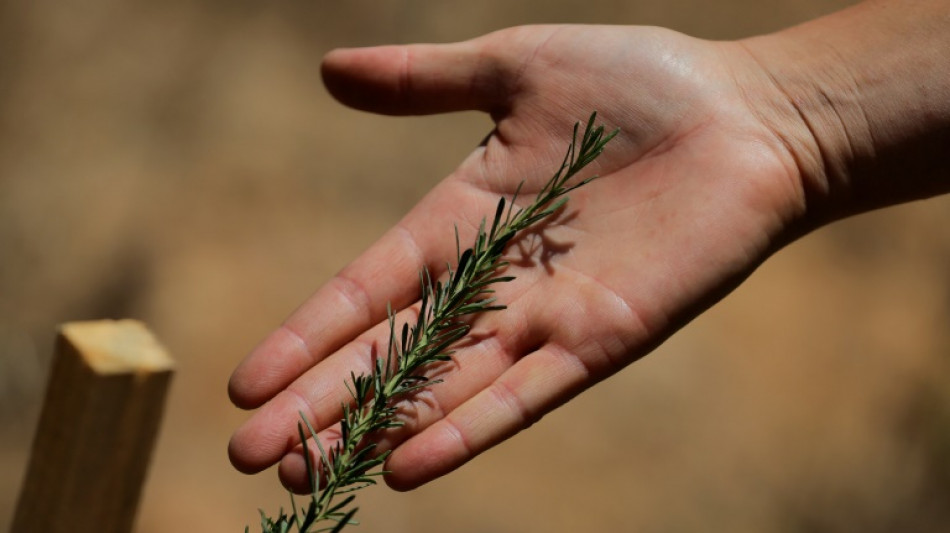
Disaster-hit Chilean park sows seeds of fire resistance / Photo: © AFP

 Nepal flood death toll rises as rescuers scour tunnels

 France's Mistral sees value soar with 3 bn euro cash infusion

 Nepal glacier saw exceptional heat before collapse caused deadly floods: researcher

 Ethiopia boosts drone production to fight rebels

 Yemen rebels hit Saudi Arabia with wave of strikes, wounding 73

 Nepalis mark a year since deadly protests that toppled government

 Rubio launches Latin America tour to cement US influence

 France tries 14 over deadliest Channel migrant crossing disaster

 Australia threatens hefty fines if big tech fails 'duty of care'

 Zverev romps into quarter-finals as Darderi downed

 Kauai on tornado watch as Hurricane Lowell nears Hawaiian islands

 Pakistan roll the dice in search of consolation win over England

 Yen extends gains as traders eye rate hike, tech rallies again

 'The ber months': Christmas arrives early in the Philippines

 N. Korea calls Russia bridge a sign of tighter ties

 US sanctions threaten to crush Iranian students' dreams
 Former champ Gauff holds off Jovic to reach US Open quarter-finals

 OMP Asia Conferences to Showcase How Industry Leaders Kraft Heinz, Mars, Medac, And Nestlé Approach AI-Powered Supply Chain Planning At "Decision Velocity"

 Panama Canal considering more cuts in transits due to El Nino

 Maresca agrees with Haaland that players started season jaded

 Hurricane warning issued for westernmost Hawaiian islands

 UK PM denounces 'politics of poison' after anti-migrant protests

 Comeback queen Zheng strikes again for US Open quarter-final berth

 Third absence for injured Hadjar as Lawson fills in again in Spain

 Far-right victory in Germany draws protesters in Berlin

After a wildfire that devastated Chile's largest botanical garden, the century-old park has planted thousands of native trees that it hopes are less likely to go up in flames.
Last year's inferno -- considered the deadliest in Chile's recent history -- killed 136 people, razed entire neighborhoods and destroyed 90 percent of the 400-hectare (990-acre) garden in the coastal city of Vina del Mar.
Park director Alejandro Peirano thinks it is only a matter of time before the wildfires return.
"One way or another, we're going to have a fire. That's for sure," he told AFP, standing under one of the trees that survived the flames.
With authorities predicting another intense season of forest fires due to rising temperatures, the park wants to make sure it is better placed to survive.
It established a new "battle line" with trees such as litre, quillay and colliguay that are native to Mediterranean forests found in areas with hot, dry summers.
"The idea is to put the species that burn more slowly in the front line of the battle... so that fires, which will happen, don't advance so quickly," Peirano said.
- Recovery takes root -
Summer heat and strong gusts of wind meant that the February 2024 fire ripped quickly through Vina del Mar, 120 kilometers (75 miles) northwest of Santiago, leaving 16,000 people homeless.
The Vina del Mar National Botanical Garden, first designed by French architect Georges Dubois in 1918, boasted 1,300 species of plants and trees, including native and exotic ferns, mountain cypresses, Chilean palm and Japanese cherry trees.
Some came from seeds that survived the atomic bombing of Hiroshima in 1945.
The park was home to wildlife including marsupials, gray foxes and countless birds.
Weeks ago on one of the garden slopes, dozens of volunteers began to plant 5,000 native trees that are watered through an irrigation system.
In two years, the foliage is expected to be large enough to provide shade and encourage the regrowth of other species around them.
The tree planting is part of the first stage of a plan to revive the garden through a public-private partnership.
The park is also expected to be reforested with species capable of adapting to "scarce rainfall and prolonged drought," said Benjamin Veliz, a forest engineer with Wildtree, a conservation group involved in the project.
Firebreaks are also being created on the park's edges and its ravines are being cleared of dry vegetation and trash that feed fires.
Unlike eucalyptus, an exotic species that burns quickly, some native trees are able to withstand or contain flames for longer, according to research by the Federico Santa Maria Technical University (USM).
Scientific experiments have demonstrated that quillay and litre, for example, are less flammable than eucalyptus and pine, USM researcher Fabian Guerrero said.
When the inferno erupted last February, there was little firefighters could do to stop it consuming most of the park in less than an hour.
But nature is slowly healing: abundant rainfall in 2024 in central Chile -- after more than a decade of drought -- has already brought green shoots of recovery in the botanical garden.
The beauty of Sclerophyll forests resistant to summer droughts is that "trees that burn come back," Peirano said.
R.Fischer--VB