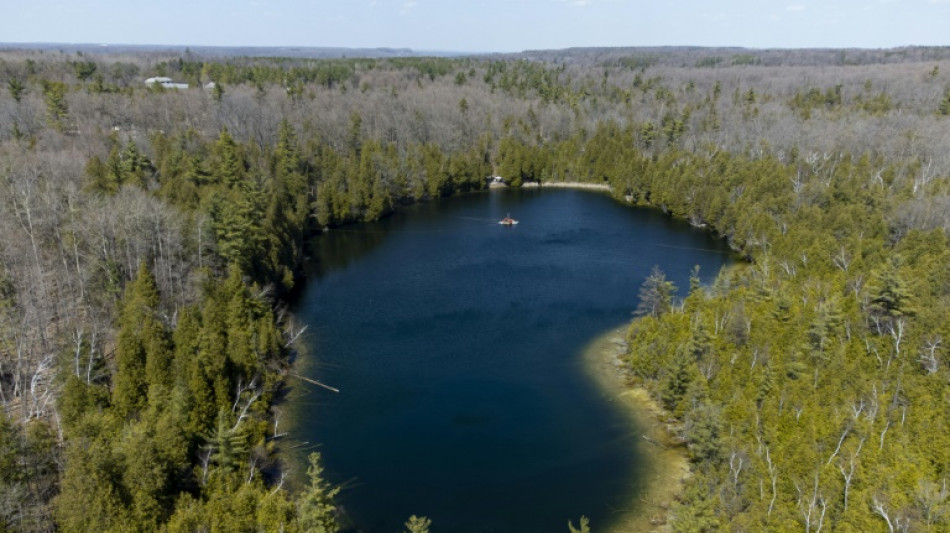
No 'human era' in Earth's geological history, scientists say / Photo: © AFP

 International Trading Institute Expands Professional Trader Development Beyond the Master’s in Trading

 Nairobi to host 2029 world athletics championships in African first

 Ukraine winemakers defy war to make a splash at home

 Prominent Greek neo-Nazi exits prison, vows return to politics: AFP

 Saudi Arabia vows to respond 'firmly' to Houthi attacks

 'We unleashed the beast': the world's fears and hopes about AI

 Carragher sees Manchester City’s winning start as challenge to Arsenal

 Oasis fans weigh ticket costs and reunion memories ahead of 2027 tour

 EastEnders previews Kat’s grief after Zoe’s death

 US military confirms Iran war has led to munitions shortfall

 SkySail Strategies Outperforms Wall Street's 30-Year Risk Standard With Proprietary AI Inference Model

 Canada ends refugee family sponsorship exemption over integrity concerns

 Berlin's run-down public spaces at heart of election campaign

 Ribeiro and Richie among celebrity birthdays for September 20–26

 Bob Mackie, costume designer for Cher and Madonna, dies aged 87

 Mahomes makes triumphant return as Chiefs rout Broncos 31-10

 Belgium completes outer structure of offshore energy island

 Video documents rescue of injured US airman from Iran

 Asian Games: Bigger than Olympics, young stars and a cruise ship

 Asian Games set for liftoff but will have everyone have a bed?

 Most markets drop as oil extends gains ahead of expected US rate hike

 Kate Beckinsale challenges assumptions about her beauty routine

 Sri Lanka's famed beach shack battles demolition

 Drone shot down by NATO over Lithuania

 Vserv targets ₹1,000 crore revenue by 2030 through AI expansion

A top panel of geologists has decided not to grant the 'human age' its own distinct place in Earth's geological timeline after disagreeing over when exactly our era might have begun.
After 15 years of deliberation, a team of scientists made the case that humankind has so fundamentally altered the natural world that a new phase of Earth's existence -- a new epoch -- has already begun.
Soaring greenhouse gases, the spread of microplastics, decimation of other species, and fallout from nuclear tests -- all were submitted as evidence that the world entered the Anthropocene, or era of humans, in the mid-20th century.
But the proposal was rejected in a contentious vote that has been upheld by the International Union of Geological Sciences, the field's governing body said in a statement published on its website on Thursday.
The decision "to reject the proposal for an Anthropocene Epoch as a formal unit of the Geologic Time Scale is approved", it said.
There is no avenue for appeal, though some involved in the voting committee have raised allegations over the conduct of the ballot and a perceived lack of due process.
The union denied these assertions and called the outcome "a decisive rejection of the Anthropocene proposal" by the field's pre-eminent experts.
There were four votes in favour, 12 against and three abstentions, it added.
Despite this, the Anthropocene would endure as a widely used term: "It will remain an invaluable descriptor of human impact on the Earth system," the union said.
- 'Missed opportunity' -
In 2009 scientists began an enquiry that ultimately concluded that the Holocene epoch -- which began 11,700 years ago as the last ice age ended -- gave way to the Anthropocene around 1950.
They gathered a trove of evidence to show this, including traces of radioactive material found in the layered sediment of lakes, the global upheaval of plants and animals, and omnipresent "forever chemicals".
But opponents argued mankind had been reshaping the planet long before the 1950s, pointing to defining moments like the advent of farming and the industrial revolution.
Martin Head, who was part of the team that advocated for the Anthropocene, said there was "a myriad of geological signals" and lamented the way the process was handled.
"I feel this has been a missed opportunity to recognise and endorse a simple reality, that our planet left its natural functioning state in the mid-20th century," Head, a professor of earth sciences at Brock University in Canada, told AFP.
There was no disagreement that 'the age of man' had resulted in profound planetary changes, said Erle Ellis, an environmental scientist critical of the Anthropocene proposal.
But scientists weren't convinced this impact represented an epoch, no less one that definitively began only seven decades ago, said Ellis, professor of geography and environmental systems at the University of Maryland.
"The truth is, there was never a need for a firm boundary. It just wasn't the critical thing," he told AFP earlier this month after the proposal was first voted down.
D.Bachmann--VB