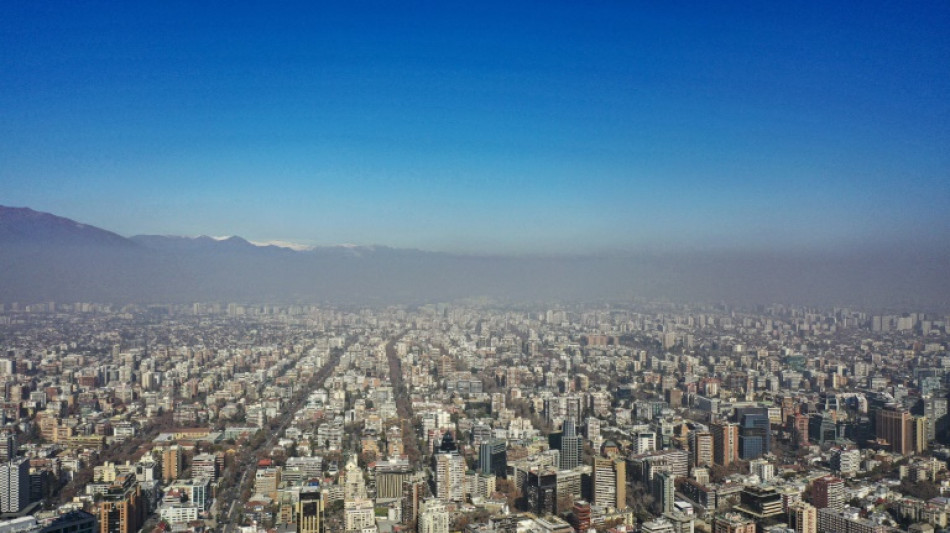
South America sweats under high temps -- in the middle of winter / Photo: © AFP

 Himalayan glacier study warns of flood and water-supply risks

 Kuwait schools restore classroom routines after remote learning

 US designer Bob Mackie, known for Hollywood glamour, dies at 87

 BIS flags debt and profitability risks in AI-driven market rally

 Qatar Chamber and Maltese envoy consider business forum

 Spanish PM denies being blackmailed by Morocco

 Doha Islamic finance forum names AlRayan firms as co-lead partners

 Leeds thrash Newcastle to go third in the Premier League

 Zelensky says Ukraine ready for 'de-escalatory steps'

 In-form Malen fires Roma to Serie A summit, Inter on their heels

 Lebanese agency reports Israeli shelling and gunfire in south

 Expert proposes phased digital reform for Arab business schools

 Trump rejects 'hoax' warnings that AI could destroy humanity

 Houthis say Saudi Arabia hits Yemen with 54 strikes after attack on bases

 Why the far right is losing ground in Sweden
 Ex-Ireland fly-half O'Gara extends deal as La Rochelle coach

 Russian attacks on Ukraine railways escalating every week: rail CEO to AFP

 France, Iraq deepen energy, defence ties during Zaidi visit

 Trump says Ukraine, Russia agree not to hit energy targets

 Nigeria's Dangote refinery launches continent's biggest IPO

 Trump blasts 'sick conspiracy' against AI as warnings mount

 For Laura Linney, role in Parkinson's-themed movie marked a turning point

 Doctors face life sentence over Greek pop star's death

 Trump moves to axe power plant climate rules

 Slow the AI race? Investors weigh the potential cost

Far away from the extreme summer temperatures of the northern hemisphere, Southern Cone countries such as Chile and Argentina are also experiencing record heat, but in the middle of what is supposed to be their winter.
On Tuesday, the mountain town of Vicuna in central Chile hit 37 degrees Celsius (almost 99 degrees Fahrenheit).
"It's been more than 70 years since a temperature like this was recorded" in Vicuna, Chilean meteorologist Cristobal Torres told AFP.
Unusually high temperatures were also recorded 450 kilometers (280 miles) south in the capital Santiago: 24C (75F) on Wednesday, with similar levels forecast for Thursday and Friday.
Meanwhile in Buenos Aires, the temperature exceeded 30C (86F) on Tuesday, making it the highest August 1 temperature since record-keeping began, according to Argentina's National Meteorological Service. The average August temperature in Buenos Aires is usually between 18C (64F) and 9C (48F).
Several cities across Uruguay also recorded temperatures of 30C (86F) on Wednesday.
"What we are experiencing is the combination of two phenomena: a global warming trend due to climate change plus the El Nino phenomenon," said Chile's Environment Minister Maisa Rojas, a climatologist.
"When El Nino ends, the global weather situation should stop being so extreme," she said.
An El Nino event is characterized by increased Pacific Ocean temperatures, causing rainfall, floods and avalanches in western South America, as well as heat waves.
Santiago, Buenos Aires and Montevideo are expected to return to normal temperatures in the coming days, but it is believed that similar heat waves will occur with increasing frequency.
"It is very likely that the heat record will be broken this year (in Santiago), and that is extraordinarily abnormal. Ten years ago we had two heat waves a year and now we are talking about nine," explained University of Santiago climatologist Raul Cordero.
One of the most significant impacts of the warm weather is on snowpacks in the mountains, which are vital for the water supply in Chile's capital.
"Winter heat waves have devastating effects on glaciers and snow," Cordero said.
Rojas also warned about the effects of heat at the poles.
"The ice around the polar areas is at minimum levels," she said on X, formerly known as Twitter.
"Especially around Antarctica, where at this time of year sea ice grows to reach a maximum in September, it is at a historic minimum."
F.Pavlenko--BTB