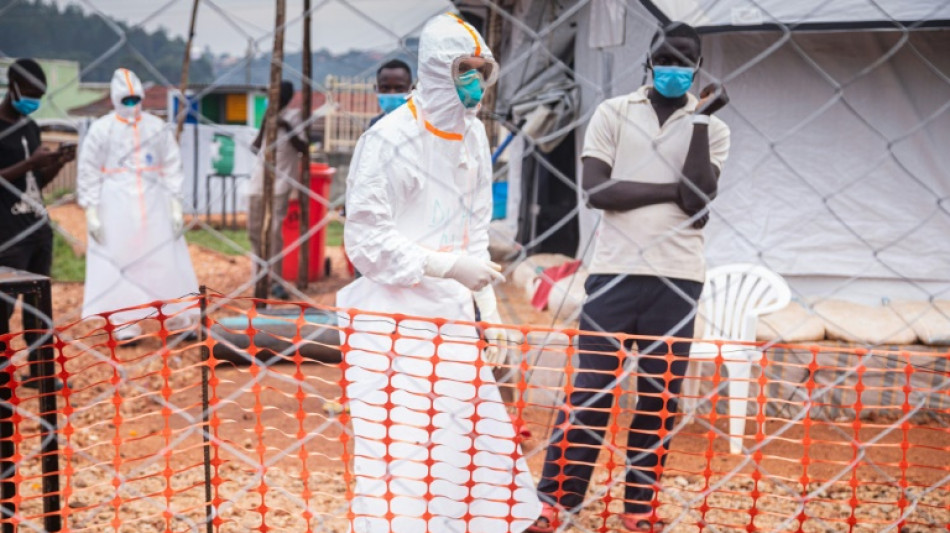
'Death every day': Fear and fortitude in Uganda's Ebola epicentre / Photo: © AFP

 Repsol says profit more than triples on higher oil prices

 TotalEnergies says profit doubled on Mideast war
 Giant swing on Swiss peak aims to boost summer tourism as Alps warm
 ASEAN to call for open straits as US-Iran war casts shadow
 AI catches up with humans to score 100% at top maths contest

 South Korea election office raided in fake turnout figures probe: investigators
 Killer whales: orcas blow fish to bits 'for fun', study finds
 Deadly wildfires force thousands from homes in parts of Europe

 Tech bounce lifts Asia stocks, oil extends gains on US-Iran fears

 Surrounded by militias, Sudanese fear endless cycle of war

 Commonwealth Games 'where champions are made' despite slimmed down model, argues president
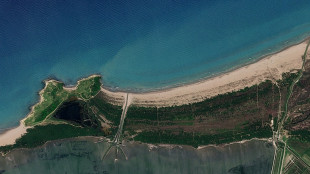 Trump family project in Albania has already caused 'irreparable' damage: NGOs
 Bollywood blast master keeps it real with fire and fury

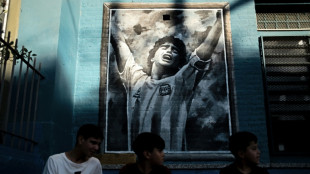 Tearful fights, edible offerings: A glimpse into the Maradona trial
 What's the deal with peptides? The hyped market under US review
 Tesla shares fall as Musk touts ambitious -- and costly -- plans
 Houthis claim Red Sea tanker strikes as US hits Iran again

 Wildfires ravage parts of southern France, Italy and Spain
 Alphabet beats expectations in second quarter, cloud revenue nearly doubles

 Trump threatens Iran infrastructure, Tehran vows 'eye for eye'

 US teen withdraws lawsuit against Meta over social media addiction
 Lebanon PM says Beirut working for 'complete Israeli withdrawal'

 EU conditionally clears Paramount bid for Warner Bros.
 Philipsen snaps 'horrible' drought with Tour de France stage 17 victory

 US trial of Venezuela's Maduro set for June 2027

As Ugandan farmer Bonaventura Senyonga prepares to bury his grandson, age-old traditions are forgotten and fear hangs in the air while a government medical team prepares the body for the funeral -- the latest victim of Ebola in the East African nation.
Bidding the dead goodbye is rarely a quiet affair in Uganda, where the bereaved seek solace in the embrace of community members who converge on their homes to mourn the loss together.
Not this time.
Instead, 80-year-old Senyonga is accompanied by just a handful of relatives as he digs a grave on the family's ancestral land, surrounded by banana trees.
"At first we thought it was a joke or witchcraft but when we started seeing bodies, we realised this is real and that Ebola can kill," Senyonga told AFP.
His 30-year-old grandson Ibrahim Kyeyune was a father of two girls and worked as a motorcycle mechanic in central Kassanda district, which together with neighbouring Mubende is at the epicentre of Uganda's Ebola crisis.
Both districts have been under a lockdown since mid-October, with a dawn to dusk curfew, a ban on personal travel and public places shuttered.
The reappearance of the virus after three years has sparked fear in Uganda, with cases now reported in the capital Kampala as the highly contagious disease makes its way through the country of 47 million people.
In all, 53 people have died, including children, out of more than 135 cases, according to latest Ugandan health ministry figures.
In Kassanda's impoverished Kasazi B village, everyone is afraid, says Yoronemu Nakumanyanga, Kyeyune's uncle.
"Ebola has shocked us beyond what we imagined. We see and feel death every day," he told AFP at his nephew's gravesite.
"I know when the body finally arrives, people in the neighbourhood will start running away, thinking Ebola virus spreads through the air," he said.
Ebola is not airborne -- it spreads through bodily fluids, with common symptoms being fever, vomiting, bleeding and diarrhoea.
But misinformation remains rife and poses a major challenge.
In some cases, victims' relatives have exhumed their bodies after medically supervised burials to perform traditional rituals, triggering a spike in infections.
In other instances, patients have sought out witchdoctors for help instead of going to a health facility -- a worrying trend that prompted President Yoweri Museveni last month to order traditional healers to stop treating sick people.
"We have embraced the fight against Ebola and complied with President Museveni's directive to close our shrines for the time being," said Wilson Akulirewo Kyeya, a leader of the traditional herbalists in Kassanda.
- 'I saw them die' -
The authorities are trying to expand rural health facilities, installing isolation and treatment tents inside villages so communities can access medical attention quickly.
But fear of Ebola runs deep.
Brian Bright Ndawula, a 42-year-old trader from Mubende, was the sole survivor among four family members who were diagnosed with the disease, losing his wife, his aunt and his four-year-old son.
"When we were advised to go to hospital to have an Ebola test we feared going into isolation... and being detained," he told AFP.
But when their condition worsened and the doctor treating them at the private clinic also began showing symptoms, he realised they had contracted the dreaded virus.
"I saw them die and knew I was next but God intervened and saved my life," he said, consumed by regret over his decision to delay getting tested.
"My wife, child and aunt would be alive, had we approached the Ebola team early enough."
- 'Greatest hour of need' -
Today, survivors like Ndawula have emerged as a powerful weapon in Uganda's fight against Ebola, sharing their experiences as a cautionary tale but also as a reminder that patients can survive if they receive early treatment.
Health Minister Jane Ruth Aceng urged recovered patients in Mubende to spread the message that "whoever shows signs of Ebola should not run away from medical workers but instead run towards them, because if you run away with Ebola, it will kill you."
It is an undertaking many in this community have taken to heart.
Doctor Hadson Kunsa, who contracted the disease while treating Ebola patients, told AFP he was terrified when he received his diagnosis.
"I pleaded to God to give me a second chance and told God I will leave Mubende after recovery," he said.
But he explained he could not bring himself to do it.
"I will not leave Mubende and betray these people at the greatest hour of need."
L.Janezki--BTB