Makeshift wifi spot reconnects shattered Ukraine city / Photo: © AFP

 Modi vows punishment for exam fraud fuelling India protests

 Six candidates in race to lead UN set for televised debate

 Comic-Con kicks off with Marvel's return

 Dutch riders dreaming of crazy party corner of Alpe d'Huez

 Houthis target Red Sea shipping as US hits Iran
 Record-equalling Red Sox streak halted at 15 wins

 Messi-less Miami beat Fire 3-2 to spoil Lewandowski's MLS debut

 Mercedes expect Hungary challenge from Hamilton and Ferrari

 In Ghana, one man's race to save critically endangered fish
 Wilson captain, Slipper absent in Kiss's first Wallabies squad
 New Mideast fighting puts eurozone rate-setters on alert

 Venezuelans search for animal companions lost in the quakes

 Argentine Football Association says US did not detain its president

 June heatwave cost UK economy more than £1bn: study

 Google-parent Alphabet beats expectations, cloud revenue nearly doubles
 US announces civilian nuclear deal with Saudi Arabia

 Tesla shares dip after profit misses expectations

 Red Sox tie club record with 15th straight MLB win

 US eyes offshore nuclear reactors

 The Sterling Announces Luxury Cocktail Lounge Concept and Investor Showcase in Orlando

 Inter Miami signs Brazil veteran Casemiro but MLS probes deal

 White House accuses China's Moonshot of stealing Anthropic AI

 Pogacar sweating on Yates's fitness ahead of Tour Queen stage

 Ukrainian soldiers and civilians welcome new army commander

 UK fintech Revolut valuation soars to $115 bn: source

Starved of news and contact with the outside world during six months of occupation by Russian forces, residents of recently liberated Izyum are grateful for a makeshift wifi spot in the shattered Ukrainian city.
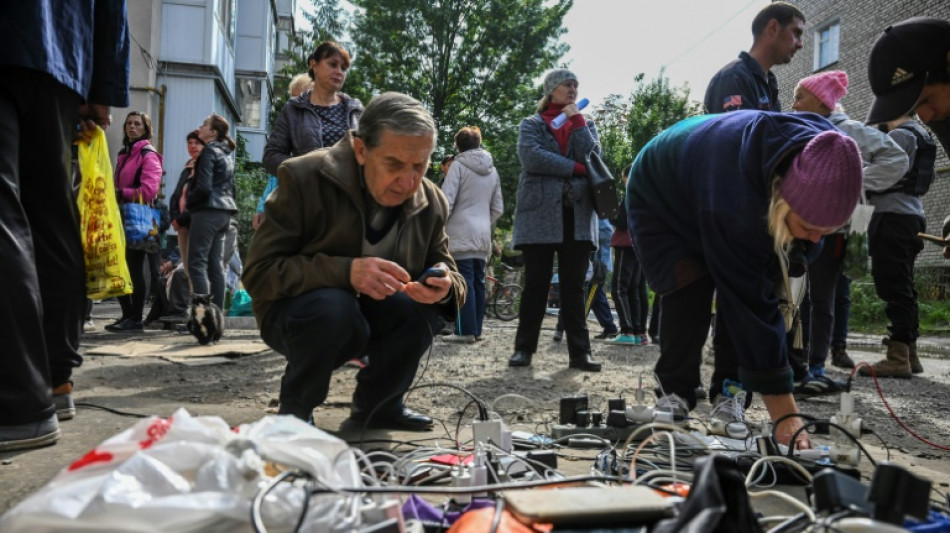
Outside an apartment block dozens of people queue before a sign that reads "15 minutes of wifi", where an aid worker takes each phone and enters the password.
Izyum, a predominantly Russian-speaking city of about 50,000 people before the war, had been fully occupied since April until it was recaptured earlier this month during Kyiv's lightning counter-offensive.
Soon after the liberation, investigation teams found what they said were 447 bodies buried during the occupation.
Residents told AFP Thursday that with electricity and mobile infrastructure networks badly damaged during the fighting, and still not restored, lack of information has kept them in the dark about what was happening.
But thanks to a power generator provided by the army, they can now reconnect to the internet -- at least for a brief window each day.
"From 8:00 am to 7:00 pm, some three to four thousand per day can connect," Seraphim, a soldier, told AFP.
"If too many people get connected at the same time the internet goes down, hence the 15-minute limit," explained resident Olga German.
"After zero minutes a day, 15 is quite a lot. Now we can check the news online, and compare sources, and keep in touch with our families," the 34-year-old English teacher said.
The eight-storey block is one of the few buildings in the devastated town to have escaped relatively unscathed, although many windows are broken, with the sound of sawing and hammers emanating from many floors.
A TV screen on a stand beside the queue showed a Ukrainian channel broadcasting news about the war, while people huddled on the ground charging their telephones from extension cables connected to the generator.
Residents ate borshch beetroot soup cooked on a nearby campfire, as children chopped firewood.
Around the corner a half-torn poster hung from a billboard: "Russia for ever", it said.
- Information vacuum -
German said the six-month period of occupation felt like "purgatory".
"We were living in an information vacuum, we couldn't get in touch with our relatives, and we could feel that the information we got from the Russians was not objective.
"So we lived only on gossip, and the stories got twisted".
Nadezda Oleksandrivna, a 64-year-old dog-trainer waiting her turn in the queue, said being deprived of news and contact with friends felt "like having a bag on my head".
It could have a serious impact on mental health, she added.
Oleksandrivna said she stayed in Izyum during the occupation because she did not want to abandon her two dogs.
Before the war she was an avid internet-user, keeping up with relatives, bloggers, politics and international news.
Now, she said she gets around the 15-minute wifi limit by returning to the back of the line when her time is up.
For a group of teenagers scrolling their phones in the corner, the wifi spot is an opportunity to catch up with friends on Viber and Telegram.
"Everyone started messaging me, including friends I have in Germany and the Czech Republic, they were really worried about me," said 16-year-old resident Anton.
"When I first got connection back I didn't know what to do, I noticed that my TikTok really changed.
"Now it's only about the war," he said.
R.Adler--BTB