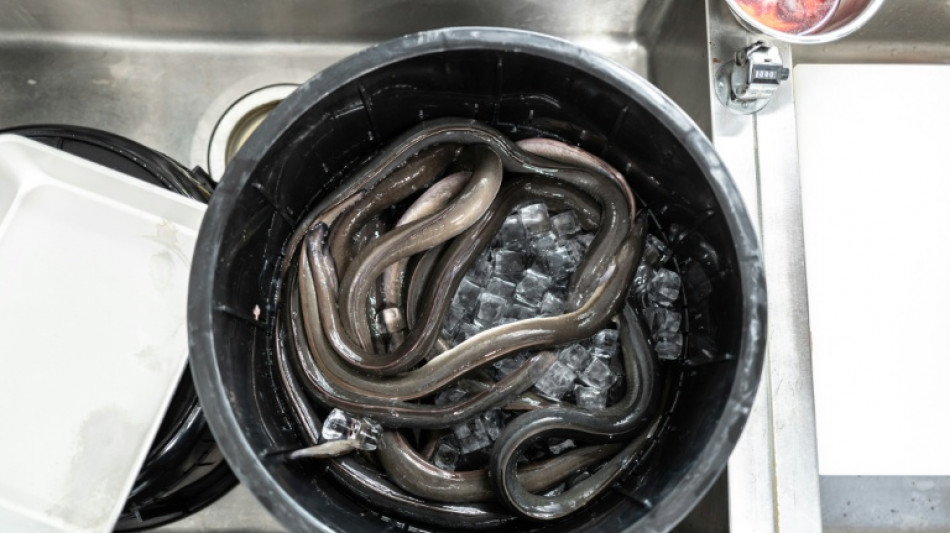
Japan to sell eels bred in captivity in 'world first' / Photo: © AFP/File

 Colombian judge bans strikes on guerrillas if minors are present

 Khachanov shocks ailing Auger-Aliassime, Swiatek and Osaka advance at US Open

 Lone juror blocking verdict in US mother's child murder trial: defense
 'Kinda chic' - Williams sisters set to launch US Open doubles bid

 Volkswagen says cutting 100,000 jobs by end of decade

 Russia slaps curfew on charity director over army criticism

 Ailing Auger-Aliassime upset by Khachanov at US Open

 Richarlison omitted from Tottenham's Premier League squad

 How El Nino is choking the Panama Canal

 Hamilton drives his Ferrari dream at Monza

 Senegal has an IMF loan, now what?

 Auger-Aliassime upset by Khachanov at US Open
 Hugging Face, the French start-up that became AI's warehouse

 World Cup winner Llorente retires from Spain team at 31

 Osaka squeezes into US Open third round

 Apple faces £2 bn lawsuit in UK over app privacy feature
 Former champ Swiatek eases into US Open third round

 DR Congo latest to promise moving Israel embassy to Jerusalem

 War criminal Mladic's body returns to Serbia with military honours

 Pierre Cardin museum brings designer's futurist style to Venice

 Slovenian rookie Omrzel triumphs as Mas extends Vuelta lead

 British, French leaders talk migrants, EU relations

 Heading for Ferrari's home race, Leclerc still dreams of world title

 Cafe at centre of Israel culture clash agrees to shut on Sabbath

 Spacecraft bound for Mercury begins 'tricky' arrival

Eels bred in captivity will be sold in Japanese shops for the first time, in a move that could ease eventually pressure on the endangered fish, officials said Wednesday.
Eel populations are falling worldwide, scientists say, largely due to factors linked to human activity such as the pollution of waterways, destruction of wetlands, hydroelectric dams, and fishing.
Eel is an enormously popular food in Japan and other parts of Asia.
The fish has proved stubbornly unwilling to reproduce in captivity without intervention, but Japanese researchers succeeded in breeding Japanese eels from eggs in a laboratory setting in 2010 at great expense.
Since then, they have been trying to reduce the "huge cost... so that the price could be accepted in the market," Yasutaka Okamoto, a fisheries agency official in charge of aquaculture promotion, told AFP.
"With countless small technological breakthroughs, the cost is now some 1,800 yen ($11) per one baby eel, down from more than a million yen at the initial stages, and down from some 40,000 yen in 2016," he said.
The price is still three to four times higher than a wild baby eel, "but we think it's time to test market reactions," he explained.
The project brought together government researchers, universities and the private sector.
Eel is eaten worldwide but is particularly popular in Japan, where it is called "unagi" and traditionally served grilled and covered in a sticky-sweet sauce.
"If the (Japanese) people didn't love eels so much, we wouldn't go to such lengths to research how to farm them," Okamoto said.
Grilled "kabayaki" using fully farmed eel will be sold from May 29 at a department store in Tokyo and several other outlets including online shops in Japan.
Yamada Suisan, the eel farming company selling the fish, said it was a world-first, and a "very significant step toward the future commercialisation of fully farmed eel."
Two kabayaki eels will be sold at around 9,000 yen ($57), a price that is broadly comparable to high-end produce.
Last year, a key global forum that regulates trade in threatened wildlife rejected an EU-led proposal to protect more species of eel.
The protections were fiercely opposed by top consumers of the fish, led by Japan.
The Japanese eel, along with the American variety, is listed as endangered by the International Union for Conservation of Nature.
The European eel is considered critically endangered.
M.Betschart--VB