Eurovision, venerable institution where art meets politics / Photo: © APA/AFP

 Spain high-speed train collision kills 31, injures 80
 Turkey hosted Libya east-west reunification talks last week
 Spain high-speed train collision kills 30
 Plane reportedly carrying Brazil's Bolsonaro departs Ecuador

 Springboks pick six uncapped players for Nations Championship
 Israel's unassuming President Herzog holds keys to next government
 Real Madrid apologise to China over Mbappe comments
 Three killed by storm in southern India
 China says takes Mbappe apology 'seriously' after Mao remark
 Flavio Bolsonaro on way to Ecuador from Argentina after fleeing Brazil
 Netanyahu bloc leads after half of Israeli votes counted but no majority
 India vows action after first cheetah shot dead
 'Now or Never': Ethiopia influencers push for Eritrea invasion
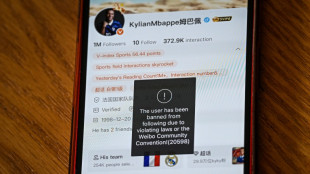 Mbappe furore rages on in China, but Mao comments censored
 Billionaire Ambani's Jio jumps 21% in market debut after record India IPO
 Rays win thriller to thwart Brewers in World Series
 Reigning champ Knicks earn first win against Pistons
 Runners swap streets for shopping malls as haze chokes Singapore
 Billionaire Ambani's Jio to debut after record India IPO
 UK set for cautious budget as borrowing costs climb
 Anthropic's record IPO faces some big questions

 US Fed expected to hold rates steady ahead of key midterm elections
 Can this Latin Grammy-winner help Democrats win back Congress?
 Tuvalu has 'limited' power to halt its fossil fuel investments: NZ govt papers seen by AFP
 Palestinian activist Khalil returns to Columbia after US detention
The Eurovision Song Contest is famous for celebrating everything from cross-dressing ballad singers to heavy metal bands in monster masks, but geopolitics is threatening its 70th anniversary edition.
More than 1,000 artists this week urged a boycott, and several countries have already said they are staying away in protest over Israel's participation.
Just eight years ago in Lisbon, the competition managed by Europe's public broadcasters featured artists from 43 countries, but only 35 will be vying for the top prize on May 16 this year in Vienna, marking the smallest edition in recent years.
While Israel's presence poses a challenge this year, the world's largest live music event has long been interwoven with politics, experts say.
Hungary quit the contest in 2020, a decision widely seen as linked to its increasingly conservative political line.
Belarus was suspended in 2021 for suppressing media freedom, while Russia got kicked out after its 2022 invasion of Ukraine.
Meanwhile, other countries including North Macedonia have pulled out in past years citing financial issues.
– 'Slow death' –
Sanctioning Russia created a precedent and sparked "a debate", said Christina Oberg, the author of several studies on how Eurovision has become a stage for geopolitical tensions against its will.
Some are asking, she said, "why they haven't done the same with Israel in terms of saying that you're not allowed into the competition" because of the massive civilian death toll from Israel's two-year bombardment of Gaza.
Five broadcasters, including Spain, are expected to boycott the 2026 edition over Israel's participation.
This is an unprecedented move by one of the "Big Five", as the Eurovision jargon calls the five largest financial contributors enjoying automatic qualification to the Grand Final.
Iceland, Ireland, the Netherlands and Slovenia have also decided to snub the upcoming edition for the same reason, complaining that its political neutrality is no longer guaranteed.
More than 1,000 musicians around the world have signed a petition under the banner of "no music for genocide" to exclude Israel's public broadcaster KAN "complicit" in "crimes" committed by Israel.
The signatories include star artists and bands such as Massive Attack, Peter Gabriel, Roger Waters and Sigur Ros.
Eurovision organiser, the European Broadcasting Union (EBU), has defended KAN in the past, arguing that it meets all criteria for independence.
It has also announced changes and safeguards to the public voting system following accusations of manipulation in favour of the Israeli candidate last year.
If more broadcasters quit, it would be "sort of a slow death... because you need a certain amount of countries within it for it to still feel like this is for everyone," said Oberg, a professor at Linnaeus University in Sweden.
- In the spotlight -
Hosting this year's edition, Austria has labelled any cultural boycott as "stupid and pointless".
Though in fact it was Austria that led the way by snubbing the 1969 edition in Madrid "because of the dictatorship of Francisco Franco," according to Croatian-Australian Eurovision historian Dean Vuletic.
Eurovision remains a major tool for promoting inclusion and tolerance, and analysts agree it has always been more than a singing contest.
Artists parade under their countries' flags, and the event is broadcast live across Europe, providing an outstanding platform augmented by social media.
And with 166 million viewers claimed in 2025, the financial stakes are high for Eurovision, which has become a brand to protect.
"When the EBU started to attract sponsors in the late 1990s, produce merchandise, place the contest in larger halls and sell tickets to the public, it also started taking steps to avoid any damage to the contest's image," Vuletic told AFP.
Further tensions could arise this year as the spotlight will be on Denmark "in a way that never happened before", said Lisanne Wilken from Aarhus University in Denmark.
"The situation with Greenland and (US President Donald) Trump has put Denmark even more on the map," she said.
Trump's strident claims on the vast Arctic territory that belongs to Denmark have stirred a wave of concern and resistance within the European Union.
Experts predict that Danish entry Soren Torpegaard Lund could benefit from a wave of empathy.
S.Gantenbein--VB