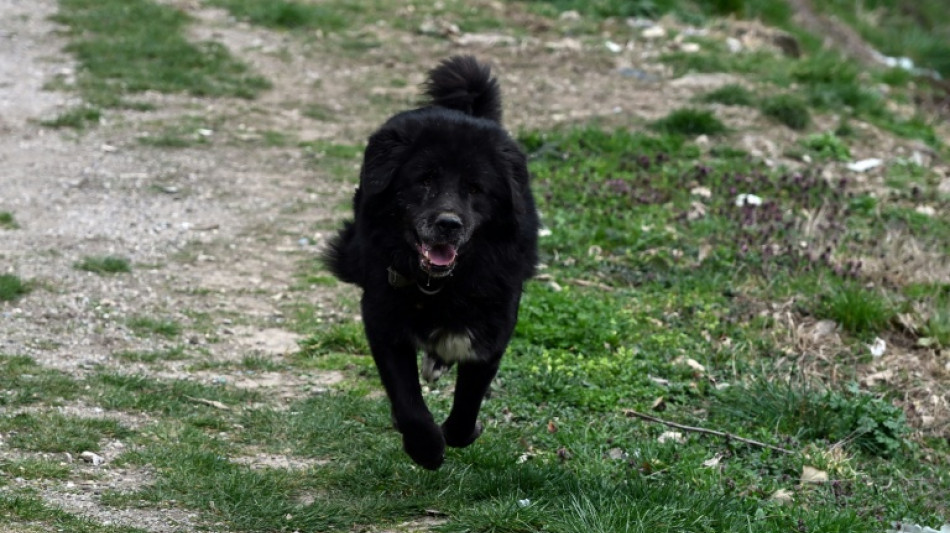
Mountain-made: Balkan sheepdog eyes future beyond the hills / Photo: © AFP

 Kyrgios gets month ban for cocaine, enters treatment programme

 Colombian judge bans strikes on guerrillas if minors are present

 Khachanov shocks ailing Auger-Aliassime, Swiatek and Osaka advance at US Open

 Lone juror blocking verdict in US mother's child murder trial: defense

 'Kinda chic' - Williams sisters set to launch US Open doubles bid

 Volkswagen says cutting 100,000 jobs by end of decade

 Russia slaps curfew on charity director over army criticism

 Ailing Auger-Aliassime upset by Khachanov at US Open

 Richarlison omitted from Tottenham's Premier League squad

 How El Nino is choking the Panama Canal

 Hamilton drives his Ferrari dream at Monza

 Senegal has an IMF loan, now what?

 Auger-Aliassime upset by Khachanov at US Open

 Hugging Face, the French start-up that became AI's warehouse

 World Cup winner Llorente retires from Spain team at 31

 Osaka squeezes into US Open third round

 Apple faces £2 bn lawsuit in UK over app privacy feature

 Former champ Swiatek eases into US Open third round

 DR Congo latest to promise moving Israel embassy to Jerusalem

 War criminal Mladic's body returns to Serbia with military honours

 Pierre Cardin museum brings designer's futurist style to Venice

 Slovenian rookie Omrzel triumphs as Mas extends Vuelta lead

 British, French leaders talk migrants, EU relations

 Heading for Ferrari's home race, Leclerc still dreams of world title

 Cafe at centre of Israel culture clash agrees to shut on Sabbath

At a remote monastery in North Macedonia's rugged west, Father Porfirij starts his day by feeding his large black Karaman sheepdogs, a breed that has guarded highland flocks for centuries.
In February, the Karaman -- a hardy mountain shepherd -- won provisional recognition as an indigenous breed from the International Canine Federation (FCI).
The decision caps years of work by breeders, scientists and Porfirij himself to define and preserve one of the region's oldest breeds.
"They are very nice dogs, very peaceful," the Orthodox priest told AFP, as he dished out the morning meal to the thick-coated hounds at their home in the centuries-old monastery.
Rooted in nomadic herding traditions, the Karaman is one of several breeds Balkan shepherds used to guard mountain-dwelling flocks against bears and wolves, a practice that dates back to Ottoman times.
- 'Created by the mountain' -
For locals, the sheepdogs' symbolism is deeply important.
The more famous Yugoslavian Shepherd, also known as the Sharplanina or Sharr, even features on the country's currency.
But as rural populations decline across the region, the pastoral life that sustained the Karaman is fading, leaving just 2,000 of them registered in the country, according to Ilija Karov, who heads a kennel club devoted to the breed.
Official recognition as a distinct breed was important because it "opened the borders" for the animal to become a pet abroad and bolster breeding efforts, Karov said.
It is also the first breed with its origins exclusively recognised in North Macedonia, with the Sharr shared with Serbia.
Porfirij was drawn to the campaign for the animal almost a decade ago, while living at the St Jovan Bigorski Monastery.
Using the monastic kennel as his base, the priest travelled through the mountains, collecting dogs with specific traits.
Although the Karaman is visually similar to the Sharr, scientists have found clear genetic and anatomical differences, which Karov says include its curled tail, lighter eyes and spoon-shaped paws.
It was important to define the breed only by characteristics "created by the mountain", he said.
"In Karaman, there is literally zero human intervention in relation to how it should look."
- 'Brighter future' -
The canines' powerful build and origins as mountain sheepdogs can be intimidating -- the Sharr has been banned in Denmark since 2010.
But Porfirij said any fears of the Karaman are unfounded and hopes there will be growing interest in the breed thanks to its loyalty and friendliness.
"Especially towards kids," he said, as two local children hugged a thick-furred dog behind him.
As young people leave and mountain communities age, Karov said the breed's future would rely more on urban pet owners than its pastoral past.
"The breed has a brighter future, even if that is more in the cities than in the mountains."
S.Leonhard--VB