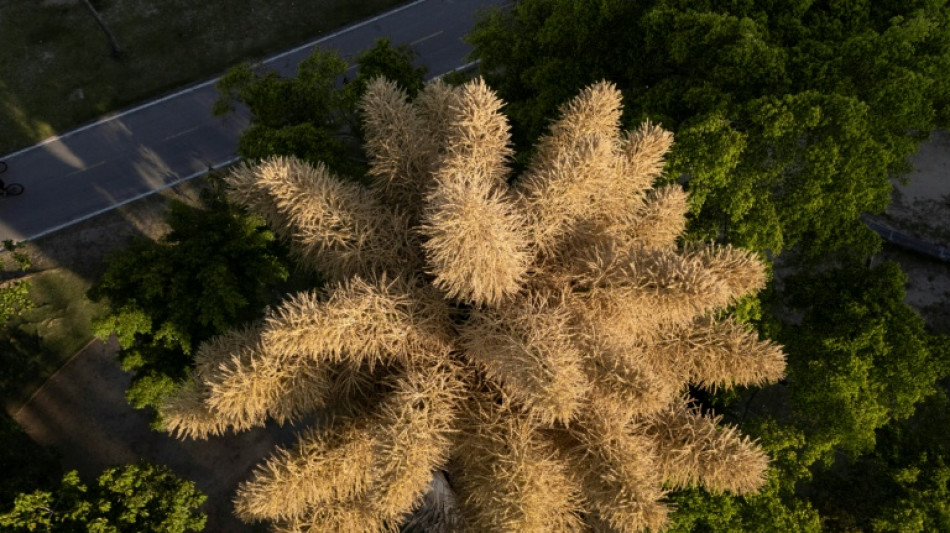
'In her prime': Rare blooming of palm trees in Rio / Photo: © AFP

 Volvo Cars sees declining sales in 'challenging' environment

 India launches first hydrogen-powered train in clean energy push

 MEXC May–June Report: 750M+ USDT Futures Insurance Fund & 100% Asset Reserves

 Petula Clark, 93, hopes real singers will survive the AI tide

 Japan outlaws flag desecration despite critics

 From coal pits to wind turbines, Polish miners rise to the occasion

 Opposition to data centres grows in cramped urban Japan

 Japan imperial rules tweaked, but still no woman emperor

 China's Xi says AI should not be dominated by one country

 India's space sector takes off as private rocket readies launch

 Taiwan lawmakers to remove legal hurdles for Starlink to operate

 Tokyo, Taipei lead tech losses as Asian markets suffer again

 Ireland to attack at All Blacks' Eden Park stronghold

 Australia protests Laos response to 2024 tainted alcohol deaths

 'Blessed town' on Venezuelan coast escapes quake damage

 Buried in 1967 quake, Venezuelan now scrambles to help new victims

 UK Labour party to crown Burnham as leader and next PM

 Hazardous Canadian wildfire smoke choking millions in US

 SpaceX abruptly scrubs Starship test flight
 Giannis: Miami offers best path to another NBA title

 Lewandowski MLS debut match postponed by air quality concern

 McIlroy laments 'stupid mistakes' but retains British Open hope

 Argentina footballers 'inspire' Contepomi's Pumas before England Test

 Root's 99 not out sees England to ODI series-levelling win over India

 Suber the shock leader of British Open as McIlroy faces cut battle
An extraordinary botanical spectacle is drawing crowds in Rio de Janeiro: several talipot palm trees, planted more than six decades ago, are blooming for the first -- and last -- time in their lives.
The trees, growing in Rio's Aterro do Flamengo park and the Botanical Garden, were planted in the 1960s by the legendary landscape architect Roberto Burle Marx.
Now, some six decades later, these giants have reached the peak of their existence in the Brazilian seaside city.
The talipot palm (Corypha umbraculifera), native to southern India and Sri Lanka, is one of the largest palm species on the planet, some reaching more than 30 meters (98 feet) tall.
It flowers only once in its entire life, if it reaches between 40 and 70 years of age.
"The talipot palm only fruits once in its lifetime, and can produce up to five million fruits," Marcus Nadruz, from the Research Institute of the Rio de Janeiro Botanical Garden, told AFP.
The inflorescences, or flower clusters on stems, began to unfurl in October, forming enormous crowns atop the palm trees that teem with millions of tiny yellowish blossoms.
The entire process, from the opening of the first flowers to the ripening of the fruit, will take about a year, explained Nadruz.
But this splendor has an inevitable end. Once the fruit falls, the palm trees will slowly begin to die.
"I was born in 1961, so she's my age and in her prime," said Deborah Faride, who traveled to see the trees from Sao Paulo and was taking pictures of them with a friend.
"We're the same age and we're blooming together. Just one detail: the talipot is going to die. And I'm going to continue, God willing."
The Botanical Garden plans to collect the seeds to cultivate new seedlings to replace these older plants, and will also distribute them for landscaping projects in public spaces.
M.Schneider--VB