Ethiopia's invasive prosopis tree chokes livelihoods and land / Photo: © AFP

 US eyes offshore nuclear reactors

 The Sterling Announces Luxury Cocktail Lounge Concept and Investor Showcase in Orlando

 Inter Miami signs Brazil veteran Casemiro but MLS probes deal

 White House accuses China's Moonshot of stealing Anthropic AI

 Pogacar sweating on Yates's fitness ahead of Tour Queen stage

 Ukrainian soldiers and civilians welcome new army commander

 UK fintech Revolut valuation soars to $115 bn: source

 German FM, on Africa tour, eyes business ties amid US, China pressure

 Rubio says at ASEAN meeting he expects 'positive' US visit by China's Xi

 Philipsen wins Tour de France 17th stage

 DonnaPro Introduces AI-Trained Executive Assistants for European CEOs

 Happy birthday, George! UK prince becomes a teenager

 Oil prices jump on Mideast war, stock markets diverge
 US hits Iranian island, says war cost at $37.5 bn
 Metal mining's carbon footprint far larger than thought: study
 TokenInsight Q2 2026 Report: TradFi Momentum Lifts MEXC to No. 2 in Commodity Perpetuals

 Leonardo chief sees potential for Germany to join GCAP fighter jet project

 Louvre heist gallery reopens to public, but with nothing to steal

 Ukraine's new army chief: who is Mykhailo Drapaty?

 India student protests keep up pressure on Modi government

 Italian FA chief says in touch with Guardiola over coaching vacancy

 Cooler inflation hands new UK PM Burnham an early boost

 Bezos holds talks with group interested in buying Liverpool stake: reports

 The student movement in India challenging Modi's government

 Danish fish fossil cliffs set to gain UNESCO status

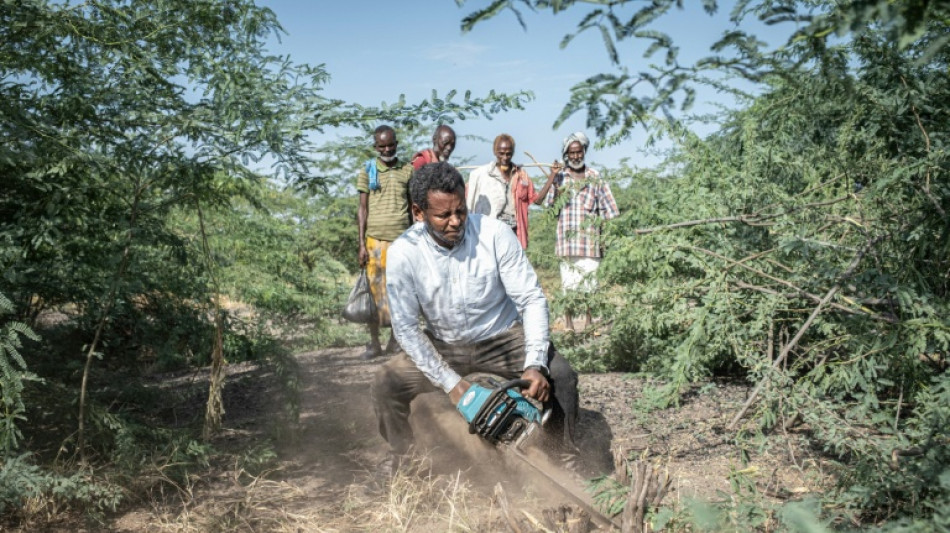
Once hailed as a solution to Ethiopia's creeping desertification, a foreign tree is now spreading uncontrollably across the east African nation, threatening fragile ecosystems and the very survival of local communities.
Native to Latin America, the prosopis shrub-like tree was first planted in Ethiopia's northeastern Afar region in the 1970s.
It has become a nightmare for locals like livestock farmer Khadija Humed.
"Because of this plant, we have become poor," she told AFP.
Heat-resistant and fast-growing, prosopis initially promised to curb soil erosion and provide shade to cool the local micro-climate in Afar's arid lowlands.
But today it has overrun the region's vast plains -- its thorny, drooping branches rising up to 10 metres (33 feet) high.
Each tree can draw up to seven litres of water a day through its deep roots, drying out the soil and crippling agriculture.
The prosopis also harms livestock, local pastoralists say.
"The plant has turned against us," Hailu Shiferaw, a researcher at the Ethiopian Water and Land Resources Centre, told AFP.
"No one could have foreseen its harmful effects."
- 'Everything has changed' -
In Khadija's village, some 200 kilometres (124 miles) northeast of the capital Addis Ababa, she said the tree's pods make their cows sick, blocking their mouths and stomachs and killing some -- losses that have driven the community into deep poverty.
"I personally have 10 cows and more than 20 goats and sheep. But before prosopis, people here used to have 50 to 100 cattle shesaid.
"Everything has changed," said 76-year-old local Yusuf Mohammed, adding that the tree's dense foliage attracted wild animals that attack their livestock.
"We never had wild animal attacks before... after prosopis spread, lions, hyenas, wild cats and foxes invaded our villages," Mohammed said.
Its poisonous thorns also injure livestock, leaving them too weak to roam for food, he added.
Worldwide, there are some 3,500 invasive species introduced by humans, many of which have damaged local ecosystems.
They cost local economies a total of $423 billion, according to a 2023 report by the Intergovernmental Science-Policy Platform on Biodiversity and Ecosystem Services -- equivalent to the entire GDP of Denmark.
Ketema Bekele, associate professor of environmental economics at Ethiopia's Haramaya University, estimates that prosopis has cost Afar $602 million over the past three decades -- nearly four times its annual budget.
- Out of control -
Some 20,000 square-kilometres of Afar is now invaded by the plant, which is "out of control" and spreading into Amhara and Oromia, he said.
It covered 8.61 percent of Ethiopia in 2023, according to the Journal of Environmental Management published last year, up from 2.16 percent in 2003, while overall pastureland shrank by more than a quarter.
The report said prosopis could occupy 22 percent of Ethiopia's 1.1 million square kilometres by 2060.
Camels help it spread by eating the pods and excreting them far and wide.
CARE International, an NGO, has attempted to stop the spread since 2022 by encouraging locals to harvest the plant.
Supported by Danish fund Danida, it also removes the trees to plant fruit orchards.
It is controllable, said Mohammed, but more support is needed.
"We can't tackle it alone," he said.
A.Ruegg--VB