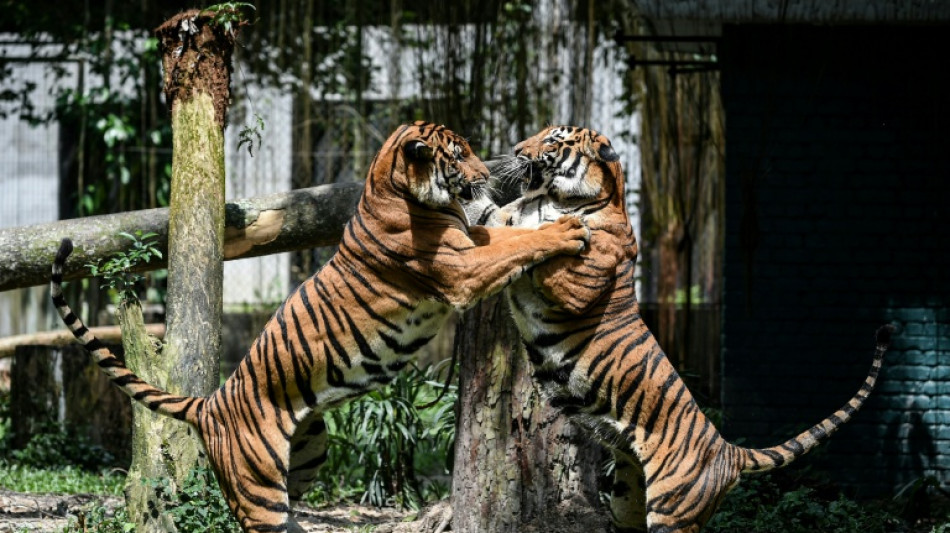
Tigers in trouble as Malaysian big cat numbers dwindle / Photo: © AFP/File

 US eyes offshore nuclear reactors

 The Sterling Announces Luxury Cocktail Lounge Concept and Investor Showcase in Orlando

 Inter Miami signs Brazil veteran Casemiro but MLS probes deal

 White House accuses China's Moonshot of stealing Anthropic AI

 Pogacar sweating on Yates's fitness ahead of Tour Queen stage

 Ukrainian soldiers and civilians welcome new army commander

 UK fintech Revolut valuation soars to $115 bn: source

 German FM, on Africa tour, eyes business ties amid US, China pressure

 Rubio says at ASEAN meeting he expects 'positive' US visit by China's Xi

 Philipsen wins Tour de France 17th stage

 DonnaPro Introduces AI-Trained Executive Assistants for European CEOs

 Happy birthday, George! UK prince becomes a teenager

 Oil prices jump on Mideast war, stock markets diverge
 US hits Iranian island, says war cost at $37.5 bn

 Metal mining's carbon footprint far larger than thought: study
 TokenInsight Q2 2026 Report: TradFi Momentum Lifts MEXC to No. 2 in Commodity Perpetuals

 Leonardo chief sees potential for Germany to join GCAP fighter jet project

 Louvre heist gallery reopens to public, but with nothing to steal

 Ukraine's new army chief: who is Mykhailo Drapaty?

 India student protests keep up pressure on Modi government

 Italian FA chief says in touch with Guardiola over coaching vacancy

 Cooler inflation hands new UK PM Burnham an early boost

 Bezos holds talks with group interested in buying Liverpool stake: reports

 The student movement in India challenging Modi's government

 Danish fish fossil cliffs set to gain UNESCO status

For two years, Malaysian conservationists tracked a tiger named "Bulan" as she raised four cubs. Then a fatal traffic accident made her another statistic in the country's dwindling population.
Malaysia's national animal is in trouble.
Poaching, food loss and diminishing habitat have slashed the population from 3,000 in the 1950s to less than 150 roaming free today, according to official estimates.
The government said last month it was ramping up efforts to combat wildlife crime, introducing AI-enabled camera traps and methods to detect smuggling at airports.
But experts and officials admit that resources fall far short of what is needed to protect the country's famed big cat, listed as critically endangered.
Bulan (Moon in Malay) was killed on the East-West Highway, a throughfare notorious for animal traffic incidents.
"We were devastated when we lost her," said Lara Ariffin, president of the Tiger Protection Society of Malaysia (RIMAU).
"Not only that, she was butchered after she was run over," Ariffin told AFP, showing graphic pictures of the animal's carcass.
"They took her canines, they took her claws. For me, it was like desecrating the dead."
The fate of the apex predator's population leapt back into local headlines recently after a dead tiger was found in the back of a car in southern Johor state, sparking public outrage.
Three poachers were later handed seven-year jail sentences and a $59,000 fine, but experts say the business remains enticing.
- 'Serious money' -
A single Malayan tiger carcass can fetch around $60,000 on the black market, according to Malaysia's Department of Wildlife and National Parks.
"The pelt alone can fetch around RM100,000 ($24,000), while a tiger penis has been valued at RM20,000 ($5,000)," the department's national director-general Abdul Kadir Abu Hashim told the New Straits Times newspaper last month.
Tiger bones go for about $1,186 per kilogramme, while teeth, claws, and even whiskers -- used in acupuncture -- fetch around $118 each, Kadir said.
The department did not respond to AFP's request for comment.
Even animals that escape poachers can be harmed by snares made from cheap plastic, rope or metal cable.
Camera traps have spotted animals with injuries or even missing limbs.
Research shows Malaysia feeds demand for tiger parts in Vietnam and further afield in China, with cross-border poaching syndicates using drug, gun and human trafficking routes to move their wares.
The first six months of 2025 saw 201 wildlife smuggling arrests and seized illegal assets valued at $30.5 million, Malaysia's top internal security and public order police officer told local media.
"These figures tell you poaching is no longer a small-scale crime. It is organised, cross-border -- and backed by serious money," Azmi Abu Kassim said.
- 'No overnight success' -
The Malaysian government admits it has limited manpower, funding and equipment to deal with the challenge, though there are efforts to address the problem.
Joint operations by Malaysian police and wildlife services have resulted in hundreds of arrests and millions of dollars in seizures, officials said.
And community-based ranger programmes run by NGOs like RIMAU employ more than 1,000 local community members.
"Malaysia has made great progress in fighting illegal poaching," said Ariffin, who produced a documentary called "Malaysia's Last Tigers".
"We are moving in the right direction, but there is no guaranteed success overnight."
The local chapter of the New York-based Wildlife Conservation Society estimates at least 5,000 rangers are needed to properly patrol Malaysia tiger habitats.
"The first line of defence is not there, meaning we don't have enough front-line rangers to protect our wildlife from poachers," WCS country director Mark Rayan Darmaraj told AFP.
"Poachers are still able to operate simply because they outnumber enforcement personnel, and once they're inside the jungle, it's like looking for a needle in a haystack," he said.
That's a view echoed by other NGOs working on conservation.
"The issue is not a lack of commitment, but a lack of capacity," WWF-Malaysia told AFP.
"The next 10 years will decide whether we can bring back the roar of the Malayan tiger."
M.Vogt--VB