With EuroPride, Lisbon courts LGBTQ travellers / Photo: © AFP

 Houthis target Red Sea shipping as US hits Iran

 Record-equalling Red Sox streak halted at 15 wins

 Messi-less Miami beat Fire 3-2 to spoil Lewandowski's MLS debut
 Mercedes expect Hungary challenge from Hamilton and Ferrari
 In Ghana, one man's race to save critically endangered fish
 Wilson captain, Slipper absent in Kiss's first Wallabies squad
 New Mideast fighting puts eurozone rate-setters on alert
 Venezuelans search for animal companions lost in the quakes
 Argentine Football Association says US did not detain its president
 June heatwave cost UK economy more than £1bn: study

 Google-parent Alphabet beats expectations, cloud revenue nearly doubles

 US announces civilian nuclear deal with Saudi Arabia

 Tesla shares dip after profit misses expectations

 Red Sox tie club record with 15th straight MLB win

 US eyes offshore nuclear reactors

 The Sterling Announces Luxury Cocktail Lounge Concept and Investor Showcase in Orlando
 Inter Miami signs Brazil veteran Casemiro but MLS probes deal
 White House accuses China's Moonshot of stealing Anthropic AI
 Pogacar sweating on Yates's fitness ahead of Tour Queen stage
 Ukrainian soldiers and civilians welcome new army commander

 UK fintech Revolut valuation soars to $115 bn: source
 German FM, on Africa tour, eyes business ties amid US, China pressure
 Rubio says at ASEAN meeting he expects 'positive' US visit by China's Xi
 Philipsen wins Tour de France 17th stage

 DonnaPro Introduces AI-Trained Executive Assistants for European CEOs

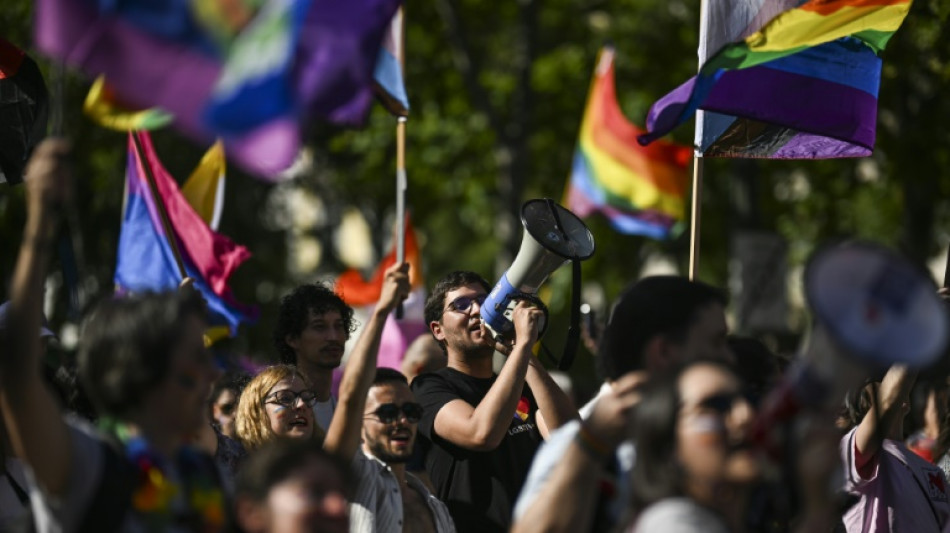
Rainbow flags will fill Lisbon's streets on Saturday when the Portuguese capital hosts the annual EuroPride parade in support of LGBTQ rights which organisers hope will cement its standing as a gay-friendly destination.
Tucked away in the cobbled alleys of the bohemian Bairro Alto neighbourhood, Carlos Sanches Ruivo, 57, proudly welcomes guests to his small queer-focused hotel, The Late Birds.
"We've had guests from 114 different nationalities," said Ruivo, a dual French-Portuguese citizen who quit his engineering job in France to move to Lisbon in 2012.
Perched between the Tagus River and the Atlantic Ocean, Lisbon is seen as "more relaxed" than other European capitals, he added.
Portugal, a nation of around 10 million people, was once deeply shaped by Catholic conservatism.
It only decriminalised homosexuality in 1982, eight years after a military coup toppled a decades-long rightist dictatorship.
But it has since emerged as a quiet leader in LGBTQ rights.
Portugal in 2010 became one of the first nations in Europe to legalise same-sex marriage.
This was followed by a law allowing gay people to adopt, legislation against transgender discrimination and, more recently, a ban on "conversion therapy" aimed at changing people's sexual orientation.
- 'Open society' -
While not on the same scale as Berlin or San Francisco, within the global LGBTQ community Lisbon's status as a gay-friendly city has steadily grown.
"This is now an open society," said Vitor Correia, a researcher who has studied social attitudes toward gay relationships in Portugal and recently published a book on the topic.
Paulo Morais, a 58-year-old Brazilian, said he has lived in Portugal for "nearly six years and never had any problems".
"Here, our rights are more respected," he added at a pride event in Lisbon earlier this month.
Nearby, 35-year-old Italian expat Sonia Montanari shared a similar view.
"I have never felt unsafe in Lisbon, even when I was first going out alone," she said.
With LGBTQ tourism booming, local business owners have organised to better serve and advocate for this growing demographic.
In 2018 they formed Variacoes, a chamber of commerce named after Antonio Variacoes, a groundbreaking pop icon who challenged cultural norms during Portugal's post-dictatorship period. He died in 1984 aged 39 from complications related to AIDS.
"We represent a niche market with strong growth potential" and above-average purchasing power, said Jose Marquina, president of the association and owner of Finalmente, a Lisbon nightclub famous for its drag shows.
- 'Not afraid' -
Around two million LGBTQ tourists visit Portugal annually, contributing nearly two billion euros to the economy, according to Variacoes.
The association is one of the organisers of this year's nine-day EuroPride festival, an event advocating for LGBTQ equality that is held in a different European city each year.
The highlight will be Saturday's parade which will make its way along main avenues under the motto "Proudly Yourselves". It will be followed by a concert and a series of parties.
"This will be a moment of strong affirmation," said Marquina.
He called for the community to "show our unity" in the face of the rise across Europe of far-right parties pushing a conservative social agenda opposed to LGBTQ rights.
In Portugal far-right party Chega won a record vote share in a snap general election last month to become the main opposition party in the country's parliament for the first time.
"They want to make us invisible again," said Marquina. "But we're not afraid, and we will defend our rights."
L.Maurer--VB