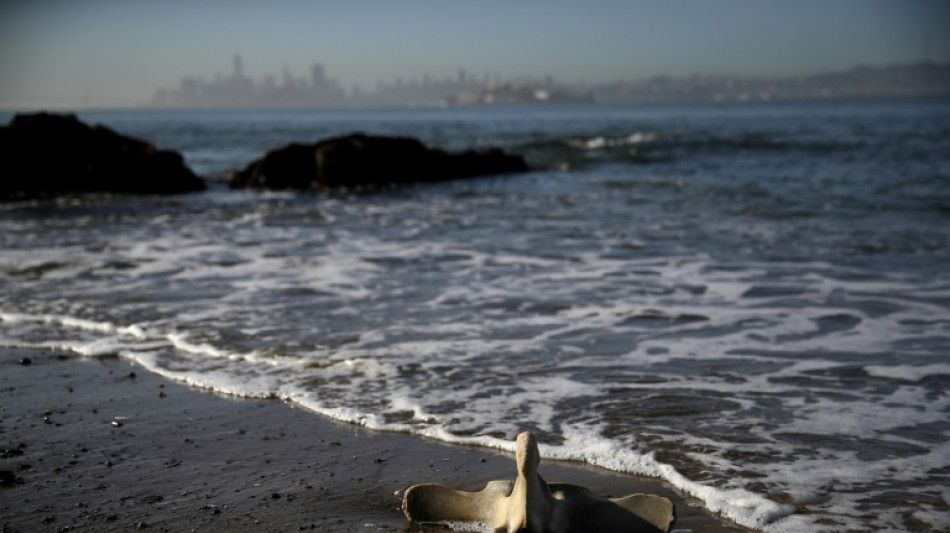
Earliest proof of humans using whale bone tools discovered / Photo: © GETTY IMAGES NORTH AMERICA/AFP/File

 Houthis target Red Sea shipping as US hits Iran

 Record-equalling Red Sox streak halted at 15 wins

 Messi-less Miami beat Fire 3-2 to spoil Lewandowski's MLS debut

 Mercedes expect Hungary challenge from Hamilton and Ferrari

 In Ghana, one man's race to save critically endangered fish
 Wilson captain, Slipper absent in Kiss's first Wallabies squad

 New Mideast fighting puts eurozone rate-setters on alert

 Venezuelans search for animal companions lost in the quakes

 Argentine Football Association says US did not detain its president

 June heatwave cost UK economy more than £1bn: study

 Google-parent Alphabet beats expectations, cloud revenue nearly doubles

 US announces civilian nuclear deal with Saudi Arabia

 Tesla shares dip after profit misses expectations

 Red Sox tie club record with 15th straight MLB win

 US eyes offshore nuclear reactors

 The Sterling Announces Luxury Cocktail Lounge Concept and Investor Showcase in Orlando

 Inter Miami signs Brazil veteran Casemiro but MLS probes deal

 White House accuses China's Moonshot of stealing Anthropic AI

 Pogacar sweating on Yates's fitness ahead of Tour Queen stage

 Ukrainian soldiers and civilians welcome new army commander

 UK fintech Revolut valuation soars to $115 bn: source

 German FM, on Africa tour, eyes business ties amid US, China pressure

 Rubio says at ASEAN meeting he expects 'positive' US visit by China's Xi

 Philipsen wins Tour de France 17th stage

 DonnaPro Introduces AI-Trained Executive Assistants for European CEOs

Scientists announced Tuesday they have discovered the earliest evidence of humans using whale bones, finding weapons made from the remains of the massive mammals dating back more than 20,000 years.
The bones, found on the northern Spanish coast in the Bay of Biscay, show that we have been underestimating our prehistoric ancestors, the European-led team of scientists said.
Southwest Europe was much colder during the Upper Palaeolithic period, and the Atlantic Ocean was 120 metres (400 feet) lower than its current level.
As the seas rose over the millennia, it destroyed or buried much of the proof that these hunter-gatherers interacted with the marine world, French prehistoric archaeologist Jean-Marc Petillon told AFP.
This led to a "biased" vision that they only hunted inland beasts such as reindeer, bison and horses, the lead author of a new study in Nature Communications said.
"Fortunately for us, people at the time transported a number of marine products inland," he added.
Perched on a cliff, these humans would likely have been able to see blue, sperm, bowhead and other whales relatively near the shore, looking for food.
Among their discoveries, the researchers found more than 60 fragments of whale ribs or vertebrae. These huge bones were carried up to five kilometres (three miles) to the top of a steep cliff, possibly to extract their oil.
"These bones are very rich in fat," Petillon explained.
Most of the bone tools were parts of weapons, such as the tips of spears.
But it is "extremely unlikely" these ancient humans were able to hunt whales, the study said, adding that it was more likely that the huge animals had simply washed up on the beach.
Some of the bones were collected more than a century ago but were misidentified. The researchers used carbon-dating, as well as spectrometry analysis to determine what species the bones were from.
There was a boom in whale bones between 17,500 and 16,000 BC, when tools have been found as far away as Germany.
"Then it stopped quite abruptly" for reasons that are not clear, Petillon said.
The people of the time did not run out of bones, nor did they lose the bone-working techniques.
"It could be a choice... like a fashion that lasts a millennium or two and then, at some point, stops," Petillon said.
N.Schaad--VB