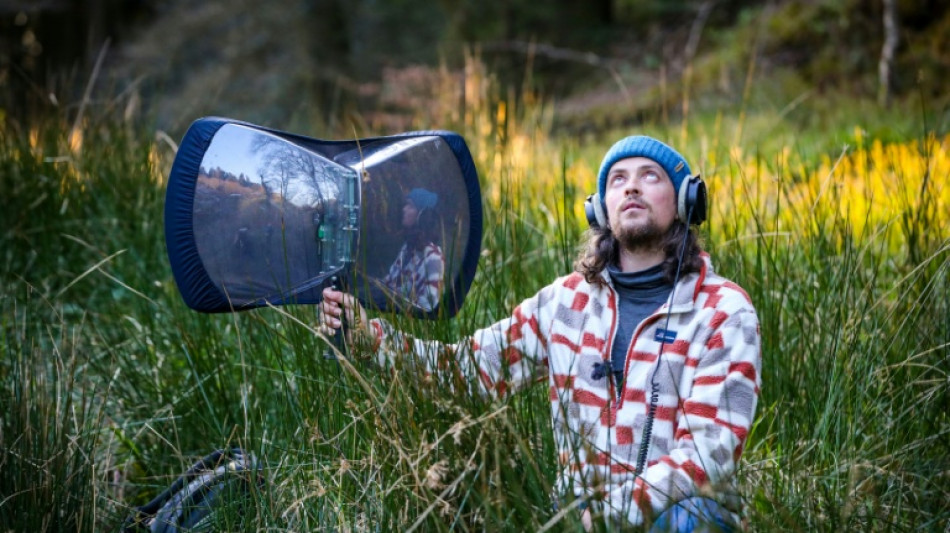
In tune with nature: expert sounds out all of Ireland's bird species / Photo: © AFP

 Modi vows punishment for exam fraud fuelling India protests

 Six candidates in race to lead UN set for televised debate

 Comic-Con kicks off with Marvel's return

 Dutch riders dreaming of crazy party corner of Alpe d'Huez
 Houthis target Red Sea shipping as US hits Iran
 Record-equalling Red Sox streak halted at 15 wins

 Messi-less Miami beat Fire 3-2 to spoil Lewandowski's MLS debut

 Mercedes expect Hungary challenge from Hamilton and Ferrari
 In Ghana, one man's race to save critically endangered fish
 Wilson captain, Slipper absent in Kiss's first Wallabies squad
 New Mideast fighting puts eurozone rate-setters on alert

 Venezuelans search for animal companions lost in the quakes

 Argentine Football Association says US did not detain its president

 June heatwave cost UK economy more than £1bn: study

 Google-parent Alphabet beats expectations, cloud revenue nearly doubles
 US announces civilian nuclear deal with Saudi Arabia

 Tesla shares dip after profit misses expectations

 Red Sox tie club record with 15th straight MLB win

 US eyes offshore nuclear reactors

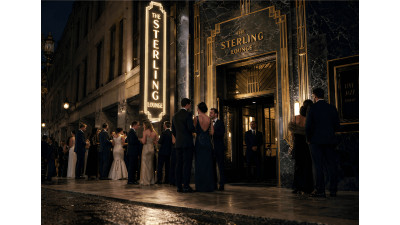 The Sterling Announces Luxury Cocktail Lounge Concept and Investor Showcase in Orlando

 Inter Miami signs Brazil veteran Casemiro but MLS probes deal

 White House accuses China's Moonshot of stealing Anthropic AI

 Pogacar sweating on Yates's fitness ahead of Tour Queen stage

 Ukrainian soldiers and civilians welcome new army commander

 UK fintech Revolut valuation soars to $115 bn: source

On a mission to record all of Ireland's bird species, many of which are dying out, Irishman Sean Ronayne calls his unique audio archive a tool to both raise alarm and bring hope.
According to conservation bodies, some 63 percent of Ireland's birds are currently either red or amber-listed, meaning they are at severe or moderate extinction risk.
"Birds are in trouble in Ireland like they are across the world, the loss of wildlife -- sonically and physically -- is devastating to me," said the 37-year-old.
"But I focus on hope and beauty, which is essential," the ornithologist told AFP at his home near Cobh (pronounced "Cove") in County Cork.
More than four years into his recording project he has sampled 201 different Irish bird species, stocking over 12,000 audio clips from around the country, Ronayne told AFP.
Just two remain to be documented: the great skua, and red-breasted merganser.
"If people realise just how spectacular wildlife is, there's no way they would let it disappear, attitudes would change," Ronayne said.
- Sound: 'an engaging tool' -
Ireland may be famed for its green fields, but Ronayne paints a bleak picture -- "realistic" he says -- of a degraded landscape and a bird population decimated by vanishing habitats.
Most of Ireland comprises intensively farmed fields bounded by trimmed hedgerows, drained and mined peatlands, overgrazed uplands, and minimal native woodland, he told AFP.
Non-native conifer plantations -- approximately nine percent of Ireland's 11 percent forest cover -- are also a biodiversity villain, described by Ronayne as "a species-poor industrial cash-crop".
"I try to show people the beauty of what we're erasing and what we must stand up and fight for," said the wildlife expert.
Last year he published an award-winning book, released two albums, and made an acclaimed documentary film. His talk tour is currently selling out venues around Ireland.
"Wildlife sound is such a great engaging tool to connect people to nature itself and get them acquainted with everything that's on their doorstep," Ronayne told AFP.
"If you know your neighbour you're more likely to help them in times of need," he said.
At the shows Ronayne, who was diagnosed with a form of autism as an adult, presents the story of his life and how nature is woven through it.
He also plays audio of warbles, tweets, trills, screeches and chirps, and mystery sounds, inviting the audience to guess the origin.
Some clips show birds mimicking other animals like dogs, people and other bird species.
"Some species in my collection can mimic 30 to 40 other species in their song," he said.
Laughter is common at his talks, but also tears and grief as listeners learn of Ireland's endangered birdlife.
- 'Sonic diversity' -
Ronayne regularly holds "dawn chorus" walks, bringing small groups into silent forests far from road noise to experience the birdlife waking up.
A gradually building cacophony of sound, the dawn chorus is "a reflection of the health of a given environment", he told AFP in an old woodland near his home while waiting for sunrise.
"The more sonically diverse it is, the healthier the habitat is," he said.
After unpacking his audio recorder, parabolic microphone and tripod, he quickly identified the melodies of song thrushes, robins, blackbirds, goldcrests and others as they greeted the day.
"Chiffchaff! Did you hear that?! There's a grey wagtail!" he exclaimed, head twitching toward each sound in the lifting gloom.
Ronayne also hides recorders for weeks and even months in remote untouched places where birds congregate.
On Ballycotton beach near Cobh, migrating birds swirled overhead before settling on an adjacent lagoon.
Ronayne carefully placed a waterproof recorder -- able to run for up two weeks -- in grass by the shore.
"They have to fly right over here to there," he said pointing upwards at their route.
"After I collect it I'll be able to monitor the birds, capture their calls, and tell environmental stories from the audio," he said.
Back home, he scrolled on a computer showing thousands of archived sonogram clips -- visual representations of sound -- of birdsong audio.
Each entry included data on the behaviour, calls and protected status of each bird: many either red or amber.
"First we must realise how wonderful nature is, then how fragile it is, and how much we have kicked it down," Ronayne told AFP.
"When we as a society fall back in love with nature, and respect it as we once did, beautiful things will happen."
G.Frei--VB