Inside South Africa's wildlife CSI school helping to catch poachers / Photo: © AFP

 Repsol says profit more than triples on higher oil prices

 TotalEnergies says profit doubled on Mideast war

 Giant swing on Swiss peak aims to boost summer tourism as Alps warm

 ASEAN to call for open straits as US-Iran war casts shadow

 AI catches up with humans to score 100% at top maths contest

 South Korea election office raided in fake turnout figures probe: investigators
 Killer whales: orcas blow fish to bits 'for fun', study finds

 Deadly wildfires force thousands from homes in parts of Europe

 Tech bounce lifts Asia stocks, oil extends gains on US-Iran fears

 Surrounded by militias, Sudanese fear endless cycle of war

 Commonwealth Games 'where champions are made' despite slimmed down model, argues president
 Trump family project in Albania has already caused 'irreparable' damage: NGOs

 Bollywood blast master keeps it real with fire and fury

 Tearful fights, edible offerings: A glimpse into the Maradona trial
 What's the deal with peptides? The hyped market under US review

 Tesla shares fall as Musk touts ambitious -- and costly -- plans

 Houthis claim Red Sea tanker strikes as US hits Iran again

 Wildfires ravage parts of southern France, Italy and Spain

 Alphabet beats expectations in second quarter, cloud revenue nearly doubles

 Trump threatens Iran infrastructure, Tehran vows 'eye for eye'

 US teen withdraws lawsuit against Meta over social media addiction

 Lebanon PM says Beirut working for 'complete Israeli withdrawal'

 EU conditionally clears Paramount bid for Warner Bros.

 Philipsen snaps 'horrible' drought with Tour de France stage 17 victory

 US trial of Venezuela's Maduro set for June 2027

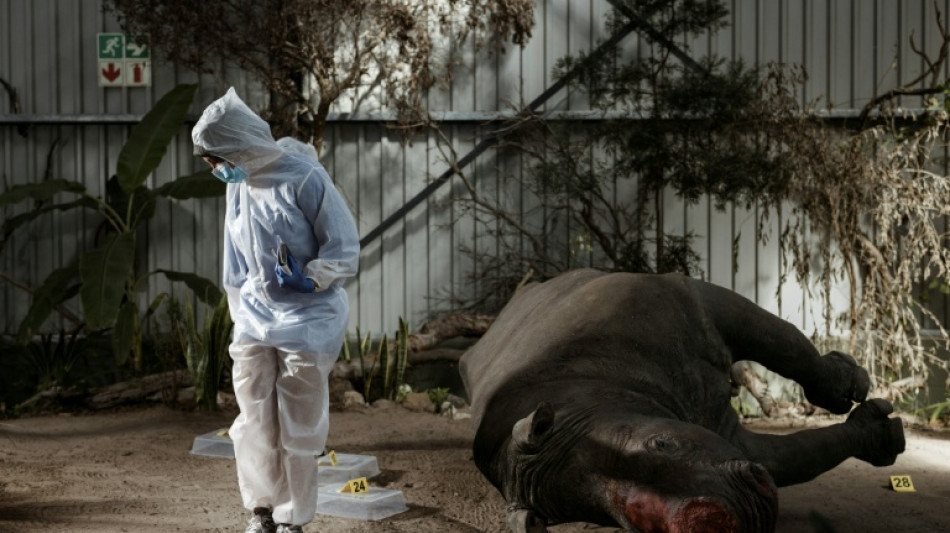
The rhino lay frozen in the sand, its grey legs stiff, glassy eyes open, horn crudely sawed off.
A dead giraffe slumped nearby and a lion's twisted body to the right -- a tableau of devastation.
Three figures in white hazmat suits tip-toed through the dust, marking every footprint. They were not first responders to another poaching tragedy, but students at South Africa's Wildlife Forensic Academy, a training centre aiming to fight poaching by teaching investigation skills to rangers, conservation officers and law enforcement.
Set inside a sunny warehouse in a private game reserve an hour north of Cape Town, the simulated carnage is staged with taxidermised animals, including rhino "Frikkie" who was poached a few years ago.
"The first people who arrive at the crime scene are absolutely crucial," said Phil Snijman, a former prosecutor and trainer at the academy.
"They are the ones who will secure the crime scene. In the absence of the necessary training... that might lead to losing a lot of your available evidence," he said, putting the last touches to an elaborate scene leading the students to a poacher's house in a corner of the warehouse.
South Africa faces an acute poaching crisis, with more than 10,000 rhinos killed since 2007 according to the International Rhino Foundation.
Yet only 36 cases were convicted in court in 2023, according to government figures, in the year almost 500 of the stocky animals were killed.
- 'Entire species disappearing' -
Killings of other species that receive less attention like reptiles and vultures, are even less likely to be prosecuted, said Snijman.
"Police aren't always available to come out, especially for a remote crime scene," he said.
That gap in justice is something Wendy Willson, a former police trainer and conservationist, sees often.
The legal head at Johannesburg's Wildlife Veterinary Hospital said cases of wildlife crime seldom make it to court, and "when they are actually prosecuted, we often end with a lenient sentence".
Willson, who is unaffiliated with the Wildlife Forensic Academy, has dedicated herself to "seeking justice for the little creatures" that don't draw public concern like rhinos and elephants.
"We are in a crisis where we are losing so many of our small animals. Entire species are completely disappearing, and nobody even knows about it," she told AFP.
While "having rangers understand the importance of the chain of custody is very important," she said, it is only one of many challenges to prosecuting wildlife crime -- which include law enforcement resources, community support and prosecutors' awareness of the crimes.
- No silver bullet -
Back at the academy, Mari-Su de Villiers -- wearing a mask and blue plastic gloves -- carefully laid down yellow markers next to each footprint surrounding Frikkie.
At 28, she works to protect endangered African wild dogs -- but it was a case of animal poisoning, and the help of a trained colleague, that led her to the academy.
"They helped our team know what evidence to look out for, anything that seems out of place in a natural environment," she told AFP.
Since opening in 2022, the academy has trained over 500 people but only 89 have been rangers, investigators, or conservation officers like De Villiers.
Much of the intake comes from European students, admits Snijman, noting that their fees help fund sponsorships for local rangers.
Improving the way evidence is gathered, especially forensic material that can stand up in court, will lead to more convictions and serve as a deterrent to future crimes, said Snijman.
"One would hope that you don't need an academy like this because there isn't any wildlife crime out there. This is not a perfect solution, but it is a small part of the bigger picture," he sighed, before returning to the dead rhino to imprint his footprints in the sand.
T.Ziegler--VB