Chunky canines: Study reveals dog obesity gene shared by humans / Photo: © AFP/File

 Repsol says profit more than triples on higher oil prices

 TotalEnergies says profit doubled on Mideast war

 Giant swing on Swiss peak aims to boost summer tourism as Alps warm

 ASEAN to call for open straits as US-Iran war casts shadow

 AI catches up with humans to score 100% at top maths contest

 South Korea election office raided in fake turnout figures probe: investigators

 Killer whales: orcas blow fish to bits 'for fun', study finds

 Deadly wildfires force thousands from homes in parts of Europe

 Tech bounce lifts Asia stocks, oil extends gains on US-Iran fears

 Surrounded by militias, Sudanese fear endless cycle of war

 Commonwealth Games 'where champions are made' despite slimmed down model, argues president

 Trump family project in Albania has already caused 'irreparable' damage: NGOs

 Bollywood blast master keeps it real with fire and fury

 Tearful fights, edible offerings: A glimpse into the Maradona trial
 What's the deal with peptides? The hyped market under US review

 Tesla shares fall as Musk touts ambitious -- and costly -- plans

 Houthis claim Red Sea tanker strikes as US hits Iran again

 Wildfires ravage parts of southern France, Italy and Spain

 Alphabet beats expectations in second quarter, cloud revenue nearly doubles

 Trump threatens Iran infrastructure, Tehran vows 'eye for eye'

 US teen withdraws lawsuit against Meta over social media addiction

 Lebanon PM says Beirut working for 'complete Israeli withdrawal'

 EU conditionally clears Paramount bid for Warner Bros.

 Philipsen snaps 'horrible' drought with Tour de France stage 17 victory

 US trial of Venezuela's Maduro set for June 2027

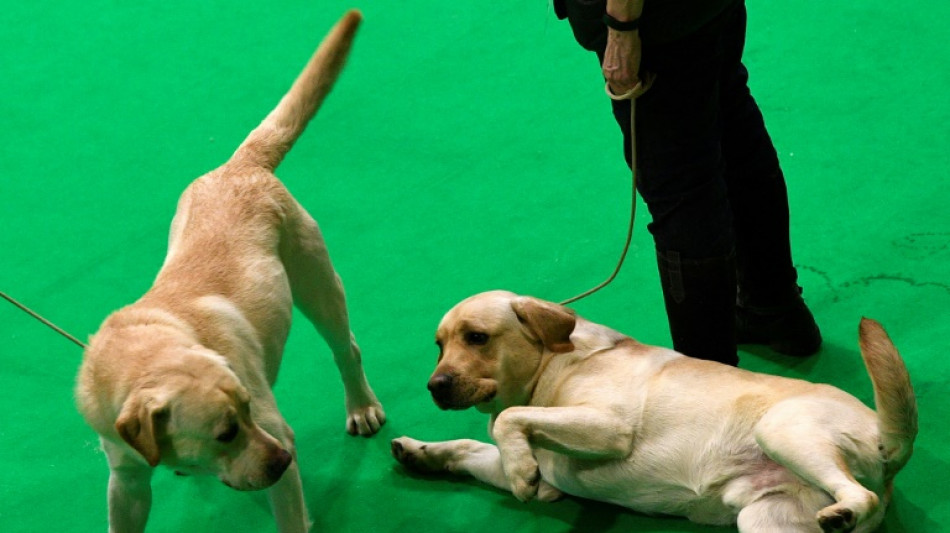
Obesity is on the rise not just in humans but in dogs, whose history of selective breeding makes them an ideal species for studying the balance between genetics, diet, and lifestyle in weight gain.
In a new paper published Thursday in Science, researchers identified a gene strongly linked to obesity in pet pooches -- and found it is also associated with weight gain in humans.
"The prevailing attitude towards obesity is that people are just a bit rubbish about controlling what they eat, whereas actually, our data shows that if you're a high-risk individual, it takes more effort to keep you slim," lead author Eleanor Raffan, a researcher in the University of Cambridge's Department of Physiology, Development, and Neuroscience, told AFP.
A veterinarian as well as a scientist, Raffan has long sought to study animal genetics to uncover broader biological insights that apply across species, including our own.
For this study, she and her colleagues focused on British Labrador Retrievers.
"Anyone who knows dogs will understand that starting with Labradors is a good idea because they're very prone to getting obese," she said. "They've got this reputation for being really foodie dogs, really obsessed by food."
The team collected slobber samples from 241 dogs and conducted a genome-wide association study, which examines an organism's entire set of genes to identify areas linked to a specific trait.
The top five genes were also present in humans, with the one exerting the strongest influence called DENND1B.
They also assessed how much the dogs pestered their owners for food and whether they were fussy eaters.
"Low-risk dogs tended to remain a healthy weight, irrespective of how their owners managed their food and exercise," said Raffan. "But if you were a high-genetic-risk dog, then if your owners were complacent about diet and exercise, you were likely to get really, really overweight."
For Raffan, the study has two major takeaways.
First, it sheds new light on how DENND1B affects a brain pathway responsible for regulating energy balance and appetite. Known as the leptin-melanocortin pathway, this system is a key target for some anti-obesity drugs.
"Only by understanding biology and the nuances of it can we possibly improve our treatment and management of obesity," she said.
Second, the study allowed researchers to quantify genetic risk for obesity in individual dogs -- and the level of effort required to keep them at a healthy weight. This is easier to measure in dogs than in humans, since their diet and exercise are entirely controlled by their owners.
"We shouldn't be rude to owners of overweight dogs," Raffan emphasized.
"It's not that they're hopeless individuals who don't care about their pets. It's just that they've got animals who persistently seek out opportunities to eat, and just a little bit extra every day is enough to cause weight gain over time."
C.Koch--VB