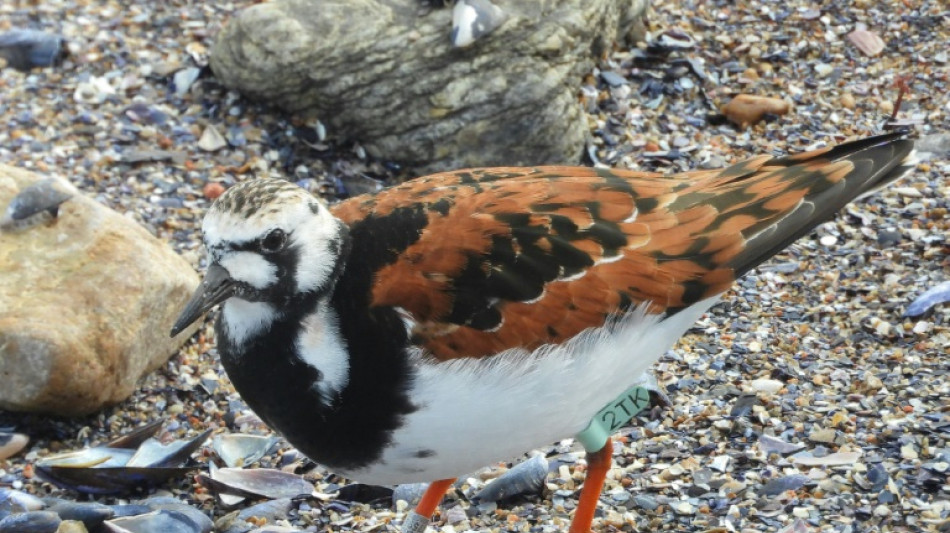
2TK, Canada's migratory bird that fell for Uruguayan resort / Photo: © BIRDWATCHING PUNTA DEL ESTE/AFP

 India's 'Cockroach' movement vows to protest until education minister resigns

 South Korea president urges regulator action on leveraged stock funds

 For Ukraine's drones, names are part of the battle

 Countries move to ban social media for children

 Asia stocks up as chip stocks recover, oil eases

 Desperate Rohingya risk deadly voyages as trafficking surges

 French lawmakers expected to approve social media ban for under-15s

 'All these rashes': chickenpox surges in Gaza camps

 Australia's Cummins, Hazlewood, Lyon back for Bangladesh Test series

 Rubio in Philippines as US condemns 'dangerous' China actions

 Unnatural physique turns Evenepoel into a Tour de France contender

 'Sit down!' Australian politician berates dog on live TV

 Argentina squad returns, without Messi, after World Cup final loss

 New strikes as Trump warns Iran will pay for US troop deaths

 Spain stars lap up adulation of estimated two million on World Cup parade

 Business of Dance Mentees and Enola Bedard Join Shakira for the FIFA World Cup Halftime Show

 "The pain is immense," says Messi of World Cup defeat

 US judge suspends Paramount's acquisition of Warner Bros.

 Chess legend Judit Polgar rejects becoming Hungary's president

 Ceferin skipped World Cup final reportedly to show disapproval of FIFA

 Judge approved night-time Tour de France doping tests

 Chile declares state of emergency over deadly rainfall

 Kevin Keegan: The 'Mighty Mouse' who conquered Europe

 'Not another one': UK voters fatigued by seventh PM in a decade

 DeChambeau threatened to call Trump over British Open penalty: reports

The first cold winds announce the arrival of winter in Uruguay's jet setters' playground, Punta del Este.
It's time for "2TK" to set flight from the plush seaside resort and return to Canada, a feat of endurance that fascinates scientists and delights local birdwatchers.
Identifiable by a plastic band on one ankle bearing the name 2TK and a metal one with nine digits on the other, this ruddy turnstone (Arenaria interpres) has spent the southern hemisphere summer on the rocks off Uruguay's Atlantic coast feeding off mussels, alongside oystercatchers and other birds.
When the food became scarce in Canada's artic tundra as winter swept in, the turnstone migrated 15,000 kilometers (9,300 miles) to South America.
By April, 2TK had become "fatter" and ditched his grey plumage for one tinged with brown and orange ahead of his return to his native lands to reproduce, said Alvaro Perez Tort, 48, an amateur photographer and member of the Punta del Este birdwatching society that has been documenting the bird's trips to Uruguay since 2016.
"2TK stole my heart," Perez told AFP.
Every year he waits for the male turnstone's return to document him "as much as possible" to share on reportband.gov -- the continental database for observing banded birds run by the United States Geological Survey.
"What's interesting is that a banded bird has a history: there's a city, a country or faraway place, a journey and people," said Perez.
By photographing the bird "we feel like we're a part" of that history, he added, noting he has seen 2TK eight times at Uruguay's southernmost tip.
- Bird 'jigsaw puzzle' -
2TK is around 14 years old, according to the Bird Banding Laboratory, which organises the banding of one million birds annually in North America for conservation purposes.
He was banded in 2012 in Delaware Bay on the US Atlantic coast, an important stopover for many migratory species.
For laboratory chief Antonio Celis-Murillo, information provided by amateur birdwatchers is vital to "build the jigsaw puzzle" of each bird's movements.
"Our work is successful thanks to the general public -- every person who reports a banded bird," he told AFP.
"The reported information is so simple but valuable, because scientifically it tells us a lot.
"Especially those reports from South America that we lack," he added.
These details allow scientists to plot the behavior of every species: their migration routes, where they stop, how long they stay there, how they live.
It all helps to refine conservation projects.
According to a 2019 study published in Science magazine, some 3,000 species of wild birds have disappeared from North America since 1970.
- 'Lots of food' -
Loss of habitat affecting all biodiversity "clearly shows its impact on migratory birds," who face ever-greater difficulties in their extraordinary journeys, said Adrian Azpiroz, a biologist and ornithologist who promotes ecotourism initiatives.
And while turnstones are not threatened like other waders, their population is nonetheless shrinking.
Of the estimated 300,000 on the continent, only several hundred or thousand winter on the Uruguayan coast. Others prefer southern Brazil or Argentina.
Scientists believe these long-distance migratory birds have favorite winter retreats and are remarkably loyal, returning year after year -- just like 2TK.
Uruguay's many coastal lagunas are "very productive from a nourishment point of view" for waders, said Azpiroz.
That is why 2TK is likely to have traveled some 350,000 kilometers in his life -- the equivalent of nine times around the planet.
That's a truly staggering accomplishment for a bird measuring little more than 20 centimeters (eight inches).
Experts are still studying the sophisticated physiological and neurological mechanisms that allow him to recognize a location with such precision following a weeks-long air journey of thousands of kilometers.
Many Uruguayan birdwatchers like to think the same thing that attracts them to return time and again to Punta del Este is what also caught 2TK's attention.
F.Müller--BTB