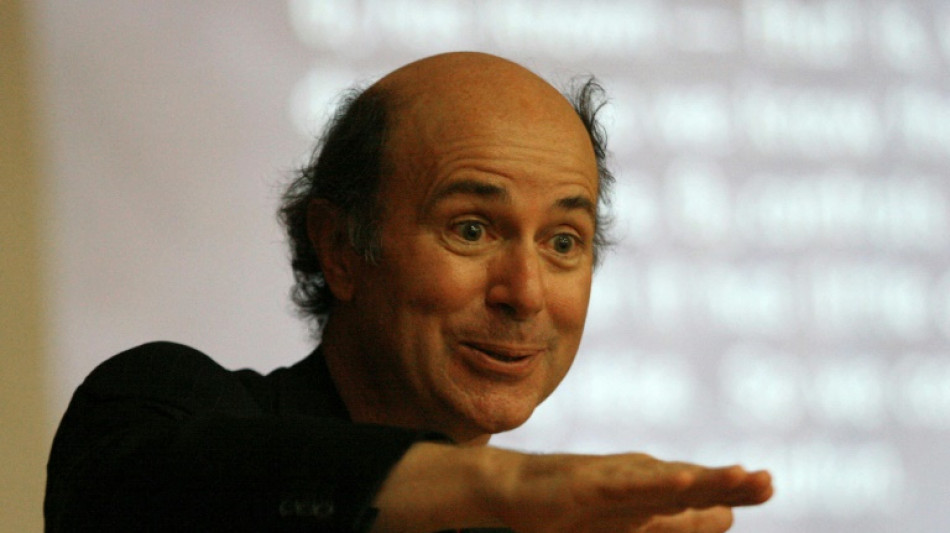
Templeton Prize-winning physicist pushes back against anti-intellectualism / Photo: © AFP/File

 Kyrgios gets month ban for cocaine, enters treatment programme

 Colombian judge bans strikes on guerrillas if minors are present

 Khachanov shocks ailing Auger-Aliassime, Swiatek and Osaka advance at US Open

 Lone juror blocking verdict in US mother's child murder trial: defense

 'Kinda chic' - Williams sisters set to launch US Open doubles bid

 Volkswagen says cutting 100,000 jobs by end of decade

 Russia slaps curfew on charity director over army criticism

 Ailing Auger-Aliassime upset by Khachanov at US Open

 Richarlison omitted from Tottenham's Premier League squad

 How El Nino is choking the Panama Canal

 Hamilton drives his Ferrari dream at Monza

 Senegal has an IMF loan, now what?

 Auger-Aliassime upset by Khachanov at US Open

 Hugging Face, the French start-up that became AI's warehouse

 World Cup winner Llorente retires from Spain team at 31

 Osaka squeezes into US Open third round

 Apple faces £2 bn lawsuit in UK over app privacy feature

 Former champ Swiatek eases into US Open third round

 DR Congo latest to promise moving Israel embassy to Jerusalem

 War criminal Mladic's body returns to Serbia with military honours

 Pierre Cardin museum brings designer's futurist style to Venice

 Slovenian rookie Omrzel triumphs as Mas extends Vuelta lead

 British, French leaders talk migrants, EU relations

 Heading for Ferrari's home race, Leclerc still dreams of world title

 Cafe at centre of Israel culture clash agrees to shut on Sabbath
Frank Wilczek, the Nobel-winning theoretical physicist whose research transformed humanity's understanding of the fundamental forces of nature, was announced Wednesday as the winner of the prestigious 2022 Templeton Prize.
The 70-year-old told AFP he saw the award as a testament to the inspiring power of science, at a time when scientists themselves are increasingly under fire by anti-intellectual elements in society.
"In the United States, where I live, it's in our face in recent years, and a whole political party is dedicated towards it. It's very unfortunate," the MIT professor said.
"These people are saying, 'Oh, I can find my own information on the internet.' There wouldn't be an internet without understanding quantum mechanics and science, and all the hard work that engineers have put into this!"
Such designers and builders of complex systems, Wilczek said, "should get a certain amount of credibility from that: they build bridges that don't fall down usually, and vaccines that work."
But he acknowledged some alienation was due to "perceived arrogance" by certain members of the scientific community, who he said must earn their credibility through patience, tolerance and honesty.
Valued at more than $1.3 million, the Templeton Prize is one of the world's largest annual individual awards, honoring those who explore the deepest questions of the universe and humankind's place within it.
Past laureates include Mother Teresa and Jane Goodall.
"Throughout Dr Wilczek's philosophical reflections, there is a spiritual quality to his ideas," said Heather Templeton Dill, president of the John Templeton Foundation, in a statement.
"By uncovering a remarkable order in the natural world, Dr. Wilczek has come to appreciate different ways of thinking about reality, and through his written work, he has invited all of us to join him in the quest for understanding."
- Demystifying dark matter -
Wilczek's achievements in physics include an explanation for one of the four fundamental forces of nature: the so-called "strong interaction" between elementary particles called quarks -- for which he and two others won the 2004 Nobel prize in physics.
He also proposed a leading explanation for dark matter, which is believed to constitute 80 percent of the matter of the universe, though its nature is not yet known.
More than four decades ago, Wilczek suggested that a type of subatomic particle called an "axion" was responsible for the mysterious matter -- but it is only recently that experiments have come closer to confirming their existence, thanks to advances in technology.
If these experiments succeed, "we would make our understanding of fundamental laws considerably more beautiful. And it would also confirm that the universe is comprehensible," he said.
In 2020, French scientists confirmed the existence of another particle that Wilczek named in the 1980s: the "anyon," which can maintain a form of memory of their interactions with one another.
Microsoft is investing in this curiosity of theoretical physics to develop the next generation of quantum computing, which Wilczek says could revolutionize that nascent field.
"Without denigrating the existing platform (of quantum computing), it's like having vacuum tubes and then having transistors," he said, recalling the technology leap responsible for today's computer chips.
Beyond his research, Wilczek is known for his public engagement through his talks and popular books, including "A Beautiful Question" and "The Lightness of Being," as well as columns for The Wall Street Journal.
Bridging the gap between science and the public is vital, he said, "especially for scientists who do research that's curiosity driven and has no obvious applications."
"What they're producing is a cultural product, and it should be brought into the culture."
W.Lapointe--BTB