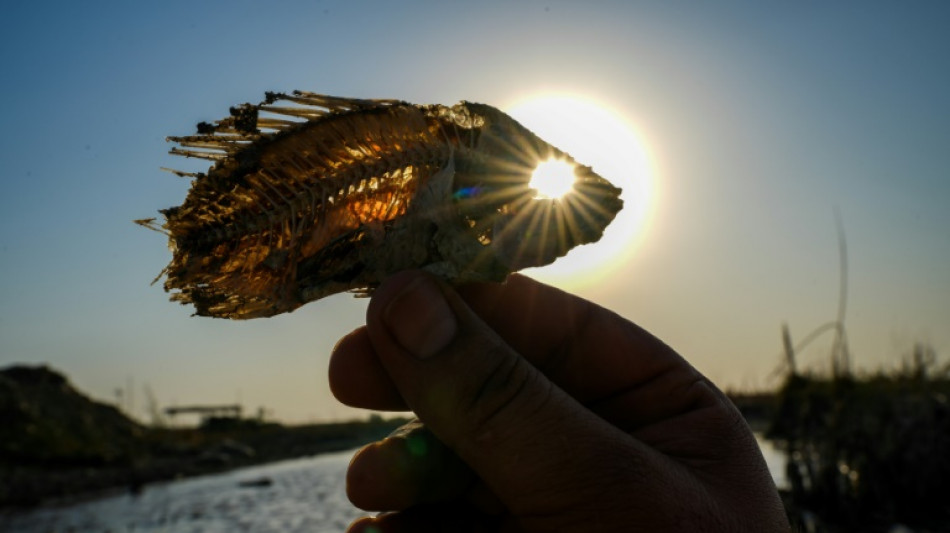
Iraq's marshes are dying, and a civilisation with them / Photo: © AFP

 Dodgers return to Trump White House despite fan anger

 Lyles, Richardson ease into 100m semis at US athletics championships
 Salman Rushdie testifies at knife attacker's US terror trial

 World Bank confirms plan to phase out China lending by 2031

 US panel backs trendy peptides despite safety concerns

 Justice Dept withdraws NY Times subpoenas over Trump plane report

 Barcelona's De Jong returns from World Cup with torn ligament
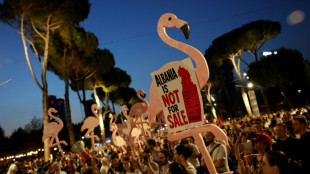 Albania police teargas protesters against Trump-linked resort

 US panel says to loosen restrictions on popular peptide despite safety concerns

 Verstappen swerves around future questions
 EU renews online child sex abuse detection powers

 Airbus, Boeing fly in different directions at Farnborough

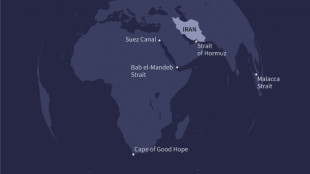 Bab al-Mandeb Strait: another key oil shipping route under threat
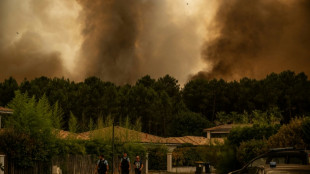
 Deadly wildfires in Europe force thousands to flee

 NATO to overhaul European fuel pipeline network

 US trade envoy to make tariff announcement as 10% duty soon expires

 Trump stuns Saudis by pinning nuclear deal to Israel ties

 Tough day for Ubisoft stock topped with weaker revenues
 Swelling jet fuel costs hit American Airlines outlook
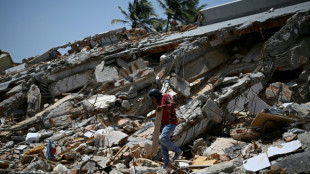
 Carapaz climbs unopposed to Tour de France 18th stage win

 Sooryavanshi hits maiden 50 as India thump Zimbabwe in T20
 ECB opens door to September rate-hike as Iran war flares up
 World Bank estimates Venezuela quakes caused $19.6 bn in damage
 Italy's far-right line up to defend jeweller who killed robbers

 AI-led boom in IPOs raises concerns about a bust

Mohammed Hamid Nour is only 23, but he is already nostalgic for how Iraq's Mesopotamian marshes once were before drought dried them up, decimating his herd of water buffaloes.
Even at their centre in Chibayish, only a few expanses of the ancient waterways -- home to a Marsh Arab culture that goes back millennia -- survive, linked by channels that snake through the reeds.
Pull back further and the water gives way to a parched landscape of bald and cracked earth.
Mohammed has lost three-quarters of his herd to the drought that is now ravaging the marshes for a fourth-consecutive year. It is the worst in 40 years, the United Nations said this week, describing the situation as "alarming", with "70 percent of the marshes devoid of water".
"I beg you Allah, have mercy!" Mohammed implored, keffiyah on his head as he contemplated the disaster under the unforgiving blue of a cloudless sky.
The buffaloes of the marshes produce the milk for the thick clotted "geymar" cream Iraqis love to have with honey for breakfast.
As the marshes dry out, the water gets salty until it starts killing the buffaloes. Many of Mohammed's herd died like this, others he was forced to sell before they too perished.
"If the drought continues and the government doesn't help us, the others will also die," said the young herder, who has no other income.
Both the Mesopotamian marshes, and the culture of the Marsh Arabs -- or Ma'adan -- like Mohammed who live in them, have UNESCO world heritage status. The Ma'adan have hunted and fished there for 5,000 years, building houses from woven reeds on floating reed islands where the Tigris and Euphrates rivers come together before pouring into the Gulf.
Even their beautifully intricate mosques were made of reeds.
But the marshlands have shrunk from 20,000 square kilometres (7,700 square miles) in the early 1990s to 4,000 (1,500 square miles) by latest estimates -- choked by dams on the great rivers upstream in Turkey and Syria and the soaring temperatures of climate change. Only a few thousand of the quarter million Ma'adan who lived in the marshes in the early 1990s remain.
Experts say that Iraq's management of the waters has not helped.
- 50 degrees C -
AFP crisscrossed the central Chibayish marshes at the end of June, where at dawn it was already 35 degrees Centigrade (95 degrees Fahrenheit) before temperatures shot towards 50.
Iraq is one of the five countries most touched by some effects of climate change, according to the United Nations. Rainfall is rarer and rarer, and in the next 25 years the World Bank said the temperature will go up by an average of 2.5 degrees.
Water levels in the central marshlands and the Euphrates which feeds it are "dropping by half a centimetre a day", said engineer Jassim al-Assadi, of Nature Iraq, the country's leading conservation group.
That will get worse "over the next two months as the temperatures rise and more and more water evaporates," he added.
To draw water for his remaining buffaloes, Mohammed Hamid Nour takes his canoe out into deeper water, where salt levels are lower.
He rolled up his sleeves to fill a water tank on the canoe revealing a tattoo of the Zulfikar, the sword of Imam Ali, one of the founding figures of Shi'ite Islam. He got it for "baraka" or blessing, he smiled. He needs all the help he can get.
- Saddam's bid to kill them -
The marshes already almost died once when former dictator Saddam Hussein dried them out so he could hunt down the Shi'ite rebels who had taken refuge there after the failed uprising in the wake of the First Gulf War in 1991.
In a few months, Saddam turned 90 percent of the marshes into a "desert", Assadi recalled. Most of the Ma'adan fled or "moved elsewhere in Iraq or emigrated to Sweden or the United States".
But when Saddam was toppled by the American-led invasion in 2003 the ditches he dug to drain the marshes were destroyed, and both the marshes and the Ma'adan returned.
Two decades later, the water level is plummeting again.
"The level of the Euphrates in Iraq is around half of what it was in the 1970s," said Ali al-Quraishi, of Baghdad's University of Technology.
Dams upstream in Turkey, where the Tigris and the Euphrates have their sources, and others on their tributaries in Syria and Iran, are the "principle" cause, he said.
"The Turks have built more dams to meet the needs of agriculture there. As the population rises, more water is needed for irrigation and domestic use," the expert added.
Water has always sparked tensions between Iraq and Turkey. With Iraq asking Ankara to release more, the Turkish ambassador to Baghdad, Ali Riza Guney, sparked outrage last July by accusing the Iraqis of "wasting water".
There is a grain of truth in the Turkish claim, scientists say. Iraq's water management is far from ideal.
Since the time of the ancient Sumerians, Iraqi farmers have flooded their land to irrigate it, which is considered hugely wasteful.
But now water for agriculture is short, with the authorities drastically reducing arable farming to make sure there is enough drinking water for the country's 42 million people.
Iraq's President Abdul Latif Rashid told the BBC last month that the government "has taken significant steps to improve the water management system in talks with neighbouring countries", without going into detail.
- Pollution and heavy metals -
Meanwhile in the central marshes, there is so little water even canoes get stuck.
Where there was water "two months ago" is now a desert, said herder Youssef Mutlaq.
Not long ago a dozen or so "mudhifs" -- traditional reed houses -- were still occupied.
"There were lots of buffaloes, but when the water started to disappear, people left," said the 20-year-old as his animals chewed feed from a bag with less and less grass to be found.
Pollution is also rising alongside salination. Sewers, pesticides and waste from factories and hospitals are dumped directly into the Euphrates along its course, and much of it ends up in the marshes, said Nadheer Fazaa, of Baghdad University, and a specialist on climate change.
"We have analysed the water and found numerous pollutants like heavy metals" which cause illness, the scientist said.
And all the while, the fish are dying. Where once the binni -- the king of the Iraqi table -- swam, there are now only fish unfit for consumption.
While the causes of the disaster are not being tackled, some are trying to limit the consequences of the drought.
- 'Our life is there' -
The French NGO Agronomists and Vets Without Borders (AVSF), supported by France, is training their Iraqi colleagues and trying to help herders and fishermen.
"We spent last summer distributing drinking water for both the people and the animals of the wetlands," said vet Herve Petit, an expert in rural development.
Many herders have been forced to "sell off their animals at derisory prices", he added.
But such initiatives are rare. Engineer Jassim al-Assadi is one of the few battling for the marshes and alerting the authorities.
Khaled Shemal, of the water resources ministry, said they were "working hard" to restore the wetlands. But drinking water and supplies for homes and agriculture came first.
In the meantime, many Marsh Arabs have left for the towns and cities, where they are often treated as pariahs. Last year, the UN's Food and Agriculture Organisation (FAO) called it an "exodus".
Walid Khdeir left the wetlands with his wife and six children "four or five months ago" to live in a house on dry land in the city of Chibayish.
"It was difficult, our lives were there like our grandparents' before us. But what can we do?" the 30-year-old said.
Today, he is fattening buffaloes to resell but is obliged to buy fodder at exorbitant prices because there is hardly a blade of grass for them to eat.
"If the water comes back like before, we will return to the marshes. Our life is there," he said.
C.Kovalenko--BTB