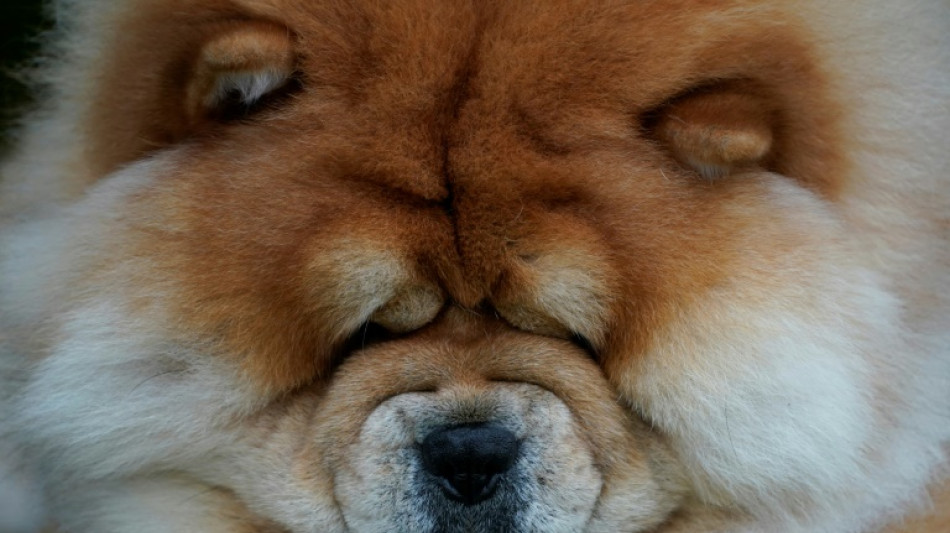
Dogs show signs of mourning after loss of canine companions / Photo: ©

 Colombian judge bans strikes on guerrillas if minors are present

 Khachanov shocks ailing Auger-Aliassime, Swiatek and Osaka advance at US Open

 Lone juror blocking verdict in US mother's child murder trial: defense

 'Kinda chic' - Williams sisters set to launch US Open doubles bid

 Volkswagen says cutting 100,000 jobs by end of decade

 Russia slaps curfew on charity director over army criticism

 Ailing Auger-Aliassime upset by Khachanov at US Open

 Richarlison omitted from Tottenham's Premier League squad

 How El Nino is choking the Panama Canal

 Hamilton drives his Ferrari dream at Monza

 Senegal has an IMF loan, now what?

 Auger-Aliassime upset by Khachanov at US Open

 Hugging Face, the French start-up that became AI's warehouse

 World Cup winner Llorente retires from Spain team at 31

 Osaka squeezes into US Open third round

 Apple faces £2 bn lawsuit in UK over app privacy feature

 Former champ Swiatek eases into US Open third round

 DR Congo latest to promise moving Israel embassy to Jerusalem

 War criminal Mladic's body returns to Serbia with military honours

 Pierre Cardin museum brings designer's futurist style to Venice

 Slovenian rookie Omrzel triumphs as Mas extends Vuelta lead

 British, French leaders talk migrants, EU relations

 Heading for Ferrari's home race, Leclerc still dreams of world title

 Cafe at centre of Israel culture clash agrees to shut on Sabbath

 Spacecraft bound for Mercury begins 'tricky' arrival
Dogs are deeply affected by the deaths of canine companions, eating and playing less and seeking attention more following a loss, a large scientific study said Thursday.
Signs of grief have previously been reported across many species, including great apes, whales, dolphins, elephants and birds.
Among the canid family, there were some prior indications: some wild wolves have been reported burying the carcasses of two-week-old pups, and a dingo mother had been observed transporting its deceased pup to different locations in the days following its death.
But the evidence was overall sparse, and, when it came to domestic dogs, confined to anecdotal reports from owners, which run the risk of anthropomorphism and over-stating the case.
The new study, published in the Nature journal Scientific Reports, involved a survey completed by 426 Italian adults who owned at least two dogs, one of whom had died while the other was alive.
Negative changes were reported by 86 percent of owners, with a quarter saying these lasted longer than six months.
These behaviors included more attention seeking (67 percent), reduced playfulness (57 percent), and reduced overall activity (46 percent).
Surviving dogs also slept more, became more fearful, ate less, and whined or barked more.
The researchers found that the length of time the two dogs had lived together was not an important factor in determining grief -- rather it was the quality of the relationship the pair had shared that mattered.
How much the owner felt the loss also played a significant role, suggesting that the surviving dog was also responding to the human's emotional cues.
"This is potentially a major welfare issue that has been overlooked," with better understanding of behavior patterns key to meeting the animals' emotional needs, concluded the authors.
I.Meyer--BTB