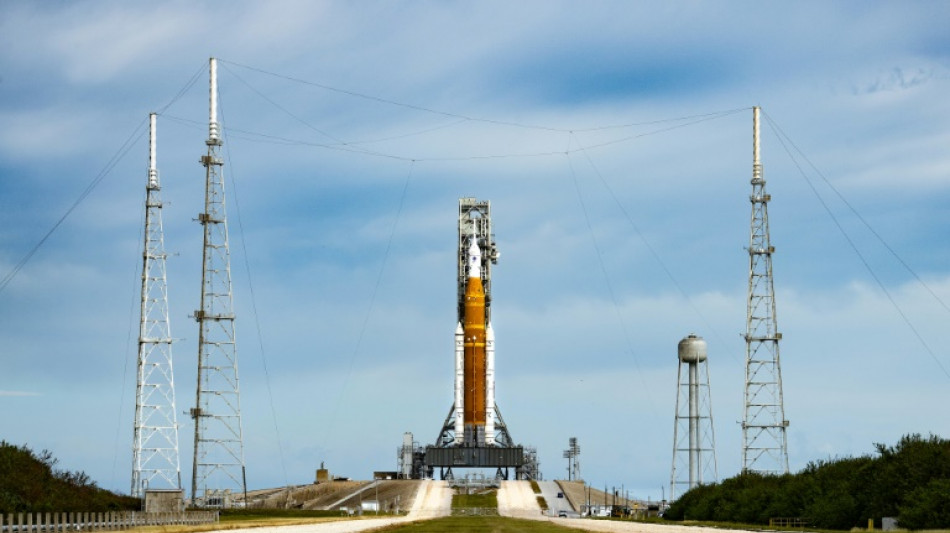
Final preparations underway for NASA's Moon rocket launch / Photo: © AFP

 EU fines Google 890 mn euros, risking US fury

 France evacuates thousands of tourists as fire rages in pine forest

 French Jewish DJ sues after activists disrupt stage show: lawyer

 Nokia says AI, cloud boosted sales in second quarter

 Repsol says profit more than triples on higher oil prices

 TotalEnergies says profit doubled on Mideast war
 Giant swing on Swiss peak aims to boost summer tourism as Alps warm

 ASEAN to call for open straits as US-Iran war casts shadow

 AI catches up with humans to score 100% at top maths contest

 South Korea election office raided in fake turnout figures probe: investigators

 Killer whales: orcas blow fish to bits 'for fun', study finds

 Deadly wildfires force thousands from homes in parts of Europe

 Tech bounce lifts Asia stocks, oil extends gains on US-Iran fears

 Surrounded by militias, Sudanese fear endless cycle of war

 Commonwealth Games 'where champions are made' despite slimmed down model, argues president

 Trump family project in Albania has already caused 'irreparable' damage: NGOs

 Bollywood blast master keeps it real with fire and fury

 Tearful fights, edible offerings: A glimpse into the Maradona trial

 What's the deal with peptides? The hyped market under US review

 Tesla shares fall as Musk touts ambitious -- and costly -- plans

 Houthis claim Red Sea tanker strikes as US hits Iran again

 Wildfires ravage parts of southern France, Italy and Spain

 Alphabet beats expectations in second quarter, cloud revenue nearly doubles
 Trump threatens Iran infrastructure, Tehran vows 'eye for eye'

 US teen withdraws lawsuit against Meta over social media addiction
After two failed attempts this summer, NASA was busy Monday completing final preparations for the launch of its new mega Moon rocket, now scheduled for early Wednesday from Florida.
The Artemis 1 mission, a test flight without astronauts, represents the first step in the US space agency's plan to build a lasting presence on the Moon, and taking lessons from there to prepare for a future voyage to Mars.
Named after the sister of Apollo in Greek mythology, the new space program comes 50 years after humans last set foot on lunar soil.
The first launch of the Space Launch System rocket, the most powerful ever designed by NASA, is set for Wednesday at 1:04 am local time (0604 GMT), with a possible launch window of two hours.
Countdown has already begun at the storied Kennedy Space Center, where the orange and white behemoth awaits its maiden flight.
The takeoff is scheduled less than a week after the passage of Hurricane Nicole, which the rocket endured outside on its launch pad.
For now, officials are evaluating the risk associated with hurricane damage to a thin strip of caulk-like material called RTV, which encircles the Orion crew capsule atop the rocket, and makes it more aerodynamic.
Teams are looking at whether the RTV could shake loose during launch and pose problems.
Two fallback dates are possible if needed, on November 19 and 25.
But Mike Sarafin, in charge of the Artemis 1 mission, was optimistic Sunday evening. "I feel good headed into this attempt," he said.
- Far side of Moon -
The weather promises to be mild, with a 90 percent chance of favorable conditions during the launch window.
At the end of September, the rocket had to be wheeled back to its assembly building to be sheltered from another hurricane, Ian, postponing the mission by several weeks.
Before these weather setbacks, two launch attempts had to be canceled for technical reasons.
The first failure was related to a faulty sensor, and the second to a fuel leak when filling the rocket's tanks. It runs on ultra-cold, ultra-volatile liquid oxygen and hydrogen.
NASA has since replaced a seal and modified its procedures to avoid thermal shock as much as possible, and succeeded in a tank filling test in late September.
These filling operations are now due to begin Tuesday afternoon, under the orders of Charlie Blackwell-Thompson, NASA's first female launch director.
About 100,000 people are expected on the coast to watch the launch, with the rocket promising to light up the night sky.
The Orion capsule will be lifted by two boosters and four powerful engines under the core stage, which will detach after only a few minutes.
After a final push from the upper stage, the capsule will be well on its way, taking several days to reach its destination.
Rather than landing on the Moon, it will assume a distant orbit, venturing 40,000 miles (64,000 kilometers) beyond Earth's natural satellite -- further than any other habitable spacecraft so far.
Finally, Orion will embark on the return leg of its journey. When passing through the atmosphere, the capsule's heat shield will need to withstand a temperature half as hot as the Sun's surface.
If takeoff happens Wednesday, the mission would last 25 and a half days in all, with a splashdown in the Pacific Ocean on December 11.
NASA is banking on a successful mission after developing the SLS rocket for more than a decade. It will have invested more than $90 billion in its new lunar program by the end of 2025, according to a public audit.
Artemis 2 will be almost a replay of the first mission, albeit with astronauts, in 2024.
Boots on the ground should happen during Artemis 3, no sooner than 2025, with the crew set to include the first woman and first person of color on the Moon.
NASA then wants to launch around one mission per year and build a lunar space station called Gateway. There, humanity must learn to live in deep space and develop the technologies necessary for a round trip to Mars, perhaps in the late 2030s.
K.Brown--BTB