Webb telescope spots its first star -- and takes a selfie / Photo: ©

 UK set for cautious budget as borrowing costs climb

 Anthropic's record IPO faces some big questions

 US Fed expected to hold rates steady ahead of key midterm elections
 Can this Latin Grammy-winner help Democrats win back Congress?

 Tuvalu has 'limited' power to halt its fossil fuel investments: NZ govt papers seen by AFP

 Palestinian activist Khalil returns to Columbia after US detention

 Trump drastically loosens oil and gas methane rules

 French Senate weighs bill to make protesters pay for unrest damage

 'A very sad day': Arteta despair as Arsenal stunned by Fleetwood
 Charles tackles thorny legacy of slavery on Caribbean trip

 Former Grand Slam winner Wawrinka ends tennis career

 Brazil's Flavio Bolsonaro flees to US after election loss

 'Faerie' nights: 'ACOTAR' fans finally get their book

 American woman convicted of getting military training from Islamic State

 Israel opposition holds narrow edge over Netanyahu in first projections

 Floriani hits maiden goal as Lazio go top
 Trump set to drastically loosen oil and gas sector's methane rules
 Storied Paris department store seeks bankruptcy protection

 Xhaka, Embolo can return to Swiss squad after fake Covid docs affair

 Allegri suspended for two Serie A games after red card

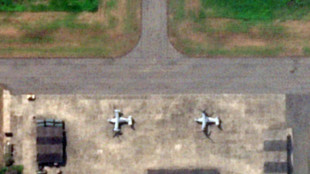 Flight data, satellite images reveal growing US role at Ecuador base

 McInnes feels 'guilt' ahead of Hearts return with Rangers

 Brazil's Lula turns 81, vows to work '24 hours a day'
 Boeing releases cautious growth plan as shares fall sharply

 Exiled Russian dissident Navalnaya warns dictators becoming 'more cunning'
Star light, star bright, the James Webb Space Telescope has seen its first star (though it wasn't quite tonight) -- and even taken a selfie, NASA announced Friday.
The steps are part of the months-long process of aligning the observatory's enormous golden mirror that astronomers hope will begin unraveling the mysteries of the early Universe by this summer.
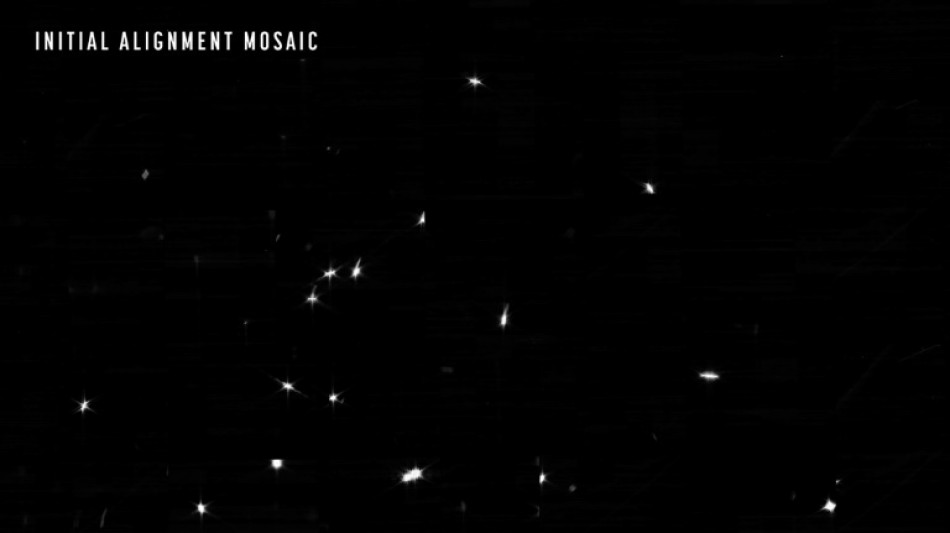
The first picture sent back of the cosmos is far from stunning: 18 blurry white dots on a black background, all showing the same object: HD 84406 a bright, isolated star in the constellation Ursa Major.
But in fact it represents a major milestone. The 18 dots were captured by the primary mirror's 18 individual segments -- and the image is now the basis for aligning and focusing those hexagonal pieces.
The light bounced off the segments to Webb's secondary mirror, a round object located at the end of long booms, and then to the Near Infrared Camera (NIRCam) instrument -- Webb's main imaging device.
"The entire Webb team is ecstatic at how well the first steps of taking images and aligning the telescope are proceeding," said Marcia Rieke, principal investigator for the NIRCam instrument and regents professor of astronomy, University of Arizona, in a statement.
"We were so happy to see that light make its way into NIRCam."
The image capturing process began on February 2, with Webb pointing at different positions around the predicted location of the star.
Though Webb's initial search covered an area of the sky about equal to the size of the full Moon, the dots were all located near the center portion, meaning the observatory is already relatively well positioned for final alignment.
To aid the process, the team also captured a "selfie" taken not through an externally mounted camera but through a special lens on board NIRCam.
NASA had previously said a selfie wasn't possible, so the news comes as a welcome bonus for space fans.
"I think pretty much the reaction was holy cow," Lee Feinberg, Webb optical telescope element manager, told reporters in a call, explaining that the team wasn't sure it was possible to obtain such an image using starlight alone.
The $10 billion observatory launched from French Guiana on December 25 and is now in an orbit that is aligned with the Earth's around the Sun, one million miles (1.5 million kilometers away) from our planet, in a region of space called the second Lagrange point.
Webb will begin its science mission by summer, which includes using its high resolution instruments to peer back in time 13.5 billion years to the first generation of galaxies that formed after the Big Bang.
Visible and ultraviolet light emitted by the very first luminous objects has been stretched by the Universe's expansion, and arrives today in the form of infrared, which Webb is equipped to detect with unprecedented clarity.
Its mission also includes the study of distant planets, known as exoplanets, to determine their origin, evolution and habitability.
E.Schubert--BTB