Baltic startups take aim at deterring Russia on NATO's eastern flank / Photo: © AFP/File

 Chiefs and 49ers suffer first losses of NFL season, Vikings stay unbeaten

 Obama mocks Trump tariffs on Canada during Michigan campaign stop
 Brewers erase four-run deficit as Rays lose World Series Game 2

 Shadab century and record last-wicket stand carry Pakistan past England

 Baylor dismisses Dave Aranda and appoints Joe Klanderman interim coach

 Stocks sink as traders brace for tech earnings, central bank decisions

 Albert Zahn’s carved birds find a lasting home in Wisconsin museums

 NPS Vatsalya offers three choices when a child turns 18

 China's Communist Party elite gather for governance talks

 Maine logging, cross-border ties whipsawed by US-Canada tariff war

 From Carnegie to Claude: AI wealth could reshape philanthropy

 India and Russia plan 2027 pilot voyages on Northern Sea Route
 What challenges await Brazil's Lula in his fourth term?

 Brazil's Lula defies odds to clinch poll victory against Flavio Bolsonaro

 Falcons hand 49ers first defeat of NFL season, Vikings remain unbeaten

 Readers debate YES Bank bonds, climate commitments and candidate disclosure
 Australian politicians pay tribute to wounded lawmaker

 Modi opens RBI data centre and cybersecurity training institute

 Nifty heads toward weakest Samvat of Modi era after 13% fall

 Disappointed Verstappen admits to wrong tyre strategy at US Grand Prix

 India trims weekly wheat auction volume despite strong miller demand

 Brazil braces for result of knife-edge election after voting chaos

 Bleems adds UFFF toys and collectibles through Kuwait partnership

 Real Madrid beat Barcelona in La Liga Clasico

 Antonelli wins US Grand Prix to close on world title

When Russia launched its full-scale invasion of Ukraine, Rapolas Markevicius was managing a private equity fund in Lithuania -- a country on NATO's eastern flank that fears it might be Moscow's next target.
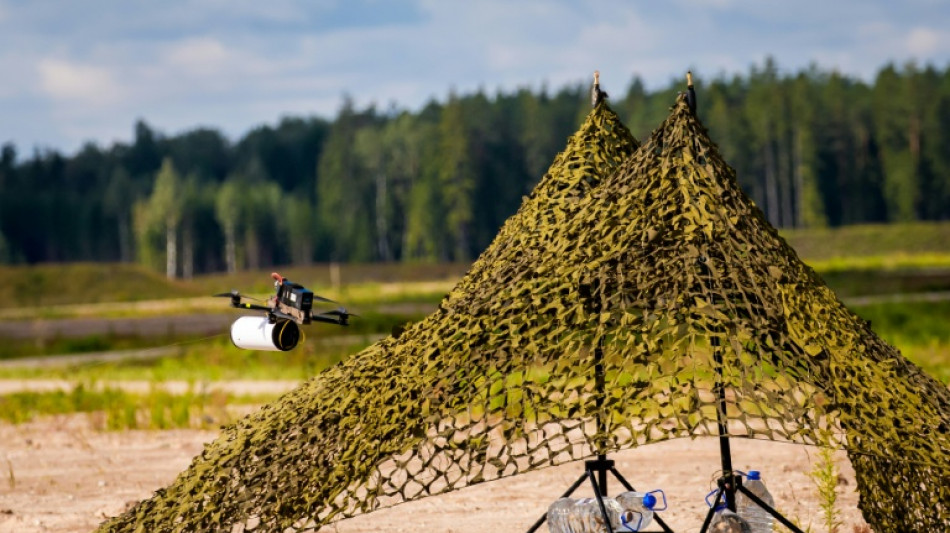
Four-and-a-half years later, his new startup Pdkinematics builds precision guidance systems that help drones strike targets more accurately even when GPS signals are jammed, which are supplied to both Ukraine and its European allies.
He is one of several startup founders in the Baltics trying to invigorate the region's defensive capabilities, as NATO's eastern members face their own hybrid threats from Russia and its close ally Belarus.
"The beginning of the war was kind of a call for action for us," Markevicius told AFP.
After Russia's February 2022 invasion, he launched a research and development programme to "understand what kind of technologies we could actually deliver to the battlefront", working with his co-founder from the space-tech sector.
As states across NATO's eastern flank face a raft of hostile actions from Moscow and Minsk ranging from drone incursions to cyberattacks, experts say startups like his are improving the region's economic resilience and helping to deter Russian aggression.
- 'Scalable solutions' -
An active startup scene has developed in Lithuania and its fellow Baltic states of Estonia and Latvia in the decades since their transition from Soviet-controlled command economies.
It is even home to several companies that are now well known far from the Baltics, such as Vinted, Bolt and Skype.
Entrepreneurs are filling gaps left by traditional arms contractors.
The conflict in Ukraine has seen a massive technological shift in warfare, with drones and robots taking on much of the fighting.
That has put a premium on quick development as well as the capacity to rapidly scale up production.
"The current technology that will drive, and is currently driving, the transition of European arms must be as scalable as it must be high-tech," Markevicius said.
And, he added, it is usually startups that are "creating quite efficient, cost-efficient and scalable solutions".
- 'Tried and tested' -
The Baltic states have some of the highest defence spending in all of NATO in relative terms -- Lithuania directs 5.3 percent of GDP to defence, the most of NATO's 32 members.
Governments are more open to working with less experienced contractors given the speed at which warfare is transforming.
The Lithuanian Armed Forces provide access to fields and airspace every month as a practical testing grounds for emerging technologies.
The Ukraine war is also giving companies real-time feedback on how their technologies fare against the Russian military.
"You can test your product with Ukraine, with Lithuanian soldiers, with any NATO soldiers," said Elvinas Kukys, CEO and founder of Luna Robotics, a startup developing advanced imaging systems for FPV drones.
In that environment, defence startups across the region have been able to attract significant foreign investment.
"The Baltic states have really been tried and tested over the past four years about how they needed to restructure their economies, reorient and really invest in their defence capabilities," said Mario Bikarski, Senior Europe Analyst at risk intelligence company Verisk Maplecroft.
"They are really now some of the best-prepared countries to withstand a wide range of new forms of attacks," he added.
- 'A new normal' -
A burgeoning defence startup sector "is not something that is going to stop a potential Russian attack", Milan Trajkovic, an analyst at Fitch, told AFP.
"But it does probably make it more difficult," he added.
Invest Lithuania (IL), which helps foreign firms invest in the country, said the Baltics' position next to Russia means some investors require reassurance.
"We understand that this is the new normal," said its director Elijius Cevelis.
He said meetings between investors and government ministries -- sometimes involving confidential information -- can help calm some fears and promote a better image of the country and region.
"We have many international troops, we have armour, we have vehicles, we have everything we haven't had before," he said.
L.Wyss--VB