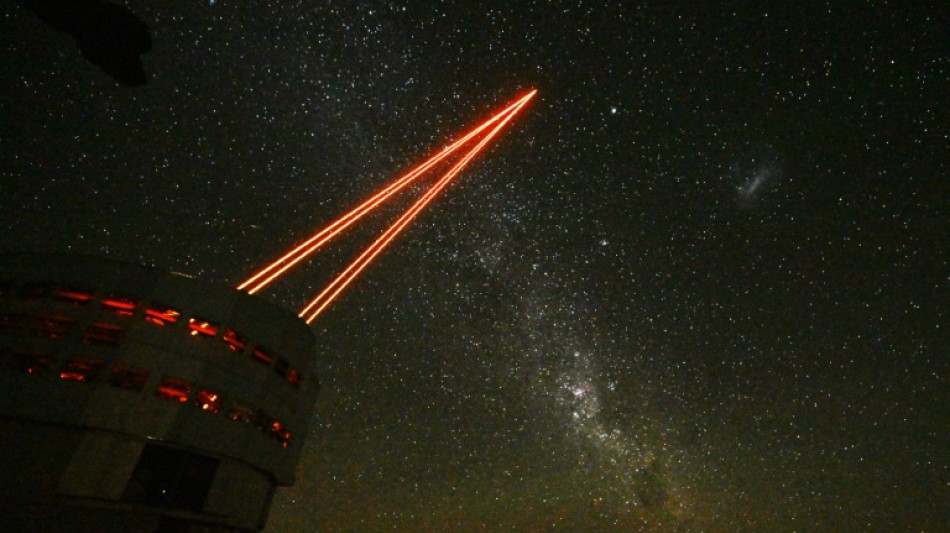
Exoplanets can have magnetic fields, 'hot Jupiter' winds reveal / Photo: © AFP/File

 Colombian judge bans strikes on guerrillas if minors are present

 Khachanov shocks ailing Auger-Aliassime, Swiatek and Osaka advance at US Open

 Lone juror blocking verdict in US mother's child murder trial: defense

 'Kinda chic' - Williams sisters set to launch US Open doubles bid

 Volkswagen says cutting 100,000 jobs by end of decade

 Russia slaps curfew on charity director over army criticism

 Ailing Auger-Aliassime upset by Khachanov at US Open

 Richarlison omitted from Tottenham's Premier League squad

 How El Nino is choking the Panama Canal

 Hamilton drives his Ferrari dream at Monza

 Senegal has an IMF loan, now what?

 Auger-Aliassime upset by Khachanov at US Open

 Hugging Face, the French start-up that became AI's warehouse

 World Cup winner Llorente retires from Spain team at 31

 Osaka squeezes into US Open third round

 Apple faces £2 bn lawsuit in UK over app privacy feature

 Former champ Swiatek eases into US Open third round

 DR Congo latest to promise moving Israel embassy to Jerusalem

 War criminal Mladic's body returns to Serbia with military honours

 Pierre Cardin museum brings designer's futurist style to Venice

 Slovenian rookie Omrzel triumphs as Mas extends Vuelta lead

 British, French leaders talk migrants, EU relations

 Heading for Ferrari's home race, Leclerc still dreams of world title

 Cafe at centre of Israel culture clash agrees to shut on Sabbath
 Spacecraft bound for Mercury begins 'tricky' arrival

Planets beyond our solar system can have magnetic fields similar to those closer to home, astronomers said Tuesday after observing extreme winds on scorching worlds known as "hot Jupiters".
The observations offer the strongest evidence yet of magnetic fields outside our cosmic backyard, a subject which has long eluded scientists.
"It's the first time we can compare the magnetic environments of other worlds -- a key step toward ultimately understanding which planets can stay alive, keep their water, and perhaps even, one day, host life as we know it," said astronomer Julia Seidel of France's Cote d'Azur Observatory.
By deflecting the charged particles that bombard planets, magnetic fields play a "very complex role in atmospheric retention," Seidel, the lead author of a new study in Nature Astronomy, told AFP.
In our solar system, Earth, Jupiter and Saturn have active magnetic fields -- but Venus and Mars do not.
However exactly what is happening on far-away worlds known as exoplanets is difficult to measure.
Seidel and her colleagues did not originally intend to measure magnetic fields, but instead set out to look into wind.
The team studied seven "hot Jupiters", gas giants where temperatures can hit nearly 2,000 degrees Celsius. They have "compositions completely unknown in our solar system," Seidel explained.
These planets are so close to their stars that they are tidally locked.
This means they always have one side facing their star -- similar to how the same side of the Moon always faces Earth.
So it will always be a blisteringly hot day on one side of these planets, while the other sits in eternal night.
This extreme difference creates very violent winds, ranging from 7,200 to 25,000 kilometres (4,475 to 15,500 miles) an hour, the scientists found.
To measure these winds, they used the European Southern Observatory's Very Large Telescope in Chile and the Gemini North telescope in Hawaii.
- 'Totally counter intuitive' -
They also found something unexpected: the hotter the planet, the weaker the wind.
"This is totally counter intuitive," study co-author Vivien Parmentier said in a statement.
"Because, all things being equal, hot planets have more energy to accelerate the winds!"
The only plausible explanation was the presence of a magnetic field around these planets that slows down the movement of charged particles in their atmosphere.
The intensity of the magnetic fields was similar to those seen in our solar system, ranging from around four times stronger than Saturn's to half that of Jupiter's.
"This is the first study with such strong evidence" of magnetic fields on exoplanets, because it covers several worlds with the same traits, Seidel said.
"Now we know that exoplanets have magnetic fields" that are of "the same order of magnitude as what we see for Jupiter or even Earth," she added.
Previously, models had predicted exoplanets could have magnetic fields a hundred times more intense than those in our solar system.
By understanding the impact of magnetic fields in the "extreme laboratories" of hot Jupiters, "we are getting close to a comprehensive understanding of their role in planetary atmospheres," Seidel concluded.
L.Stucki--VB