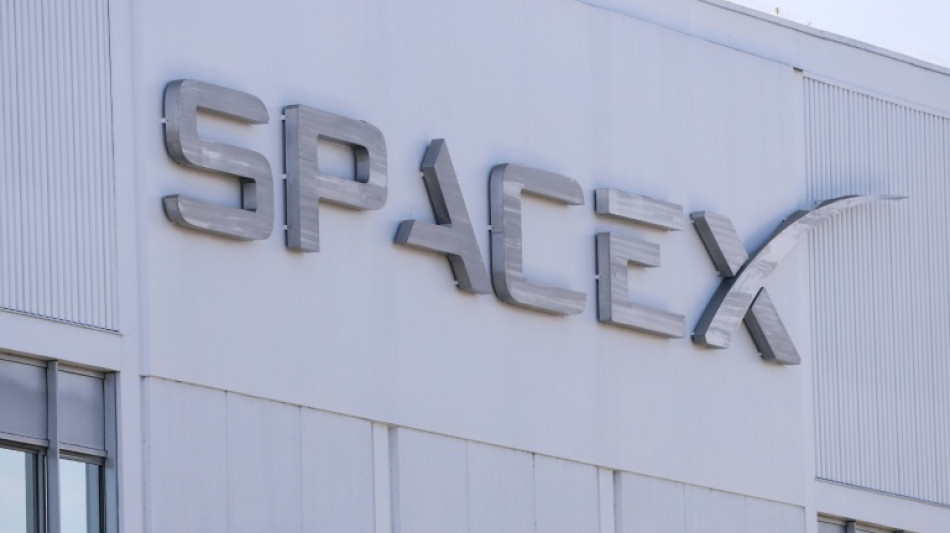
SpaceX, the sprawling company targeting the stars, Mars and an IPO / Photo: © AFP

 Kyrgios gets month ban for cocaine, enters treatment programme

 Colombian judge bans strikes on guerrillas if minors are present

 Khachanov shocks ailing Auger-Aliassime, Swiatek and Osaka advance at US Open

 Lone juror blocking verdict in US mother's child murder trial: defense

 'Kinda chic' - Williams sisters set to launch US Open doubles bid

 Volkswagen says cutting 100,000 jobs by end of decade

 Russia slaps curfew on charity director over army criticism

 Ailing Auger-Aliassime upset by Khachanov at US Open

 Richarlison omitted from Tottenham's Premier League squad

 How El Nino is choking the Panama Canal

 Hamilton drives his Ferrari dream at Monza

 Senegal has an IMF loan, now what?

 Auger-Aliassime upset by Khachanov at US Open

 Hugging Face, the French start-up that became AI's warehouse

 World Cup winner Llorente retires from Spain team at 31

 Osaka squeezes into US Open third round
 Apple faces £2 bn lawsuit in UK over app privacy feature

 Former champ Swiatek eases into US Open third round

 DR Congo latest to promise moving Israel embassy to Jerusalem

 War criminal Mladic's body returns to Serbia with military honours

 Pierre Cardin museum brings designer's futurist style to Venice

 Slovenian rookie Omrzel triumphs as Mas extends Vuelta lead

 British, French leaders talk migrants, EU relations

 Heading for Ferrari's home race, Leclerc still dreams of world title

 Cafe at centre of Israel culture clash agrees to shut on Sabbath
Elon Musk founded SpaceX in 2002 with the lofty goal of ferrying humans to Mars and colonizing Earth's neighboring planet.
Today the company is sprawling, a dominant force in the commercial space industry that is contracting with NASA in a bid to send a crewed mission to the Moon.
It's also behind the satellite internet business Starlink, the enterprise's financial engine. Its reusable rocket technology has reduced the cost of launching payloads to orbit.
The company is developing its mammoth Starship rocket -- which has a test launch slated for as soon as Thursday -- for Moon exploration and the much grander aim of taking humans to Mars, though it must demonstrate significantly more progress before either of those ambitions come to fruition.
Earlier this year, Musk merged his company xAI into SpaceX and is now racing to build out space data centers.
And now the world's richest man has laid out plans to US regulators in what could become the largest initial public offering in history, as the company seeks to raise up to $75 billion in the stock market.
- Space industry dominance -
Musk, the South African-born serial entrepreneur, founded SpaceX when he was 30 years old.
His venture followed the sale of his dot-com business Zip2, after which he founded the online payments company that merged into the entity that would become PayPal, which eBay later acquired.
He found himself flush with cash and disappointed that NASA didn't have a Mars mission on deck.
In an effort meant in part to excite the public about space travel, Musk developed a plan to send seeds in a glass-enclosed greenhouse to the surface of Mars and grow plants, but was thwarted in his bid to find a means to send it there.
So he founded a rocket company.
The early days were rife with failure and the operation hemorrhaged money.
In 2008, SpaceX finally got the Falcon 1 off the ground.
The company eventually created partially reusable rockets and landed contracts including with NASA.
The Falcon 9 rocket became the company's workhorse, and has carried out hundreds of missions.
The company's next milestone was space station delivery: Its Dragon spacecraft reached the International Space Station in 2012, later becoming the first private spaceflight company to send a crew to space.
And the enormous Starship rocket is under development with the ambitious goal of becoming the first reusable orbital rocket, with an upper stage that could carry both crew and cargo.
If completed as designed, it would require complicated and still unproven in-orbit refueling.
SpaceX is under contract with NASA to produce a modified variant of Starship that would serve as a human landing system.
The company is poised to complete its 12th Starship test on Thursday, the debut mission of its third-generation model.
And ultimately, colonizing Mars is still the SpaceX dream.
- 'Swashbuckling' -
The company is not afraid of breezing past deadlines. It's also used to fiery explosions, which several of its Starship test flights have ended in.
Yet SpaceX's "fail fast, learn fast" ethos has helped it become the world's dominant launch services provider.
But with a blockbuster IPO and a lucrative commitment to NASA to deliver on, astronautics expert G. Scott Hubbard said the ante is up.
"I think swashbuckling, you know 'move fast and break things,' has kind of come out of favor," the physicist told AFP.
It's one thing when "you're not risking anybody's life" with spaceflight and "you're doing it on your own nickel, more or less," he said.
But when NASA comes into play, it "means you've got to be very rigorous," said Hubbard, who formerly directed the space agency's Ames Research center.
Experts across government and industry have already voiced concern that Starship won't be ready on NASA's timeline, and some even question whether the system would ever be feasible.
With that in mind, NASA raised the possibility last fall of reopening the contract awarded to SpaceX and using Jeff Bezos's Blue Origin's lunar lander first, sending shockwaves through the rival companies.
NASA hopes to perform an in-orbit rendezvous between its Orion spacecraft and at least one lunar lander in 2027 -- but it's far from clear whether either SpaceX or Blue Origin will be prepared.
Hubbard emphasized that SpaceX has "fantastic people working for them" from top universities.
But the pressure is on.
"If you take risks in the space business, it needs to be understood and mitigated risk," Hubbard said. "It can't be stupid risk."
F.Mueller--VB