Spacecraft to probe how Earth fends off raging solar winds
/ Photo: © NASA/AFP/File

 Kyrgios gets month ban for cocaine, enters treatment programme

 Colombian judge bans strikes on guerrillas if minors are present

 Khachanov shocks ailing Auger-Aliassime, Swiatek and Osaka advance at US Open

 Lone juror blocking verdict in US mother's child murder trial: defense

 'Kinda chic' - Williams sisters set to launch US Open doubles bid

 Volkswagen says cutting 100,000 jobs by end of decade

 Russia slaps curfew on charity director over army criticism

 Ailing Auger-Aliassime upset by Khachanov at US Open

 Richarlison omitted from Tottenham's Premier League squad

 How El Nino is choking the Panama Canal

 Hamilton drives his Ferrari dream at Monza

 Senegal has an IMF loan, now what?

 Auger-Aliassime upset by Khachanov at US Open

 Hugging Face, the French start-up that became AI's warehouse

 World Cup winner Llorente retires from Spain team at 31

 Osaka squeezes into US Open third round
 Apple faces £2 bn lawsuit in UK over app privacy feature

 Former champ Swiatek eases into US Open third round

 DR Congo latest to promise moving Israel embassy to Jerusalem

 War criminal Mladic's body returns to Serbia with military honours

 Pierre Cardin museum brings designer's futurist style to Venice

 Slovenian rookie Omrzel triumphs as Mas extends Vuelta lead

 British, French leaders talk migrants, EU relations

 Heading for Ferrari's home race, Leclerc still dreams of world title
 Cafe at centre of Israel culture clash agrees to shut on Sabbath
A joint European-Chinese spacecraft is set to blast off Tuesday to investigate what happens when extreme winds and giant explosions of plasma shot out from the Sun slam into Earth's magnetic shield.
Particularly fierce solar storms can knock out satellites, threaten astronauts -- and create colourful auroras in the skies of northern and southern latitudes.
To find out more about this little-understood space weather, the van-sized SMILE spacecraft is tasked with making the first-ever X-ray observations of Earth's magnetic field.
The spacecraft is scheduled to launch on a Vega-C rocket at 0352 GMT on Tuesday from Europe's spaceport in Kourou, French Guiana, on the northeastern coast of South America.
Lift-off was originally planned for April 9, but was postponed due to a technical issue.
SMILE -- or the Solar Wind Magnetosphere Ionosphere Link Explorer -- is a joint mission between the European Space Agency (ESA) and the Chinese Academy of Sciences.
"What we want to study with SMILE is the relationship between the Earth and the Sun," explained Philippe Escoubet, an ESA scientist working on the project.
- Here comes the Sun -
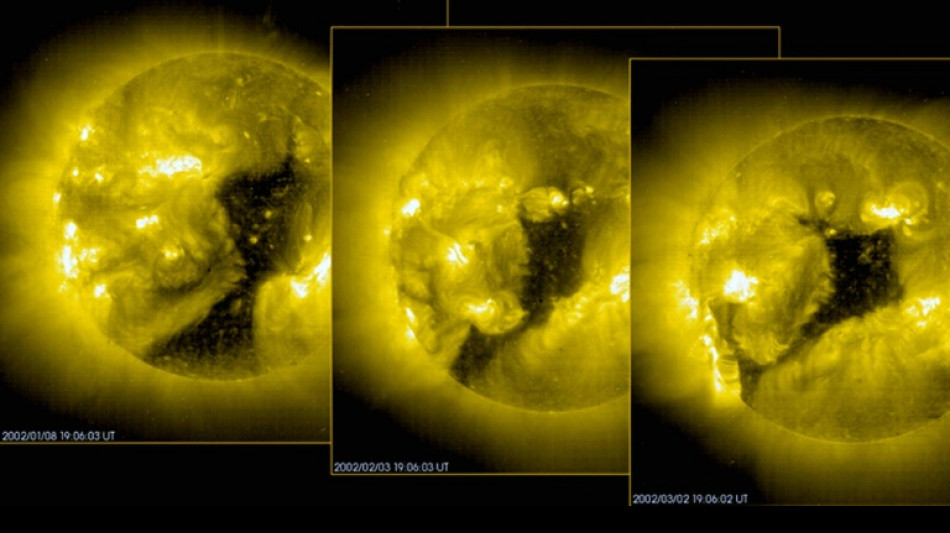
Solar wind is a stream of charged particles shot out from the Sun. Sometimes this wind is kicked up into a huge storm by massive eruptions of plasma called coronal mass ejections.
Hurtling at around two million kilometres (1.2 million miles) an hour, these powerful blasts take a day or two to reach Earth. When they arrive, Earth's magnetic field acts as a shield, deflecting most of the charged particles.
However during particularly intense events, some particles can penetrate our atmosphere, where they have the potential to take out power grids or communication networks. They also create dazzling auroras known as the northern or southern lights.
During the worst geomagnetic storm on record in 1859, bright auroras were seen as far south as Panama -- and telegraph operators around the world were given electric shocks.
Solar winds can now also pose a danger to satellites orbiting Earth, as well as astronauts sheltering inside space stations.
Given these threats, scientists want to learn more about space weather, so the world can better forecast and prepare for big blasts in the future.
To help with this endeavour, the SMILE mission plans to detect the X-rays emitted when charged particles from the Sun interact with the neutral particles of Earth's upper atmosphere.
- Poles apart -
The spacecraft will observe this phenomenon from several important locations, including the magnetopause -- where the magnetic shield deflects solar particles.
It will also soar above the Earth's poles, where X-ray photons are visible, according to Dimitra Koutroumpa of France's CNRS institute who is working on the mission.
On Tuesday, the spacecraft will be placed 700 kilometres above Earth before heading on an extremely elliptical orbit.
SMILE will be at an altitude of 5,000 kilometres when it flies over the South Pole, where it will transmit data to a research station in Antarctica called Bernardo O'Higgins.
But the spacecraft will be 121,000 kilometres above Earth when it swings over the North Pole, to take in a far wider view over a longer period of time.
Among other things, this will allow the mission to "observe the northern lights non-stop for 45 hours at a time for the first time ever", according to the ESA.
The spacecraft has four scientific instruments, including a UK-built X-ray imager, as well as a UV imager, ion analyser and magnetometer all made by the Chinese Academy of Sciences.
SMILE is expected to start collecting data just an hour after it is put into orbit.
The mission is designed to run for three years, but could be extended if all goes well.
J.Marty--VB