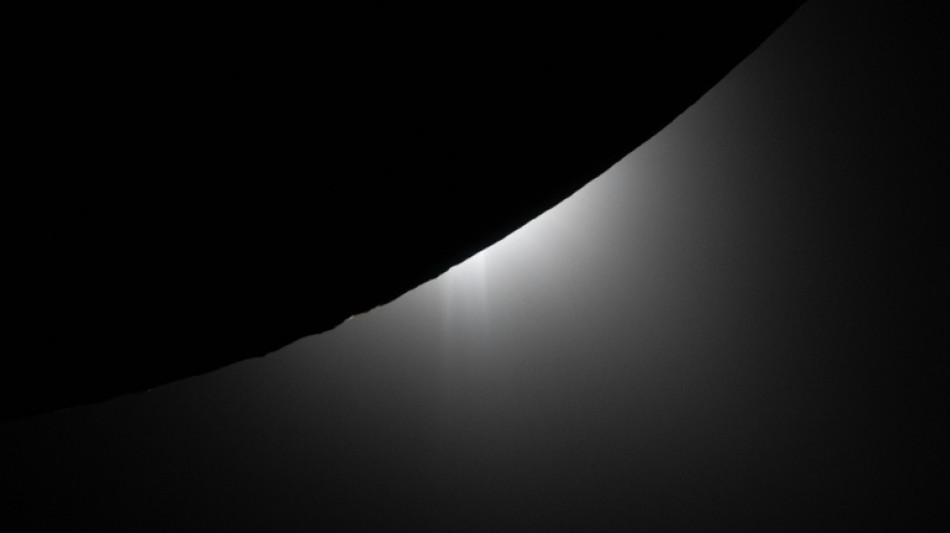
Artemis astronauts to shed light on space health risks / Photo: © NASA/AFP

 Spain high-speed train collision kills 31, injures 80
 Turkey hosted Libya east-west reunification talks last week

 Spain high-speed train collision kills 30

 Plane reportedly carrying Brazil's Bolsonaro departs Ecuador

 Springboks pick six uncapped players for Nations Championship

 Israel's unassuming President Herzog holds keys to next government

 Real Madrid apologise to China over Mbappe comments

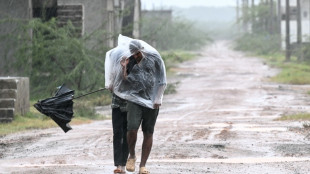
 Three killed by storm in southern India

 China says takes Mbappe apology 'seriously' after Mao remark

 Flavio Bolsonaro on way to Ecuador from Argentina after fleeing Brazil

 Netanyahu bloc leads after half of Israeli votes counted but no majority

 India vows action after first cheetah shot dead

 'Now or Never': Ethiopia influencers push for Eritrea invasion

 Mbappe furore rages on in China, but Mao comments censored

 Billionaire Ambani's Jio jumps 21% in market debut after record India IPO
 Rays win thriller to thwart Brewers in World Series

 Reigning champ Knicks earn first win against Pistons

 Runners swap streets for shopping malls as haze chokes Singapore

 Billionaire Ambani's Jio to debut after record India IPO

 UK set for cautious budget as borrowing costs climb

 Anthropic's record IPO faces some big questions

 US Fed expected to hold rates steady ahead of key midterm elections

 Can this Latin Grammy-winner help Democrats win back Congress?

 Tuvalu has 'limited' power to halt its fossil fuel investments: NZ govt papers seen by AFP
 Palestinian activist Khalil returns to Columbia after US detention

While the Artemis II astronauts have been protected from the icy vacuum of space on their journey, their bodies have nonetheless been left exposed to possibly high levels of radiation -- a danger of space travel that NASA is anxiously waiting to study.
Their trip around the Moon has taken the four astronauts farther into space than any human before -- more than 1,000 times the distance from Earth to the International Space Station.
Earth's magnetosphere offers some protection against radioactive cosmic rays and solar particles to the orbiting ISS, but no such cover on the Moon.
Studying the impacts of radiation is essential as NASA hopes to eventually build a Moon base and send astronauts on the long trip to Mars.
The US space agency installed radiation sensors on the Orion capsule and took blood samples of the astronauts before takeoff to compare with samples post-trip. The crew's saliva samples are gathered throughout the journey and their health is monitored via smartwatches.
NASA has also placed state-of-the-art computer chips in the capsule that can replicate certain physiological functions, like that of an organ.
Mission planners chose to mimic bone marrow, which produces blood cells and is one of the tissues "most quickly affected by radiation and other stressors," NASA Human Research Program chief scientist Steven Platts told AFP.
With all of the data, Platts said his team hoped to better understand the variation between low earth orbit and deep space.
"It will be good research information for us to see the level of radiation, but also the type of radiation," he said.
"Our prediction is that we'll see a lot more galactic cosmic radiation... which is from supernovas and is everywhere," versus radiation coming from the Sun, he said.
- Mental health -
Platts said while most people associate radiation with cancer risk, it also can impact the central nervous system and blood circulation.
"It can lead to inflammation in the brain, and that's one of the things that can increase the risk of Parkinson's disease," he said.
With the Artemis II astronauts spending just 10 days in space, radiation is not a major concern, but the danger could rise dramatically with longer stays on the Moon.
Extensive health studies were conducted on the Apollo astronauts, but technology has advanced greatly in the 50 years since, said Bruce Betts, chief scientist at the Planetary Society, a space advocacy group.
"There will be a lot of information on the medical side of things," he said.
The other major focus is on psychological risks of spending long periods of time on the Moon or Mars.
With greater disconnection from home and tight living quarters, mental health could pose the greatest danger to astronauts on such missions, Platts said.
He compared the difference between the ISS and the tiny Orion capsule as like going from a "six-bedroom house, like a mansion... to a camper van."
M.Vogt--VB