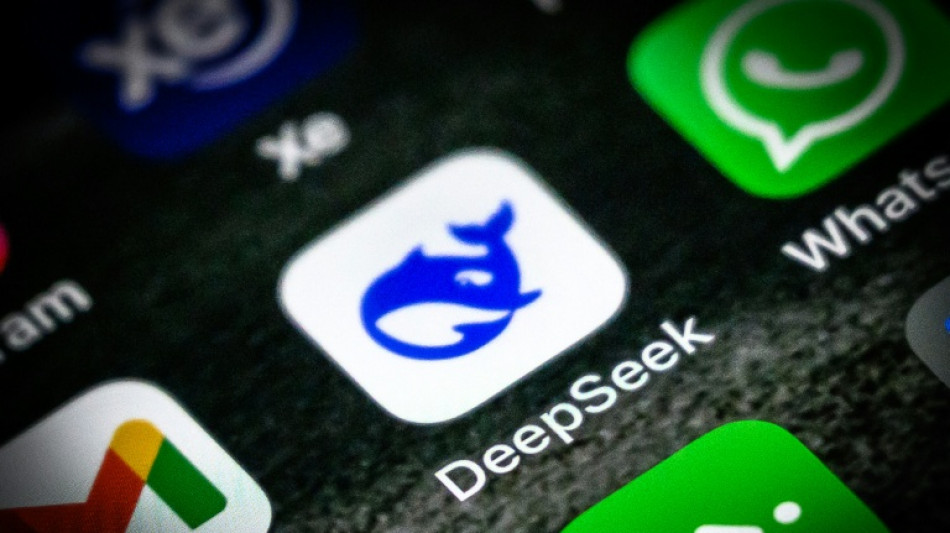
Waiting for DeepSeek: new model to test China's AI ambitions / Photo: © AFP

 Andy Burnham set to take over as new British PM
 Survivors warn of loopholes in Hong Kong sexual offence reforms

 Ferry capsizes off Guyana, authorities still searching for 66

 Spain win World Cup after Messi's Argentina fall flat

 Spain deserved to win World Cup: Argentina's Scaloni

 Mbappe retains World Cup Golden Boot crown

 Messi denied dream farewell as abject Argentina lose World Cup final

 Mbappe wins World Cup Golden Boot

 Spain beat Argentina to win World Cup

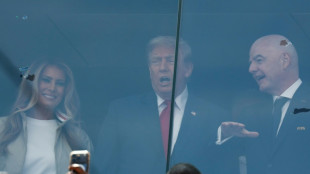 Trump basks in World Cup final spotlight

 Madonna, Shakira, Bieber and The Muppets light up World Cup half-time show

 Ukraine blames Russia for deadly strike on Turkish cargo ship

 New Zealander Fox birdies last hole for 'surreal' British Open win

 Italy's Mazzoli wins US PGA Dominican Republic title

 Evenepoel wins Tour stage, Vingegaard crashes out after night-time control

 New Zealander Fox wins British Open on final hole

 Three-team NBA trade sends Dort to Hawks, Risacher to Mavs: reports

 Left knee issues will keep Ohtani off the mound for now

 Floating igloo leaves France for polar exploration mission

 Young charges into British Open lead as Scheffler comes up short

 Olympic champ Evenepoel wins Tour de France 15th stage

 Kim leads British Open as Young charges into clubhouse lead

 Antonelli takes sixth win of the season with victory at Belgian Grand Prix

 Red and yellow sweep Madrid before World Cup final

 Russell out of Belgian GP after colliding with Hamilton on lap one

For weeks now, the global tech industry has been waiting for a major artificial intelligence launch from DeepSeek, seen as a benchmark for China's progress in the fast-moving field.
More than a year has passed since the startup put Chinese AI on the map in early 2025 with a low-cost chatbot that performed at a similar level to US rivals.
But despite reports and rumours about its imminent release, DeepSeek's next-generation "V4" model is nowhere in sight.
Speculation is also swirling over the geopolitical implications of which computer chips were chosen to train and power the new system: world-leading US designs or made-in-China alternatives that the country is racing to develop.
"It's important to know because at one level, it is a signal of China's AI self-sufficiency trajectory," Wei Sun, principal AI analyst at Counterpoint Research, told AFP.
Tech news outlet The Information reported last week that V4 can be run on the latest chips made by China's Huawei.
Such a shift would mark a milestone for China in its bid to beat US restrictions on the export of top-of-the-range AI chips from Californian titan Nvidia to the country.
The report cited five people with direct knowledge of large orders for Huawei chips, made in preparation for the DeepSeek launch by tech giants including Alibaba, ByteDance and Tencent.
AFP contacted DeepSeek, Huawei, Alibaba, ByteDance and Tencent but none were able to comment.
- 'Wake-up call' -
DeepSeek started life in 2023 as a side project of a hedge fund that had access to a cache of powerful Nvidia processors.
It shot to attention in January 2025 with its R1 deep-reasoning chatbot, which sent US tech shares tumbling with President Donald Trump calling it a "wake-up call" for American firms.
R1 was based on DeepSeek's last major AI model, V3, which was released in December 2024.
The company's affordable, customisable AI tools have been widely adopted in China, and are also popular in emerging markets such as Southeast Asia and the Middle East.
Stephen Wu, founder of the Carthage Capital fund, told AFP that V4 -- said to be multimodal, meaning it can generate text, pictures and video -- could again shock US tech valuations.
"I expect the upcoming DeepSeek V4 release will not just be a software update; it will be a highly capable, open-source model that handles massive context windows at a fraction of the cost," he predicted.
But DeepSeek's reputation as a company at the frontier of AI technology is also at stake.
Its models previously relied on Nvidia chips, so a move to collaborate with domestic chipmakers would require "substantial re-engineering", Wei said.
"That transition can slow development cycles and introduce performance trade-offs, especially for V4, a model expected to be state-of-the-art."
- Training vs inference -
The US cites national security concerns as the reason for its export ban on Nvidia's most powerful AI processors to China.
"The ongoing wait for DeepSeek V4 points to friction in scaling advanced models without unrestricted access to top-tier Nvidia hardware," Wu said.
But some reports allege that DeepSeek skirted the ban to train V4 using thousands of Nvidia's top-end Blackwell chips, dismantled in third countries and smuggled to China.
Training AI models requires huge amounts of computing power -- much more than for processing generative AI queries, which is known as inference.
AFP has contacted DeepSeek for comment. Nvidia did not respond to a comment request but told The Information it had not seen evidence of this and "such smuggling seems farfetched".
Another Chinese AI startup, Zhipu, in January unveiled an image generator that it said had been entirely trained on Huawei chips.
And Alibaba said this week it would open a new data centre for AI training and inference in southern China, powered by 10,000 of its own chips and operated by China Telecom.
As for DeepSeek, "if they have successfully trained V4 entirely on Huawei silicon, it signals a material shift in the geopolitical tech landscape", Wu said.
P.Keller--VB