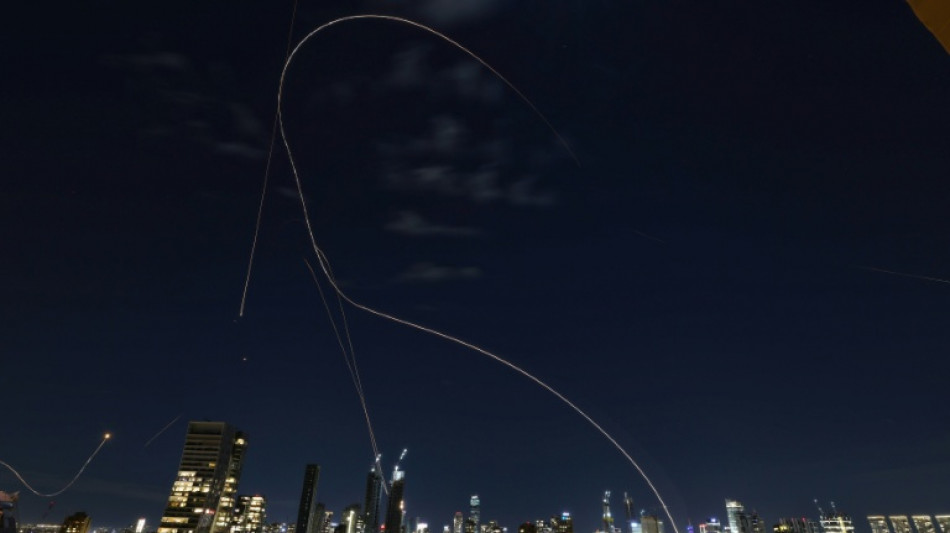
Israel using AI to fine-tune air raid alert system / Photo: © AFP

 US accuses Cuba of sweeping spy campaign, aiding American left

 US stocks drop on latest Middle East fighting, tech earnings caution

 Louvre heist gallery to reopen to public on Wednesday

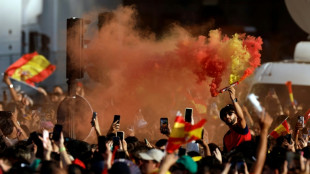 World Cup champs Spain lap up adulation of a million on bus parade

 Canada faces one of its most intense fire seasons

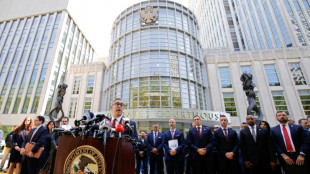 Mexican drug lord 'El Mayo' sentenced to life in US prison

 Spanish king hails World Cup heroes as celebration tour begins

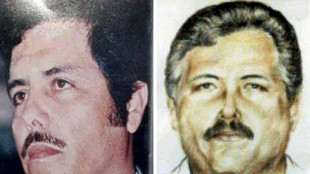 Mexican drug lord 'El Mayo' sentenced to life in prison

 Leasing firm SMBC orders 200 planes from Airbus and Boeing
 Zelensky faces deepening political crisis as protests dig in

 'Legendary' former Liverpool and England star Keegan dies aged 75

 Former Liverpool and England star Kevin Keegan dies aged 75

 Three things we learned from the Belgian Grand Prix

 Without Messi, Argentine team set for low-key homecoming
 Garcia departure leaves Belgium facing 'generational change'
 Scars of war linger on Syria's Saint Simeon monastery

 Plane carrying Spain's World Cup winning team lands in Madrid

 MEXC Launches 0-Fee Stock Futures Campaign With $5,000,000 SNDK Prize Pool

 Iran says fighting 'full-scale war' with US
 Swiss researchers hoard vast trove of NASA climate data

 Starmer 'proud' of achievements as Andy Burnham set to become new UK PM
 Hungary PM proposes chess great Judit Polgar for president

 Lara calls for celebration of 'father figure' Sobers

 Madrid awaits triumphant return of Spain's World Cup heroes
 Superb Spain worthy winners of World Cup dominated by superstar names
During the war in the Gaza Strip and two wars with Iran in the space of a year, Israel has used artificial intelligence to fine-tune its missile early warning system.
In last year's 12-day conflict with Iran, incoming missiles would spark city-wide air raid alerts, and Israelis would have to rush for cover, often several times a day.
But now the systems that warn of an impending attack have become increasingly more sophisticated and localised.
Sarah Chemla is a 32-year-old mother whose second child was born in a delivery room set up in an underground hospital bunker in Tel Aviv during the 2025 war with Iran.
Back then, every alert that sounded applied to the whole city, she said, but now the system has become more precise.
"We spend less time in shelters, even if the stress is still there," Chemla said.
As the new war with Iran rages, Chemla said the refined warning systems are making lives easier.
She no longer has to shake her children awake whenever a siren sounds, and some nights they even manage to sleep through.
"Before, alarms would sound across all of Tel Aviv whenever a missile targeted the area," she told AFP.
"Now alerts are ultra-localised. If a projectile is heading for the south of the city, I only get a pre-alert and no longer have to wake my children."
Between the wars with Iran and during the Gaza conflict, Israeli civil defence has significantly upgraded its public warning system, to make daily life more manageable under the constant threat of missile fire.
Behind the shift lies the growing use of artificial intelligence, AI, to predict where incoming projectiles are likely to hit.
- Continuous surveillance -
Since the October 7, 2023 attack by Palestinian Islamist movement Hamas that triggered the Gaza war, "more than 60,000 missiles, rockets, drones and aerial threats have been fired at Israel", former air defence commander Ran Kochav told AFP.
"Each launch has been the subject of a full analysis ... incorporating all its characteristics: trajectory, timing, weather, launch angle, radar signature."
This data is "processed ... with the help of AI", added Kochav, now an associate fellow at the Royal United Services Institute think tank in Britain.
Israel's defence firm Elbit Systems has also deployed its "SkyEye" system to analyse launches, media reports say.
"The system has the capability to continuously monitor vast areas, intercept events and maintain multiple regions of interest (ROI) under constant surveillance with high spatial resolution," Elbit Systems says on its website.
Experts say AI is processing data at a speed and depth beyond human capacity.
"AI gathers millions of data points and performs what is known as data fusion," Yehoshua Kalisky, a laser specialist and researcher at Tel Aviv's Institute for National Security Studies (INSS), told AFP.
"It provides strategic planning and forecasting tools at levels the human brain cannot reach, thereby supporting decision-makers."
For each launch from Iran or Lebanon -- where Israel is also at war with Tehran-backed Hezbollah -- the prediction is passed on to the military's Home Front Command, which is responsible for civilian protection.
- 1,700 alert zones -
Nearly 20 years ago, during the 2006 war with Hezbollah, "the country was divided into 25 alert zones", a Home Front Command source told AFP on condition of anonymity.
"Today there are 1,700."
Major cities are now split into sub-zones to avoid unnecessarily confining millions of people to shelters during frequent alerts.
The Command relies on multiple channels to reach the public: street sirens, a dedicated website, the media, and a silent radio frequency that activates only in emergencies for observant Jews who switch off their phones during the Sabbath.
But above all else, it is the smart phone that has transformed the management of life during wartime.
The Israeli military says an app downloaded on more than four million phones in a country of 10 million people delivers real-time geo-located alerts, the time needed to reach a shelter and "all-clear" messages when the threat recedes.
During the June 2025 war with Iran, civil defence added cell broadcast technology, enabling alerts to be sent to all switched-on phones within range of relay antennas.
At dawn on June 13, 2025, thousands of phones across the country sounded a piercing tone, warning that Israel had struck Iran and urging people to brace for retaliation, which followed within hours.
Since February 28 this year, for many Israelis that sound has become the soundtrack of war.
Tel Aviv resident Chemla said the improvements in the early warning system over the past year have been "life-saving".
L.Stucki--VB