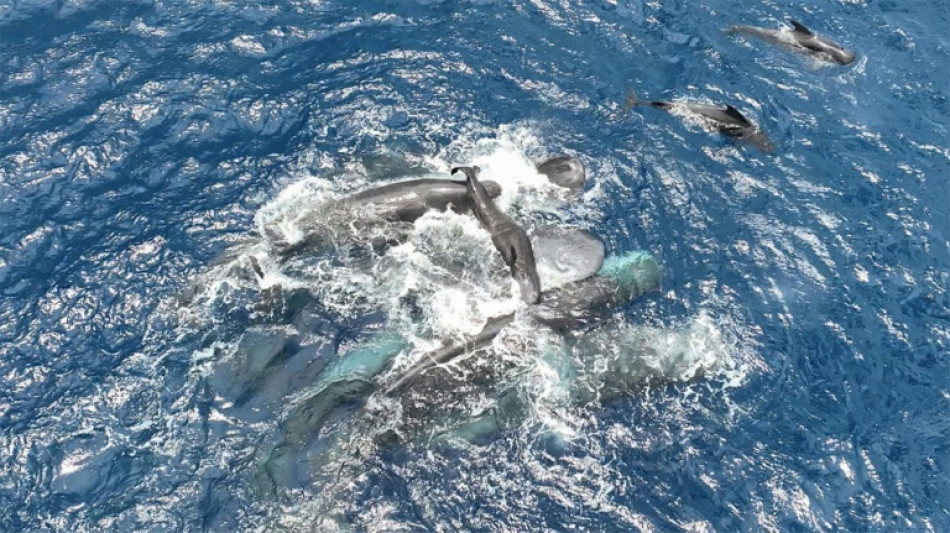
Whale filmed giving birth, with a little help from her friends / Photo: © Project CETI/AFP

 Afghans search for dozens missing after devastating flood

 Novartis says buoyed by new treatments in second quarter

 Great Barrier Reef at risk of 'collapse', scientists warn

 India's 'Cockroach' movement vows to protest until education minister resigns

 South Korea president urges regulator action on leveraged stock funds

 For Ukraine's drones, names are part of the battle

 Countries move to ban social media for children

 Asia stocks up as chip stocks recover, oil eases

 Desperate Rohingya risk deadly voyages as trafficking surges

 French lawmakers expected to approve social media ban for under-15s

 'All these rashes': chickenpox surges in Gaza camps

 Australia's Cummins, Hazlewood, Lyon back for Bangladesh Test series

 Rubio in Philippines as US condemns 'dangerous' China actions

 Unnatural physique turns Evenepoel into a Tour de France contender

 'Sit down!' Australian politician berates dog on live TV

 Argentina squad returns, without Messi, after World Cup final loss

 New strikes as Trump warns Iran will pay for US troop deaths

 Spain stars lap up adulation of estimated two million on World Cup parade

 Business of Dance Mentees and Enola Bedard Join Shakira for the FIFA World Cup Halftime Show

 "The pain is immense," says Messi of World Cup defeat

 US judge suspends Paramount's acquisition of Warner Bros.

 Chess legend Judit Polgar rejects becoming Hungary's president

 Ceferin skipped World Cup final reportedly to show disapproval of FIFA

 Judge approved night-time Tour de France doping tests

 Chile declares state of emergency over deadly rainfall

Scientists have managed to film a spectacular event rarely witnessed by humans: a sperm whale giving birth while other females worked together to support the mother and her newborn.
A team from Project CETI, an international effort seeking to understand how whales communicate, were in a boat near a pod of 11 whales off the coast of the Caribbean island of Dominica on July 8, 2023.
A 19-year-old female named Rounder was surrounded by family members and others as she was about to give birth to her second calf.
Over nearly five and a half hours, the scientists documented the group's behaviour, watching them from the boat, filming them with drones and recording the sounds underneath the waves.
The data they collected, which was published in the journals Scientific Reports and Science on Thursday, represent an exceptional rarity in the history of science.
Out of 93 species of cetaceans -- a group that includes whales, dolphins and porpoises -- only nine have ever been observed giving birth in the wild.
Rarer still was that whales not related to the mother were helping out.
"This is the first evidence of birth assistance in non-primates," Project CETI team member Shane Gero told the New Scientist.
"It is fascinating to see the intergenerational support from the grandmother to her labouring daughter, and the support from the other, unrelated females."
- Lifting up the newborn -
The birth lasted 34 minutes, from their tails emerging from the water to the calf being born.
During labour, other adult females dove under Rounder's dorsal fin, often on their backs with the heads facing her genital slit.
Immediately after the birth, the pod's behaviour "rapidly changed" as every member became active, according to the study in Scientific Reports.
All the adults were "squeezing the newborn's body between theirs, touching it with their heads", the researchers wrote.
The whales pointed their noses towards the newborn, "pushing it around, under the water, and onto and across their bodies above the surface".
The remarkable behaviour dates back more than 36 million years and is believed to be due to the unique history of cetaceans.
After their distant ancestors left the water and adapted to life on land, cetaceans are the only mammals that returned to the ocean.
This dive back into the water required some evolutionary tricks to prevent newborns from drowning.
For example, whale calves are born tail-first, rather than head-first like other mammals.
However, while newborn sperm whales become talented swimmers within a few hours, they still sink right after birth.
So other whales have to lift the calf up "to prevent the newborn from sinking while also facilitating its first breaths", the researchers suggested.
Primates -- including humans -- are the only other mammals known to help assist each other out during birth.
- Excited vocal sounds -
The scientists also recorded the whales making many sounds, including significant changes in "vocal style" during key events, the study said.
This included when a group of pilot whales approached the pod after the birth.
The changes in vocalisation suggest that the group was coordinating to support the birth -- or protect the newborn, the researchers said.
Sperm whales have one of the longest pregnancies in the animal kingdom, with a gestation period that lasts up to 16 months.
When calves are born they are already four metres (13 feet) long. They will rely on their mother's milk for at least two years.
As they grow, the young become the centre of their pod's social unit, with others helping out with babysitting while the mother searches for food.
After the birth was filmed in 2023, the pod was not spotted again for over a year. Then the newborn was spotted with Accra and Aurora -- the other young members of the pod -- on July 25 last year.
Surviving its first year is a good sign that the sperm whale will reach adulthood, the Project CETI team said.
B.Wyler--VB