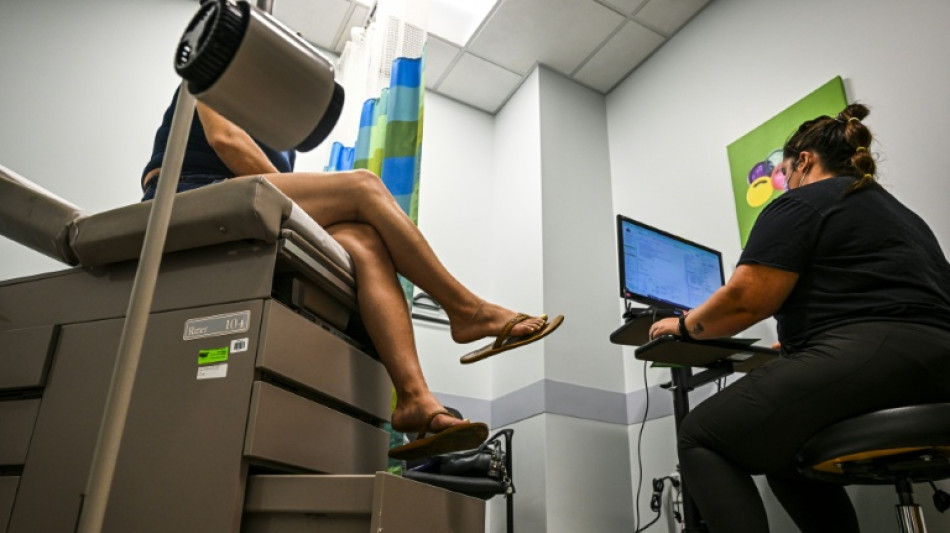
New study probes why chronic pain lasts longer in women / Photo: © AFP/File

 Messi inspires Argentina great escape over Egypt, Swiss advance

 US strikes Iran after Hormuz attacks, Tehran threatens response

 Djokovic wins five-hour epic to earn Sinner showdown at Wimbledon

 US strikes Iran after Hormuz tanker attacks: military

 Messi 'didn't want to go home' as Argentina comeback stuns Egypt

 Netflix strikes deals in short-form video push

 The height factor: how a small building survived Venezuela's quakes

 Egypt 'cheated' in controversial World Cup exit to Messi's Argentina, says Hassan

 Global AI industry falls short on safety, think tank warns

 'History made': Egyptian pride despite World Cup heartbreak

 How rescuers carried out 180-hour 'miracle' amid Venezuela's ruins

 Victorious Belgian footballers troll Trump with YMCA dance

 Scotland boss Townsend expects Russell will face Springboks

 Messi inspires Argentina great escape over Egypt

 Zverev, Cobolli targeting rematch at Wimbledon

 Colombia president-elect accuses outgoing leader of 'coup' plotting

 IOC eases restrictions on Russians before 2028 LA Games as anthem, flag ban remains

 Muchova ends Osaka run to reach Wimbledon semis

 Mexico probing if US violated sovereignty in 2024 drug lord capture

 Zverev reaches first Wimbledon quarter-final

 Nordic joy as Traeen takes yellow, Pedersen wins Tour de France 4th stage

 Electric Our Lady land: guitar made from burned Notre Dame wood

 Tanker attacks send oil higher, stocks hit by AI jitters

 IOC shuffle 2030 Winter Games events and promise gender parity

 Macron says Syria must not be destabilised after bombs wound 18

To all the women who've heard the frustrating "it's all in your head" in response to medical maladies, a new study out Friday feels your pain.
Research published in the journal Science Immunology shows that women actually do experience exacerbated chronic pain compared to men -- a gap that can be explained by biological differences in the immune system.
"The pain of women has been overlooked in clinical practice," lead author Geoffroy Laumet told AFP, "with the idea that it's more in the mind, or that it's because women are softer and more emotional."
"But here, our study shows that the difference is real... it's not a social construct. It has a real biological mechanism that is behind it."
Pain occurs when neurons react to stimuli: stubbing your toe, or tripping and skinning your knee, for example.
But chronic pain persists with mild to no stimulation -- and women constitute 60 to 70 percent of the patients experiencing it, Laumet said.
The scientist at Michigan State University said his team set out to explore how hormone-regulated immune cells, known as monocytes, impacted pain resolution.
Researchers learned those monocytes play a key role in communicating with the neurons that sense pain -- and then working to shut down those pain-sensing neurons by producing the anti-inflammatory interleukin 10, or IL-10.
Their studies weren't originally aimed at exploring potential differences related to sex, but the data was clear: it took longer for pain to resolve in female mice, and the monocytes producing IL-10 were less active in them.
Those cells are more active in males, according to the study, which cited higher levels of sex hormones like testosterone as an explanation why.
Laumet is hopeful the new research could open new doors to improved pain treatment.
In the long-term, he said research can probe how to stimulate the monocytes and boost IL-10 production to "enhance the body's ability to resolve pain."
And in the short-term, he sees the potential for topical testosterone to prove a viable option to alleviate localized suffering.
- 'More equitable care' -
Elora Midavaine -- a researcher at the University of California, San Francisco who also studies chronic pain -- told AFP the new study adds "important nuance" to how we understand the interactions of hormones and the immune system, and their influence on pain.
Midavaine, who was not involved in the study, said it fits into a broader movement focused on intersections of neuroscience with both immunology and endocrinology -- an approach she said "has potential to advance our understanding of chronic pain in women."
Laumet said he hopes that improved understanding and potential new treatment avenues could reduce prescriptions of opioid painkillers, which have high risks of side effects and addiction.
And more broadly, both researchers voiced optimism that as our knowledge of women's health improves, they will receive better treatment.
"I hope that we can contribute to erase this common idea that women's pain is exaggerated," Laumet said. "The standard of care should be adapted to the sex."
But why has it taken so long to begin understanding the bodies of half the population?
For decades women were excluded from clinical trials, and most pain studies analyzing animals only used males, Midavaine noted -- a medical bias that operated on the notion that female hormones created "too much variability."
Diagnosis of pain relies almost wholly on reporting from patients -- and the symptoms of women are "often interpreted as emotional or mood-driven rather than rooted in biology," Midavaine said.
But "the landscape is changing," Midavaine said. "As the science advances, I believe it will help shift outdated cultural beliefs and lead to more equitable care for women."
S.Gantenbein--VB