Israeli desert town aims to be medical 'cannabis capital' / Photo: ©

 UK set for cautious budget as borrowing costs climb
 Anthropic's record IPO faces some big questions
 US Fed expected to hold rates steady ahead of key midterm elections

 Can this Latin Grammy-winner help Democrats win back Congress?

 Tuvalu has 'limited' power to halt its fossil fuel investments: NZ govt papers seen by AFP
 Palestinian activist Khalil returns to Columbia after US detention

 Trump drastically loosens oil and gas methane rules
 French Senate weighs bill to make protesters pay for unrest damage
 'A very sad day': Arteta despair as Arsenal stunned by Fleetwood
 Charles tackles thorny legacy of slavery on Caribbean trip

 Former Grand Slam winner Wawrinka ends tennis career

 Brazil's Flavio Bolsonaro flees to US after election loss
 'Faerie' nights: 'ACOTAR' fans finally get their book

 American woman convicted of getting military training from Islamic State
 Israel opposition holds narrow edge over Netanyahu in first projections
 Floriani hits maiden goal as Lazio go top
 Trump set to drastically loosen oil and gas sector's methane rules

 Storied Paris department store seeks bankruptcy protection
 Xhaka, Embolo can return to Swiss squad after fake Covid docs affair
 Allegri suspended for two Serie A games after red card
 Flight data, satellite images reveal growing US role at Ecuador base
 McInnes feels 'guilt' ahead of Hearts return with Rangers

 Brazil's Lula turns 81, vows to work '24 hours a day'
 Boeing releases cautious growth plan as shares fall sharply
 Exiled Russian dissident Navalnaya warns dictators becoming 'more cunning'
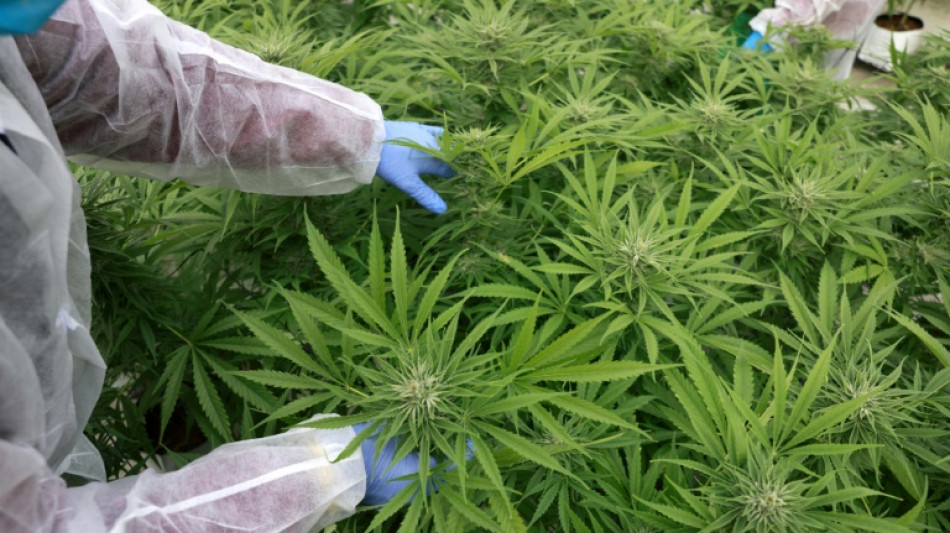
In Israel's Negev desert, far from the skyscrapers of Tel Aviv, the town of Yeruham hopes to cultivate an international reputation as the country's medical cannabis technology powerhouse.
Dozens of start-ups are already working on medical cannabis in Israel, where new legislation is expected to lead to further market growth in the fast-expanding sector.
Some believe that cannabis could help Yeruham tackle unemployment among its 12,000 residents, with initial efforts being led by a firm called CanNegev.
The company is known as an incubator, helping foster the growth of infant firms. CanNegev shelters four start-ups and is Israel's first medical cannabis technology incubator.
"We have decided to make medical cannabis the heart of our activity, here in Yeruham, one of the most peripheral towns in Israel -- a forgotten city," said CanNegev founder Zvi Bet Or.
He discovered a receptive audience in Tal Ohana, elected in 2018 to be Yeruham's first female mayor.
"My dream is to make Yeruham the capital of medical cannabis in Israel," Ohana told AFP.
"It's not every day that a new market is born" in the country, added Ohana, 37. "I told myself I have to do everything to be at the avant-garde of science and technology in this field."
CanNegev's modern building, facing the desert sands, stands out almost like a mirage, a symbol of the hoped-for future in the town whose stuccoed blocks of social housing were built in the 1950s for newly arrived immigrants.
But Yeruham is part of an economic priority zone that offers concessions to firms willing to set up there.
Ohana said the cannabis tech sector could transform the image of her town and help bring down its persistently higher-than-average unemployment, which is around eight percent.
"My goal is to create quality jobs" and to offer high incomes to attract a new population of workers, she said.
- World's leading importer -
Recreational use of cannabis is illegal though tolerated in Israel. However, authorities have encouraged its therapeutic use for the past decade to treat severe medical conditions and post-traumatic stress in former soldiers.
In October, Israel's parliament advanced a bill aimed at making medical cannabis more available.
It would expand a market that has already drawn scores of entrepreneurs including two former prime ministers: Ehud Olmert is business adviser to UNIVO Pharmaceuticals, and Ehud Barak chairs the board of InterCure.
About 100 start-ups are working on cannabis, said Dana Gourevich, Chief Technology Officer at the Israel Innovation Authority, adding that a quarter of those companies were founded in a single year, 2019.
"The medical cannabis ecosystem has received $60 million in investments in recent years," said Gourevich.
She said a key factor in developing Israel's homegrown cannabis industry was imports from overseas, especially Canada, where recreational use is legal.
According to health ministry data, Israel imported 22 tonnes of medical cannabis in 2021 compared to just over 14 tonnes a year before, making it the world's largest importer, the Israeli Cannabis Magazine noted.
By contrast, exporting cannabis is legal in theory but faces significant hurdles complying with international standards, Gourevich said.
- CBD for all -
The health ministry recently indicated it was examining the possibility of removing cannabidiol (CBD) from the list of dangerous drugs. The measure could open a new arena for companies to market CBD products at scale.
In southern Israel, near the city of Ashdod, BOL Pharma grows 400,000 cannabis plants annually on 3.5 hectares (8.6 acres), exclusively for therapeutic use.
"About 110,000 patients have (medical cannabis) licences today in Israel, but when CBD becomes available to everyone, millions of people, families, will be able to use it in cosmetics and everyday products," said Dvir Taler, 50, director of agriculture at BOL Pharma.
The company, currently the largest in the field of medical cannabis in Israel, partnered with the CanNegev incubator and supplies it with cannabis flowers for scientific experiments.
Taler said the incubator is developing a robot capable of autonomously harvesting flowers.
In its drive to become Israel's hub for green gold, the municipality of Yeruham has also allocated 50 hectares for the cultivation of medical cannabis, arguing that the desert climate is ideal for the crop's cultivation.
The user of that plot has not yet been determined.
Agreements have also been reached for two factories manufacturing non-medical cannabis products -- "self-care" goods such as oils used for cosmetics -- to be set up in Yeruham in the coming years, Ohana, the mayor said.
Resident Avraham Elbaz, 67, a retiree, said that "of course" he was in favour of these factories, which would help create jobs -- though he had not tried cannabis before.
"I have never smoked," he said.
W.Lapointe--BTB