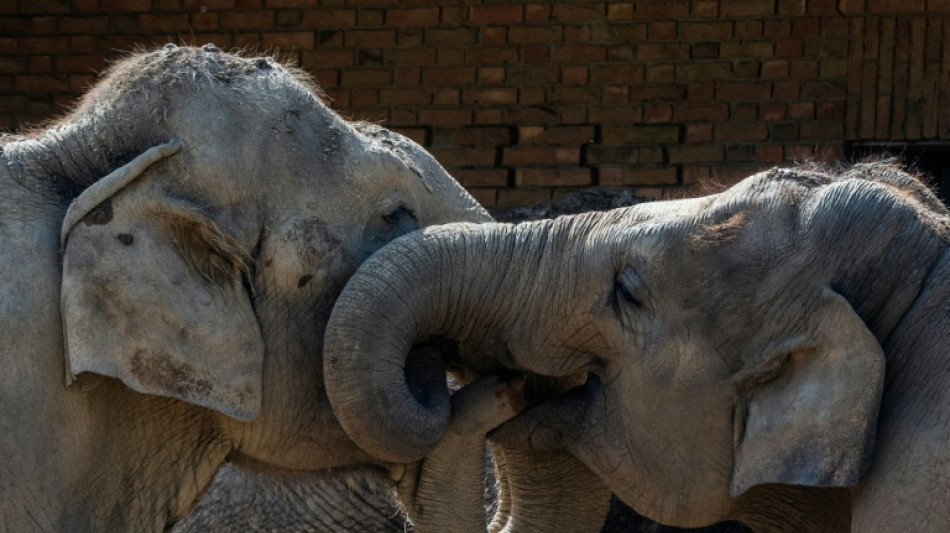
The secret to an elephant's grace? Whiskers / Photo: © AFP

 US launches new strikes on Iran after Trump vows to hit 'hard'

 Taylor Swift fans pay $25 for garbage from outside wedding

 After quakes, Venezuelans fear losing damaged homes

 PSG's Lee set to join Athletico

 Erdogan gave pistols to NATO leaders, Starmer says

 Nocera Expands Diversified Technology Strategy With Binding Agreement to Acquire an Equity Interest in INERGX, an Integrated Energy Storage and Power Platform for AI, Defense and Mission-Critical Demand

 China sends nuclear missile message as US looks elsewhere

 Justin Bieber added to 11-minute World Cup final halftime show

 Fery targets Wimbledon final birthday present after royal seal of approval

 Egypt file complaint against referee after World Cup exit

 Women's semi-finalists in uncharted territory at Wimbledon

 US man jailed after swapping 17th century manuscript

 UN maritime head urges halt to Hormuz transit to protect seafarers

 Trump skips new Air Force One on return from Turkey NATO summit

 New York building that buckled now 'stable,' says mayor

 UN says pledges for global connectivity project pass $100 bn

 McIlroy hoping for 'home' comforts at Scottish, British Opens

 Noskova aims to emulate Kvitova after reaching first Wimbledon semi

 Britain's Fery becomes first wildcard to reach Wimbledon semis in 25 years

 Korda chases third major as Kim revisits Evian-winning chip

 Kooij wins Tour de France 5th stage in chaotic sprint finish

 Trump says Ukraine can make Patriot missiles

 Teenager arrested after two girls wounded in Germany school attack

 Farage vs Count Binface: hard-right leader's UK poll gambit

 Hong Kong's Robert Wun: the bold Millennial conquering Haute Couture

An elephant's trunk can surpass a human's height and lift trees -- a marvel of strength that's conversely so gentle it can grasp a tortilla chip without breaking it.
So how do the thick-skinned animals with poor eyesight pull off such delicate tasks? In a word, whiskers.
New research published Thursday in the journal Science details how the whiskers that cover an elephant's trunk have unique properties that lend the largest land mammals remarkable dexterity.
Elephants are born with about 1,000 of these bristles, lead author Andrew Schulz told AFP, many of them anchored in the trunk's wrinkles to act like feelers and help the animals assess their surroundings.
A team of engineers, materials scientists and neuroscientists analyzed the geometry, porosity and material properties of these whiskers, and expected them to mimic the whiskers found on mice or rats -- circular at a cross-section, solid and uniformly stiff.
In fact, elephant whiskers are almost blade-like, with a porous architecture similar to sheep horns, which helps with shock absorption while eating.
And a gradiated shape and structure from base to tip allows for an amplified sense of touch, Schulz said.
"The craziest finding that we had, I think, was that these whiskers have this transition from a really, really rigid base to a very, very soft tip," said the researcher at the Max Planck Institute for Intelligent Systems in Stuttgart, Germany.
Part of elephants' whisker evolution is to prevent breakage, said Schulz. Unlike most mammals with whiskers, those of elephants don't grow back.
- Elephant-inspired advances -
Many animals have sensory hairs that can act as a radar, but few quite so precise as the elephant's.
Schulz said a rat's whiskers, for example, also picks up vibrations -- but it's akin to smashing down a handful of keys on a piano.
To an elephant's whiskers, it's more like hitting specific notes.
Researchers voiced excitement that cat whiskers have a similar kind of material intelligence and stiffness gradient.
The elephant's gradiated structure can help with things like object differentiation while foraging and eating -- which they spend the vast majority of their time doing.
Elephants are also well-documented using their trunks for social touch -- "they're using the outside of their trunk," Schulz said, "so they're using those portions that are covered in the whiskers."
Caitlin O'Connell-Rodwell -- a behavioral ecologist and elephant expert who has focused on how the giant mammals communicate and detect signals through their feet -- called the findings "fascinating."
"This is really exciting for me to see just more affirmation of how sensitive their trunks really are," she told AFP.
"There's some really interesting, intriguing thoughts for the next steps, for what one could ask in terms of the behavioral application of this," O'Connell-Rodwell said.
"Not only would this allow them to say, reach up into a tree and feel around for fruit or a seed pod with better agility, but it also has implications for communication."
There's also a wealth of technological possibilities elephant whiskers could inspire, not least when it comes to robotics, Schulz said.
And "part of the novelty of this work is functional gradients exist everywhere in biology," the researcher said.
The stiff base-to-soft tip structure also appears in rotator cuffs or ACL ligaments, he said for example -- and better understanding those structures and how they might impact sensing could perhaps allow for improved repair techniques.
T.Germann--VB