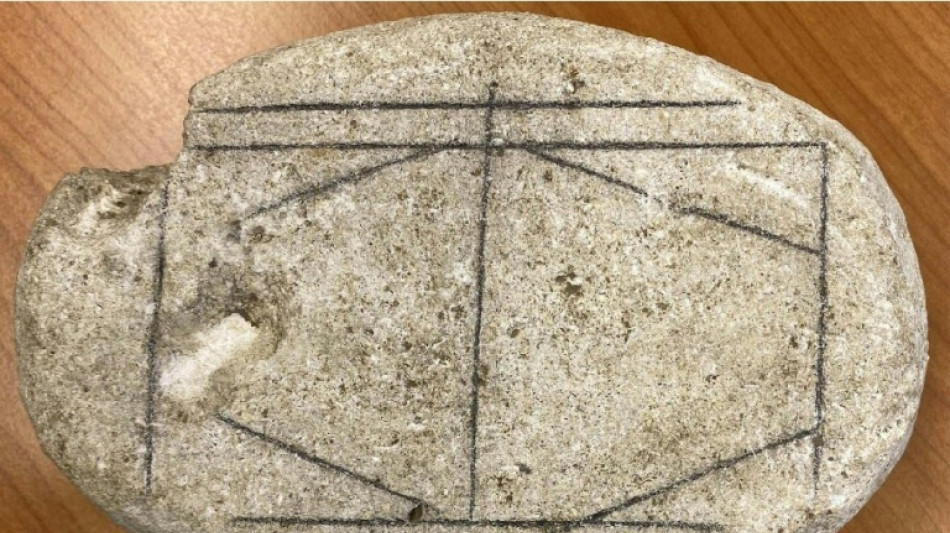
AI cracks Roman-era board game / Photo: © Antiquity/AFP

 Fashion's mystery man Margiela sells off his archives

 Nuclear test-scarred Marshall Islands criticises China missile

 Chip titan SK hynix to set price for mega US listing

 Crude extends rally as US-Iran flare-up rocks peace hopes

 Democrat accused of rape exits key US Senate race

 Japan student Ito keeps place against Ireland as Jones returns

 Belgium bid to crack Spain's ironclad defence in World Cup quarter-final

 US man sentenced after swapping 17th century manuscript

 US launches new strikes on Iran after Trump vows to hit 'hard'

 Taylor Swift fans pay $25 for garbage from outside wedding

 After quakes, Venezuelans fear losing damaged homes

 PSG's Lee set to join Athletico

 Erdogan gave pistols to NATO leaders, Starmer says

 Nocera Expands Diversified Technology Strategy With Binding Agreement to Acquire an Equity Interest in INERGX, an Integrated Energy Storage and Power Platform for AI, Defense and Mission-Critical Demand
 China sends nuclear missile message as US looks elsewhere

 Justin Bieber added to 11-minute World Cup final halftime show

 Fery targets Wimbledon final birthday present after royal seal of approval

 Egypt file complaint against referee after World Cup exit

 Women's semi-finalists in uncharted territory at Wimbledon

 US man jailed after swapping 17th century manuscript

 UN maritime head urges halt to Hormuz transit to protect seafarers

 Trump skips new Air Force One on return from Turkey NATO summit

 New York building that buckled now 'stable,' says mayor

 UN says pledges for global connectivity project pass $100 bn

 McIlroy hoping for 'home' comforts at Scottish, British Opens

A smooth, white stone dating from the Roman era and unearthed in the Netherlands has long baffled researchers.
Now with the help of artificial intelligence, scientists believe they have cracked the mystery: the stone is an ancient board game and they have even guessed the rules.
The circular piece of limestone has diagonal and straight lines cut into it.
Using 3D imaging, scientists discovered some lines were deeper than others, suggesting pieces were moved along them, some more than others.
"We can see wear along the lines on the stone, exactly where you would slide a piece," said Walter Crist, an archaeologist at Leiden University who specialises in ancient games.
Other researchers at Maastricht University then used an artificial intelligence programme that can deduce the rules to ancient games.
They trained this AI, baptised Ludii, with the rules of about 100 ancient games from the same area as the Roman stone.
The computer "produced dozens of possible rule sets. It then played the game against itself and identified a few variants that are enjoyable for humans to play," said Dennis Soemers, from Maastricht University.
They then cross-checked the possible rules with the wear on the stone to uncover the most likely set of movements in the game.
However, Soemers also sounded a note of caution.
"If you present Ludii with a line pattern like the one on the stone, it will always find game rules. Therefore, we cannot be sure that the Romans played it in precisely that way," he said.
The aim of the "deceptively simple but thrilling strategy game" was to hunt and trap the opponent's pieces in as few moves as possible.
The research and the possible rules were published in the journal Antiquity.
D.Schaer--VB