Laughing about science more important than ever: Ig Nobel founder / Photo: © afp.com/File

 Japan outlaws flag desecration despite critics

 From coal pits to wind turbines, Polish miners rise to the occasion

 Opposition to data centres grows in cramped urban Japan

 Japan imperial rules tweaked, but still no woman emperor
 China's Xi says AI should not be dominated by one country

 India's space sector takes off as private rocket readies launch

 Taiwan lawmakers to remove legal hurdles for Starlink to operate

 Tokyo, Taipei lead tech losses as Asian markets suffer again

 Ireland to attack at All Blacks' Eden Park stronghold

 Australia protests Laos response to 2024 tainted alcohol deaths

 'Blessed town' on Venezuelan coast escapes quake damage

 Buried in 1967 quake, Venezuelan now scrambles to help new victims

 UK Labour party to crown Burnham as leader and next PM

 Hazardous Canadian wildfire smoke choking millions in US

 SpaceX abruptly scrubs Starship test flight

 Giannis: Miami offers best path to another NBA title

 Lewandowski MLS debut match postponed by air quality concern
 McIlroy laments 'stupid mistakes' but retains British Open hope

 Argentina footballers 'inspire' Contepomi's Pumas before England Test

 Root's 99 not out sees England to ODI series-levelling win over India
 Suber the shock leader of British Open as McIlroy faces cut battle

 Trump suspends teleprompter operator over betting allegations

 Morocco back coach Ouahbi after World Cup exit

 France, England prepare for gloomy World Cup send-off

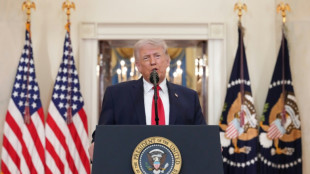 Trump speech to focus on election 'integrity'

With science increasingly coming under attack, using humour as a way to get people interested in scientific research is more important than ever, the founder of the satirical Ig Nobel prizes said.
But not to be too serious, AFP's interview with the founder Marc Abrahams also included a callout for public donations of pubic lice -- and the sudden, unexpected appearance of a taxidermy duck.
Since 1991, the Ig Nobel prizes have celebrated the sillier side of science, handing out awards -- and 10-trillion-Zimbabwean-dollar notes -- at often-raucous ceremonies in Boston every year for genuine research projects that inadvertently have an absurd side.
The research "has to make people laugh and then think", explained Abrahams, who is also the editor of the Annals of Improbable Research magazine which organises the prizes.
As the serious Nobel prizes were awarded in Stockholm this week, several events were held in Paris featuring Ig Nobel laureates presenting their work while paper airplanes rained down -- a long-running Ig Nobel gag.
Among those speaking were French physicist Marc-Antoine Fardin, who investigated whether cats can be both solids and liquids, and Italy's Daniel Maria Busiello for his research about avoiding clumpiness while making the iconic Italian pasta dish cacio e pepe.
"If you're laughing at something, you are paying attention," Abrahams said.
The idea of the Ig Nobels is to capture a person's attention -- even if just for three seconds, he said. Then maybe when they are telling their friends about it later they might realise it is actually "really interesting".
- Science 'threatened and destroyed' -
At a time when scientific research is being "threatened and actively destroyed", particularly under the administration of US President Donald Trump, many people "have been telling us that now what we're doing has become much more important", Abrahams said.
Several of this year's prize winners decided not to attend the ceremony in September out of concern about travelling to the US under Trump, the mathematician added.
At first some scientists were suspicious of the gag prize, but the Ig Nobels have now become something of an institution -- few refuse the honour, Abrahams said.
There is little antagonism with the real Nobel prizes. In fact, Nobel laureates hand out Ig Nobels every year -- often wearing funny hats. One of them, British physicist Andre Geim, has even won both prizes.
Each year's 10 winners are chosen from thousands of nominees sent into Abrahams.
An increasing number -- over 10 percent -- are researchers nominating themselves. "They almost never win," Abrahams said.
Indeed, the phone call when he tells scientists they have won is often "the first moment any of them realised that what they had done is funny", he said with a laugh.
- Pubic lice needed -
Dutch biologist and Ig Nobel laureate Kees Moeliker said the prizes award scientists for doing their job: being curious, discovering what is happening, then publishing what they found.
For example, Moeliker's prize-winning research -- the first documented case of homosexual necrophilia in a mallard -- started when an unlucky duck crashed into his office window.
At this point in the interview, Moeliker pulled the duck in question -- which is now stuffed -- out of his bag, prompting the waiter at the restaurant to ask whether it was real.
When the waiter was gone, Moeliker said: "I have a little request."
He is looking for some pubic lice, and is hoping AFP's readers can help.
The insect's numbers are thought to be dwindling because of the modern tendency to trim pubic hair, Moeliker said, comparing the phenomenon to how deforestation has threatened pandas.
But he needs more samples to research the subject, so he is asking the public to send any specimens they have to the Natural History Museum in Rotterdam. One helpful person has already sent in lice sticky-taped to the back of a postcard.
But it might not be all bad news for pubic lice.
"I've heard stories from people in the fashion industry that pubic hair is coming back," Moeliker said.
K.Hofmann--VB