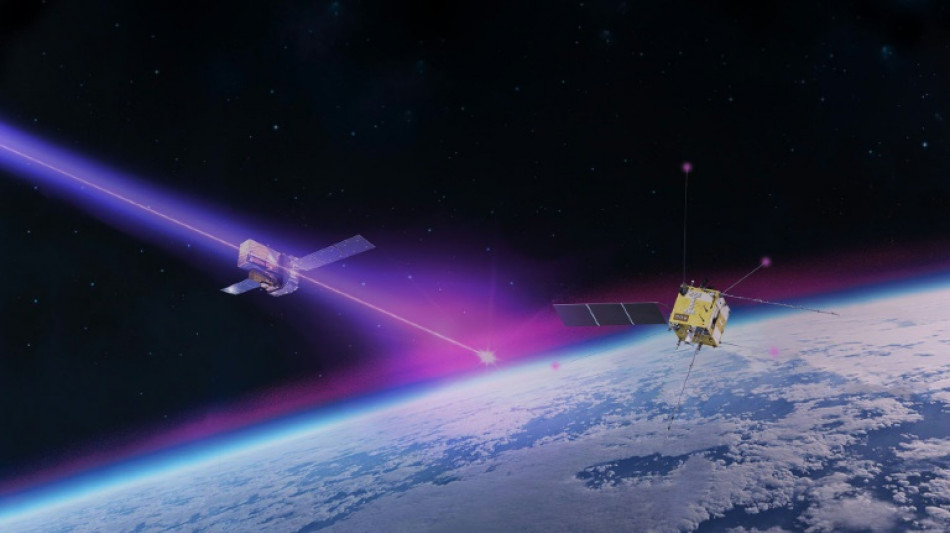
Astronomers detect cosmic flash from early universe star blast / Photo: © ESA/ATG Europe/AFP/File

 China landslide kills 8, at least 34 missing: officials

 France blocks access to Polymarket

 Warholm eyes win in London stadium that kickstarted his career

 Herbert takes British Open lead, equals major history with 62 alongside Burns

 Verstappen back on top in opening practice at Belgian Grand Prix

 MEXC Adds Five Ondo Tokenized Stocks Spanning Semiconductors to Power Infrastructure

 Polish president vetoes civil partnerships bill

 Stocks slide, oil prices jump as tech, Mideast war in focus

 Neutral games needed at Nations Championship, says official

 Herbert's record front nine snatches British Open lead

 Pakistan pressures Afghans in border province to leave

 Lucu urges France to keep heads in steamy Tokyo

 Australian cyclist Dennis admits driving while disqualified

 Root says England 'learning on the job' in ODIs after 99 no against India

 China's Moonshot AI chases 'DeepSeek moment' with much-hyped model

 With climate ambitions in question, EU reforms carbon market

 Wilson keen to continue Wallabies captaincy as Schmidt era ends

 Women sand miners toil stripped Cape Verde beach
 Startups bet on AI -- and a leaner future
 Tokyo, Taipei lead heavy losses as Asian markets suffer fresh tech rout

 Fact Check: Trump's primetime speech rehashing election claims

 Defence and minerals: inside Pakistan's lobbying push in Washington
 Trump revives election fraud claims ahead of US midterms
 India's private space industry shoots for the stars

 Trump revives sprawling election fraud claims in address to nation

An immensely powerful flash detected earlier this year was created by a massive star exploding when the universe was just five percent of its current age, astronomers said Tuesday.
The flash was spotted on March 14 by a French-Chinese space telescope called SVOM, which launched last year on a mission to track gamma-ray bursts, the brightest and most powerful explosions in the cosmos.
When the young scientists working on the mission for France's Atomic Energy Commission (CEA) received a mobile phone alert that a major burst had arrived at Earth, they urged other telescopes to turn towards the source.
It came from a star around a hundred times bigger than our Sun that exploded 700 million years after the Big Bang, according to two studies published in the Astronomy & Astrophysics journal.
"This is extremely rare -- it's the fifth most distant gamma-ray burst ever detected," said Bertrand Cordier, the CEA's scientific lead for SVOM and a co-author of both studies.
"The photons that reached our instruments travelled for 13 billion years" to reach Earth, he told AFP.
The detection of the burst, which lasted tens of seconds, is also "the most precise in terms of the light we collected and the measurements we made," he added.
- Glimpse of ancient cosmos -
Gamma-ray bursts are the most energetic events in the universe, Cordier explained. They are thought to be caused by cataclysmic cosmic events such as massive stars going supernova or when binary neutron stars merge.
These flashes can release as much energy in a few seconds as our Sun will emit during its 10-billion-year life.
They shoot out matter at "speeds close to the speed of light", creating conditions impossible to reproduce on Earth, Cordier said.
These bright flashes also act as "probes" of the cosmos, illuminating all the matter they pass through before finally reaching us, he added.
This allows scientists a rare glimpse into the distant past of the universe, which is 13.8 billion years old.
The gamma-ray burst in March, called GRB250314A, was created by an explosion during the first generation of stars formed after the Big Bang.
These stars produced the first heavy elements -- such as iron, carbon and oxygen -- which played a fundamental role in the evolution of the universe.
Cordier hopes SVOM will be able to detect one or two similar events every year.
"The challenge is to get everything together in the chain" of observations which involves other telescopes, he said.
For example, after the burst was first detected in March, it took 17 hours before the Very Large Telescope in Chile turned its powerful lens towards the flash.
"During that time, the intensity had decreased," Cordier said.
"If we get there earlier, then we'll have better data."
H.Gerber--VB