In Turkey, ancient carved faces shed new light on Neolithic society
/ Photo: © AFP

 From Maradona to Messi: Bangladesh's enduring love for Argentina
 UN to list more sites as 'in danger' from conflict or climate change

 Egypt's 'Garbage City' recyclers reap gains from Iran war plastic squeeze

 Spain, Argentina prepare for World Cup final, Trump hails success
 Supplies run dry in Venezuelan village on edge of quake zone

 Latin America's unlikely football unity: cheering against Argentina

 Aston Villa sign Swiss World Cup star Manzambi

 Trump questions England's World Cup tactics

 Spain captain Rodri preparing for 'physical' Argentina battle

 Leather jacket worn by Nvidia CEO Jensen Huang auctions for nearly $1 mn

 Leader Herbert, Burns equal record 62 at British Open, DeChambeau docked two shots

 Yankees' Judge improving, but not ready for baseball activities

 None shall pass: Spain's defence ready to thwart Messi in World Cup final

 China's Kimi K3 rattles US AI industry

 Herbert takes Open lead, equals Burns' round of 62

 'Great innings ends': Cricket mourns West Indies great Sobers

 Fickle winds whip up huge Spanish wildfire
 US links Taco Bell lettuce to diarrhea-causing parasite outbreak

 Strong quake hits southern Mexico, tsunami alert lifted
 Deschamps set for bittersweet ending to France reign as Zidane waits

 German lawmaker faces criticism for US surrogacy to have a child

 Southern Mexico hit by 7.3 quake, triggering tsunami alert

 Germany defender Gosens signs with Schalke

 Nigerian court dismisses suit challenging Shell's divestment

 Ex-president Sall arrives back in Senegal for meeting with successor

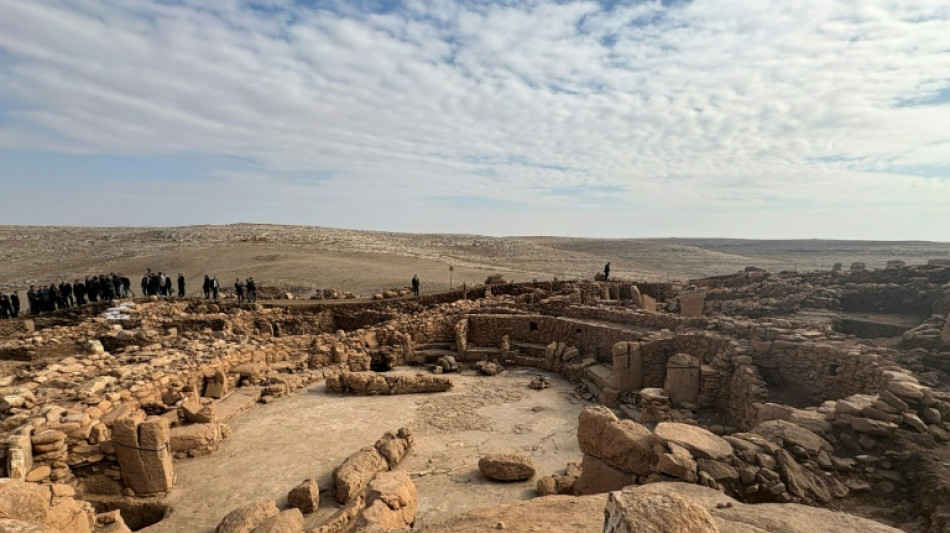
On the windswept hills overlooking Turkey's vast southeastern plains, new archaeological discoveries are revealing how life might have looked 11,000 years ago when the world's earliest communities began to emerge.
The latest finds -- a stone figurine with stitched lips, carved stone faces and a black serpentinite bead with expressive faces on both sides -- offer clues about Neolithic beliefs and rituals.
"The growing number of human sculptures can be read as a direct outcome of settled life," Necmi Karul, the archaeologist leading the dig at Karahan Tepe, told AFP.
"As communities became more sedentary, people gradually distanced themselves from nature and placed the human figure and the human experience at the centre of the universe," he said, pointing to a human face carved onto a T-shaped pillar.
The excavation is part of Turkey's "Stone Hills" project, a government-backed initiative launched in 2020 across 12 sites in Sanliurfa province, which Culture Minister Nuri Ersoy has described as "the world's Neolithic capital".
The project includes the UNESCO heritage site Gobekli Tepe -- "Potbelly Hill" in Turkish -- which is home to the oldest known megalithic structures in Upper Mesopotamia, where the late German archaeologist Klaus Schmidt began excavations in 1995.
- 'A glimpse into someone's life' -
Explaining some of the new finds on display at Karahan Tepe's visitor centre, Lee Clare of the German Archaeology Institute says they challenge long-held narratives about humanity's shift from nomadic hunter-gatherer life to early settlements.
"Every building we study gives us a small glimpse into someone's life. Every layer we excavate brings us closer to an individual -- we can almost touch that person, through their bones. We're gaining insights into their belief systems," he said.
The past five years have yielded "a wonderful amount of data coming out of all these new sites," the archaeologist told AFP.
But it was impossible to know everything. "We don't have any written records, obviously, because it's prehistory," said Clare, who has worked at Gobekli Tepe since 2013.
Identifying who the statues or figurines represented was probably impossible, given they dated back to "a period before writing, around 10,000 years ago", said Karul, who is also leading the dig at Gobekli Tepe and coordinator of the Stone Hills project.
"But as the number of such finds increases and as we learn more about the contexts in which they appear, we gain the opportunity to conduct statistical analyses and make meaningful comparisons."
- 'Highly organised society' -
The settlements began to appear after the last Ice Age, he said.
"The changing environment created fertile conditions, allowing people to feed themselves without constantly going hunting. This, in turn, supported population growth and encouraged the development and expansion of permanent settlements in the area."
As communities started to settle, new social dynamics emerged, Clare said.
"Once people produced surplus, they got rich and poor," he said, indicating the first hints of social hierarchy.
"What we see here is the beginning of that process. In many ways, we are on a slippery slope that leads toward the modern world."
As the excavations progress, they will transform understanding of the Neolithic, with each site earning its own place in scientific history, says Emre Guldogan of Istanbul University, lead archaeologist at the nearby Sefer Tepe site.
"Karahan Tepe and the wider Stone Hills project show a highly organised society with its own symbolic world and belief structures" overturning earlier ideas of a "primitive" Neolithic world, he said.
"These communities shared traits but also developed clear cultural differences," he said.
At Karahan Tepe, human symbolism is widely seen whereas in Gobekli Tepe, animal imagery is more dominant.
Archaeologists say findings at both sites show each community depicting their living environments in different ways.
"Each new discovery raises fresh questions aimed at understanding the people behind these creations," Guldogan said.
The recent archaeological discoveries have also broadened the appeal of a region known primarily as the place where Abraham once settled, a figure revered in Judaism, Christianity and Islam.
"Before the excavations began at Karahan Tepe and other sites, the area mainly attracted religious tour groups, drawn largely by its association with the prophet Abraham," tourist guide Yakup Bedlek said.
"With the emergence of new archaeological zones, a more varied mix of tourists are visiting the region."
C.Bruderer--VB