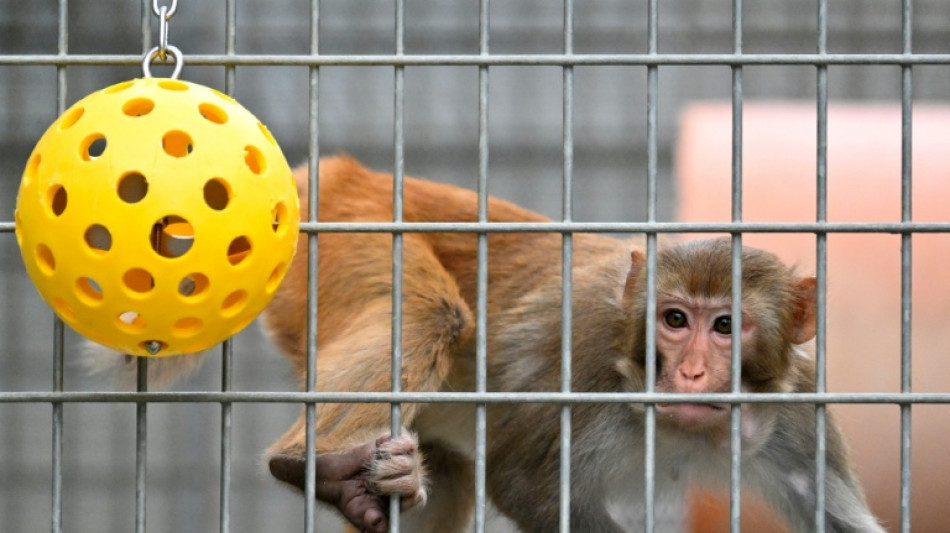
US medical agency will scale back testing on monkeys / Photo: © AFP/File

 Madonna, Cruise lead A-list stars at World Cup final

 Pogacar wins Tour de France 14th stage to extend overall lead

 Britain's Kerr sets new world record in men's mile

 Botswana says 'alarming rise' in citizens lured to Russia's war

 Brazil high court says Argentina's Milei cannot visit Bolsonaro

 Brook urges England to follow ever-green Root's example

 Jones says Japan making 'good progress' despite France defeat

 Galthie hails France 'energy and commitment' after Japan rout

 German lawmaker steps down over surrogate pregnancy controversy: party sources to AFP

 Ireland 'never really got going' against All Blacks, says Farrell

 Rennie hails 'clinical' All Blacks after 40-21 win over Ireland

 Laos says cannot determine cause of tourist deaths linked to tainted alcohol

 Six-try All Blacks see off Ireland at Eden Park fortress

 From Maradona to Messi: Bangladesh's enduring love for Argentina

 UN to list more sites as 'in danger' from conflict or climate change

 Egypt's 'Garbage City' recyclers reap gains from Iran war plastic squeeze

 Spain, Argentina prepare for World Cup final, Trump hails success

 Supplies run dry in Venezuelan village on edge of quake zone

 Latin America's unlikely football unity: cheering against Argentina

 Aston Villa sign Swiss World Cup star Manzambi

 Trump questions England's World Cup tactics

 Spain captain Rodri preparing for 'physical' Argentina battle

 Leather jacket worn by Nvidia CEO Jensen Huang auctions for nearly $1 mn

 Leader Herbert, Burns equal record 62 at British Open, DeChambeau docked two shots

 Yankees' Judge improving, but not ready for baseball activities

The United States will scale back certain drug-safety testing requirements on monkeys, federal regulators said Tuesday, marking the latest step by President Donald Trump's administration to limit the use of animals in research.
Under new draft guidance from the Food and Drug Administration, computer models, lab-grown mini-organs, and human studies will replace the use of non-human primates in testing monoclonal antibodies -- lab-engineered proteins used to treat cancers, autoimmune conditions and other diseases.
"We are delivering on our roadmap commitment to eliminate animal testing requirements in drug evaluation and our promise to accelerate cures and meaningful treatments for Americans," FDA Commissioner Marty Makary said in a statement.
The statement added that typical nonclinical programs involving monoclonal antibodies could include more than 100 macaque monkeys -- apes are no longer used in any invasive research in the US -- yet often do not yield human-approved treatments.
The move was welcomed by animal-advocacy groups.
Zaher Nahle, a former animal researcher who is now the senior scientific advisor for nonprofit Center for a Humane Economy, told AFP the move was an "important step."
"These primates are not reliable in terms of predicting the toxicity, so you can get at least equal or better results in terms of your accuracy in predicting toxicology using other approaches," he added.
What's more, he noted, studies show that more than 90 percent of drugs deemed safe and effective in animals fail to win approval for human use.
The FDA's announcement follows a report in the journal Science last month that the Centers for Disease Control and Prevention would close its primate labs.
It "moves us one step closer to wiping out the federal government's wasteful monkey business," Justin Goodman of White Coat Waste Project told AFP.
But the National Institutes of Health -- the country's primary biomedical research agency -- remains a notable "outlier," he added. According to public data, 7,700 primates are confined in federal government labs and breeding facilities, of which 6,700 are at NIH.
Advocates of animal research have pushed back.
"Poorly planned transitions -- including premature study termination -- can place animals at serious risk and may undermine years of scientific investment intended to strengthen public health preparedness and advance lifesaving medical progress," advocacy group Americans for Medical Progress said after the CDC news was reported.
Proponents of animal testing say the research has been indispensable for major medical advances, including vaccines for diphtheria, yellow fever, measles and Covid-19.
Critics counter that decades-old laws have created regulatory lock-in, that publication incentives reward animal studies in top journals, and that a lucrative "animal-industrial complex" has helped entrench the status quo.
K.Hofmann--VB