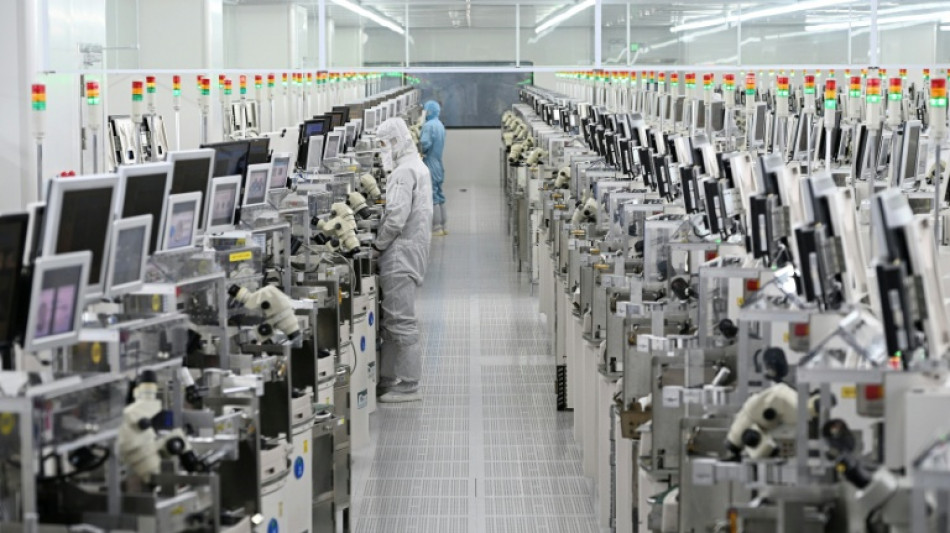
Memory chip crunch set to drive up smartphone prices / Photo: © AFP

 Tesla shares fall as Musk touts ambitious -- and costly -- plans

 Houthis claim Red Sea tanker strikes as US hits Iran again

 Wildfires ravage parts of southern France, Italy and Spain

 Alphabet beats expectations in second quarter, cloud revenue nearly doubles
 Trump threatens Iran infrastructure, Tehran vows 'eye for eye'

 US teen withdraws lawsuit against Meta over social media addiction

 Lebanon PM says Beirut working for 'complete Israeli withdrawal'

 EU conditionally clears Paramount bid for Warner Bros.

 Philipsen snaps 'horrible' drought with Tour de France stage 17 victory

 US trial of Venezuela's Maduro set for June 2027

 New UK PM Burnham gets early boost as inflation dips

 Samsung launches new, more expensive foldable smartphones

 Philipsen ends 'horrible' drought with Tour de France 17th stage victory

 Hungary's Orban says graft case is 'pretext' to target his party

 South African tycoon Motsepe rules out presidential bid

 Trump threatens Iran bridges, power as payback for Hormuz attacks

 Germany's Merz replaces leader ousted over surrogacy row

 CAF chief Motsepe backs Infantino despite criticism

 Evacuees from Spain's wildfire struggle with scale of devastation

 Ancient Lebanese city of Tyre added to heritage danger list

 Extreme heatwave grips Tunisia as wide power cuts fuel frustration

 'Beautiful game' provides Venezuelans with welcome distraction in wake of tragedy

 Oil prices surge on Mideast war, stock markets diverge

 Fury says 'best yet to come' ahead of Thailand fight

 Japan suffers heat 'disaster as cities hit by 'cruelly hot' days

Shoppers could face higher prices for phones, laptops and other gadgets next year, manufacturers and analysts warn, as AI data centres hoover up memory chips used in consumer electronics.
The world's biggest tech companies are ploughing head-spinningly huge sums into building the hardware that powers artificial intelligence tools like ChatGPT.
Their insatiable demand is snarling up a supply chain kept tight on purpose by chipmakers who are keen to avoid price drops that dent profits, experts say.
In 2026, supply chain pressure for memory chips "will be far greater than this year", Lu Weibing, president of Chinese electronics giant Xiaomi, said this week.
"Everyone will likely observe that retail prices for products will see a significant increase," he told an earnings call.
William Keating, head of semiconductor and tech consulting firm Ingenuity, expects the same.
"All companies that manufacture PCs, smartphones, servers etc will be impacted by the shortage," Keating told AFP.
"End result: consumers will pay more."
In high demand are key chips known as DRAM and storage components called NAND, which are found in everyday gadgets but are also needed to help process the vast amounts of data crunched by generative AI.
That's driving up memory chip prices, which in turn is turbocharging revenue for the firms that produce them such as South Korea's Samsung and SK hynix, and Micron and SanDisk in the United States.
"AI-related server demand keeps growing, and this demand significantly exceeds industry supply," Kim Jae-june of Samsung Electronics said last month.
- 'Keep prices high' -
Samsung said Sunday that it plans to build a new semiconductor plant in South Korea to meet the soaring demand, while SK hynix recently reported its best-ever quarterly performance, "driven by the full-scale rise in prices of DRAM and NAND".
Industry analysts TrendForce have lowered their 2026 global production forecasts for smartphones and notebook laptops.
"The memory industry has begun a robust upward pricing cycle," which "forces downstream brands to hike retail prices," TrendForce said.
Cars may also be affected, although Keating noted that a smaller portion of their tech relies on memory chips.
Last week China's largest contract chipmaker SMIC said customers were hesitant to place orders owing to uncertainty over how many phones, cars, or other products the memory chip industry can supply.
The cause of the shortage is two-fold.
AI-driven demand is greater than anticipated, but memory chip makers have also been "drastically cutting" spending on expanding capacity in recent years, Keating explained.
"Keep capacity tight, keep prices high is basically their mantra," he said.
"They've done this deliberately to ensure that there's no repeat of the most recent memory price collapse, which cost the memory makers tens of billions in losses."
Price jumps for memory chips "are huge and the trend is continuing", said Stephen Wu, founder of the Carthage Capital investment fund.
"Consumers and enterprises should expect higher memory prices, longer lead times, and more take-or-pay contracts through at least early 2026," Wu said.
burs-kaf/dan
R.Fischer--VB