Japan ex-PM Murayama, famous for WW2 apology, dies aged 101 / Photo: © AFP

 Trump family project in Albania has already caused 'irreparable' damage: NGOs

 Bollywood blast master keeps it real with fire and fury

 Tearful fights, edible offerings: A glimpse into the Maradona trial

 What's the deal with peptides? The hyped market under US review
 Tesla shares fall as Musk touts ambitious -- and costly -- plans

 Houthis claim Red Sea tanker strikes as US hits Iran again

 Wildfires ravage parts of southern France, Italy and Spain
 Alphabet beats expectations in second quarter, cloud revenue nearly doubles

 Trump threatens Iran infrastructure, Tehran vows 'eye for eye'

 US teen withdraws lawsuit against Meta over social media addiction

 Lebanon PM says Beirut working for 'complete Israeli withdrawal'

 EU conditionally clears Paramount bid for Warner Bros.

 Philipsen snaps 'horrible' drought with Tour de France stage 17 victory

 US trial of Venezuela's Maduro set for June 2027

 New UK PM Burnham gets early boost as inflation dips

 Samsung launches new, more expensive foldable smartphones

 Philipsen ends 'horrible' drought with Tour de France 17th stage victory

 Hungary's Orban says graft case is 'pretext' to target his party

 South African tycoon Motsepe rules out presidential bid

 Trump threatens Iran bridges, power as payback for Hormuz attacks

 Germany's Merz replaces leader ousted over surrogacy row
 CAF chief Motsepe backs Infantino despite criticism

 Evacuees from Spain's wildfire struggle with scale of devastation

 Ancient Lebanese city of Tyre added to heritage danger list

 Extreme heatwave grips Tunisia as wide power cuts fuel frustration

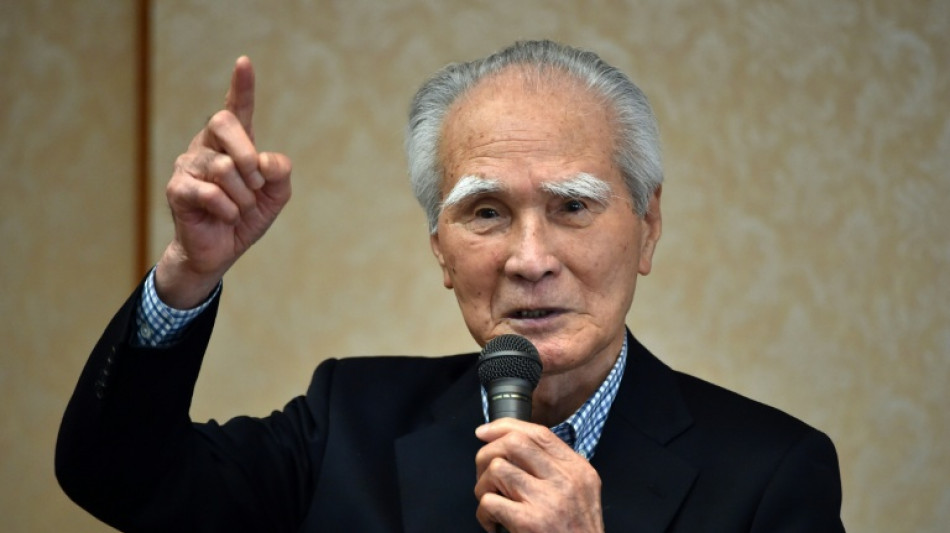
Japan's former prime minister Tomiichi Murayama, best known for making a statement apologising over World War II, died Friday aged 101, officials said.
Murayama issued the 1995 proclamation on the 50th anniversary of Japan's surrender, expressing "deep remorse" over the country's atrocities in Asia.
The statement became a benchmark for Tokyo's subsequent apologies over World War II.
"Tomiichi Murayama, the father of Japanese politics, passed away today at 11:28 am at a hospital in Oita City at the age of 101," Mizuho Fukushima, head of the Social Democratic Party, seen as the successor to Murayama's now-defunct Socialist Party, said on X.
Hiroyuki Takano, the secretary general of the Social Democratic Party in Oita, Murayama's hometown, told AFP he had been informed that the former premier died of old age.
In the landmark statement in August 1995, Murayama said that "Japan... through its colonial rule and aggression, caused tremendous damage and suffering to the people of many countries, particularly to those of Asian nations".
"In the hope that no such mistake be made in the future, I regard, in a spirit of humility, these irrefutable facts of history, and express here once again my feelings of deep remorse and state my heartfelt apology," he added.
The phrases "deep remorse" and "heartfelt apology" were used by successive Japanese prime ministers when marking the 60th and 70th World War II anniversaries.
Murayama, who was also well-known for his distinctive bushy eyebrows, was elected as the prime minister in a coalition government that also included the Liberal Democratic Party, Japan's dominant postwar political force.
He was in office from 1994 to 1996, a turbulent period that saw a huge 1995 earthquake in western Japan, and a sarin gas attack on Tokyo's subway that killed more than a dozen people and injured more than 5,800.
Murayama was conscripted into the Japanese Imperial Army in 1944 while studying at university.
In a 2015 interview with public broadcaster NHK, he called the military a "dreadful thing", describing how "rebellion or argument was absolutely forbidden".
He also recalled his difficult memories of the run-up to the end of the war, when "food was already scarce, and very few weapons remained".
"We had weapons made of bamboo. I wondered if we could wage war in this condition," he said at the time.
tmo-kh-stu-aph/mjw
A.Zbinden--VB