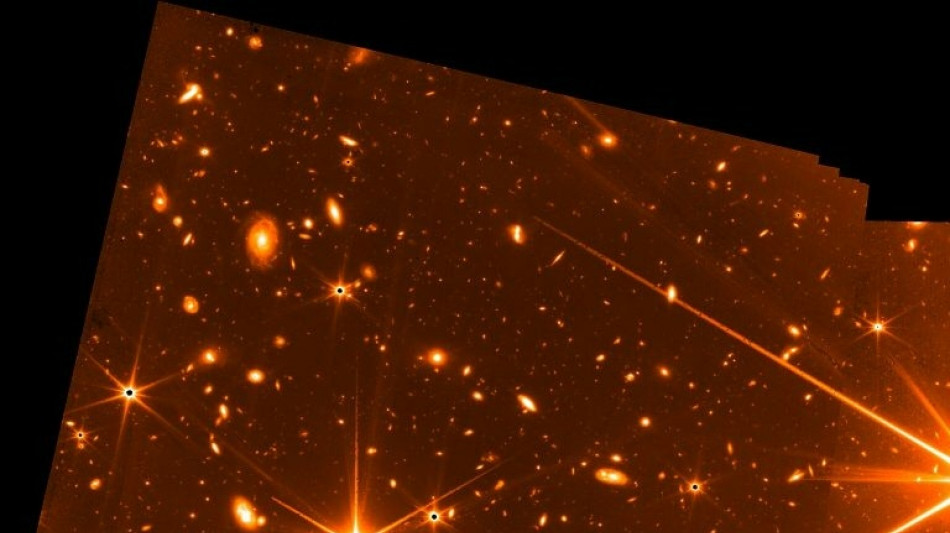
NASA releases James Webb telescope 'teaser' picture / Photo: © NASA/AFP

 US eyes offshore nuclear reactors

 The Sterling Announces Luxury Cocktail Lounge Concept and Investor Showcase in Orlando
 Inter Miami signs Brazil veteran Casemiro but MLS probes deal

 White House accuses China's Moonshot of stealing Anthropic AI

 Pogacar sweating on Yates's fitness ahead of Tour Queen stage

 Ukrainian soldiers and civilians welcome new army commander
 UK fintech Revolut valuation soars to $115 bn: source

 German FM, on Africa tour, eyes business ties amid US, China pressure

 Rubio says at ASEAN meeting he expects 'positive' US visit by China's Xi

 Philipsen wins Tour de France 17th stage

 DonnaPro Introduces AI-Trained Executive Assistants for European CEOs

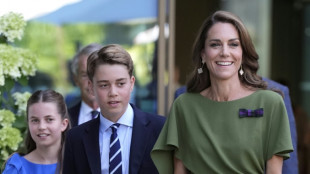 Happy birthday, George! UK prince becomes a teenager

 Oil prices jump on Mideast war, stock markets diverge
 US hits Iranian island, says war cost at $37.5 bn

 Metal mining's carbon footprint far larger than thought: study

 TokenInsight Q2 2026 Report: TradFi Momentum Lifts MEXC to No. 2 in Commodity Perpetuals

 Leonardo chief sees potential for Germany to join GCAP fighter jet project
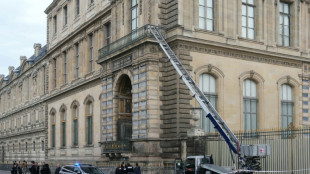 Louvre heist gallery reopens to public, but with nothing to steal

 Ukraine's new army chief: who is Mykhailo Drapaty?
 India student protests keep up pressure on Modi government

 Italian FA chief says in touch with Guardiola over coaching vacancy

 Cooler inflation hands new UK PM Burnham an early boost
 Bezos holds talks with group interested in buying Liverpool stake: reports

 The student movement in India challenging Modi's government
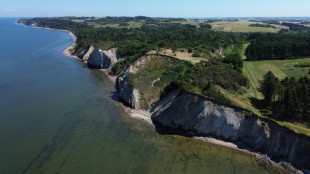 Danish fish fossil cliffs set to gain UNESCO status
NASA has a provided a tantalizing teaser photo ahead of the highly-anticipated release next week of the first deep-space images from the James Webb Telescope –- an instrument so powerful it can peer back into the origins of the universe.
The $10 billion observatory -- launched in December last year and now orbiting the Sun a million miles (1.5 million kilometers) away from Earth –- can look where no telescope has looked before thanks to its enormous primary mirror and instruments that focus on infrared, allowing it to peer through dust and gas.
The first fully formed pictures are set for release on July 12, but NASA provided an engineering test photo on Wednesday -- the result of 72 exposures over 32 hours that shows a set of distant stars and galaxies.
The image has some "rough-around-the-edges" qualities, NASA said in a statement, but is still "among the deepest images of the universe ever taken" and offers a "tantalizing glimpse" at what will be revealed in the coming weeks, months, and years.
"When this image was taken, I was thrilled to clearly see all the detailed structure in these faint galaxies," said Neil Rowlands, program scientist for Webb's Fine Guidance Sensor at Honeywell Aerospace.
Jane Rigby, Webb's operations scientist at NASA's Goddard Space Flight Center, said the "faintest blobs in this image are exactly the types of faint galaxies that Webb will study in its first year of science operations."
NASA administrator Bill Nelson said last week that Webb is able to gaze further into the cosmos than any telescope before it.
"It's going to explore objects in the solar system and atmospheres of exoplanets orbiting other stars, giving us clues as to whether potentially their atmospheres are similar to our own," he said.
"It may answer some questions that we have: Where do we come from? What more is out there? Who are we? And of course, it's going to answer some questions that we don't even know what the questions are."
Webb's infrared capabilities allow it to see back in time to the Big Bang, which happened 13.8 billion years ago.
Because the Universe is expanding, light from the earliest stars shifts from the ultraviolet and visible wavelengths it was emitted in, to longer infrared wavelengths -- which Webb is equipped to detect at an unprecedented resolution.
At present, the earliest cosmological observations date to within 330 million years of the Big Bang, but with Webb's capacities, astronomers believe they will easily break the record.
E.Schubert--BTB