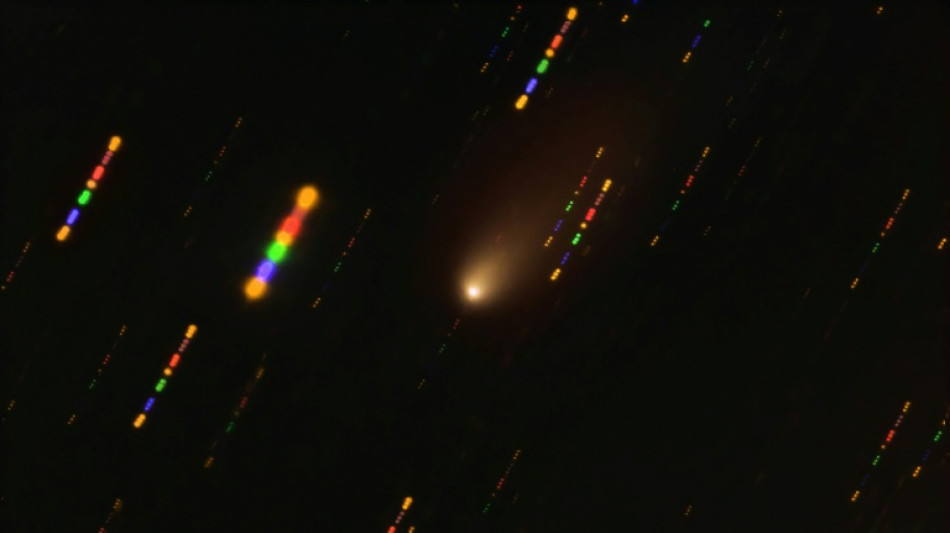
Possible interstellar object spotted zooming through Solar System / Photo: © EUROPEAN SOUTHERN OBSERVATORY/AFP/File

 Repsol says profit more than triples on higher oil prices

 TotalEnergies says profit doubled on Mideast war

 Giant swing on Swiss peak aims to boost summer tourism as Alps warm

 ASEAN to call for open straits as US-Iran war casts shadow

 AI catches up with humans to score 100% at top maths contest

 South Korea election office raided in fake turnout figures probe: investigators

 Killer whales: orcas blow fish to bits 'for fun', study finds

 Deadly wildfires force thousands from homes in parts of Europe

 Tech bounce lifts Asia stocks, oil extends gains on US-Iran fears

 Surrounded by militias, Sudanese fear endless cycle of war

 Commonwealth Games 'where champions are made' despite slimmed down model, argues president

 Trump family project in Albania has already caused 'irreparable' damage: NGOs

 Bollywood blast master keeps it real with fire and fury

 Tearful fights, edible offerings: A glimpse into the Maradona trial

 What's the deal with peptides? The hyped market under US review

 Tesla shares fall as Musk touts ambitious -- and costly -- plans

 Houthis claim Red Sea tanker strikes as US hits Iran again

 Wildfires ravage parts of southern France, Italy and Spain

 Alphabet beats expectations in second quarter, cloud revenue nearly doubles

 Trump threatens Iran infrastructure, Tehran vows 'eye for eye'

 US teen withdraws lawsuit against Meta over social media addiction

 Lebanon PM says Beirut working for 'complete Israeli withdrawal'

 EU conditionally clears Paramount bid for Warner Bros.

 Philipsen snaps 'horrible' drought with Tour de France stage 17 victory

 US trial of Venezuela's Maduro set for June 2027

An object that appears to be from beyond our Solar System has been spotted hurtling towards the Sun, which if confirmed would be the third visitor from the stars ever detected, the European Space Agency said Wednesday.
The object, which is currently being referred to as A11pl3Z, poses no threat to Earth, the ESA's planetary defence head Richard Moissl told AFP.
"It will fly deep through the Solar System, passing just inside the orbit of Mars," but will not hit our neighbouring planet, he said.
Excited astronomers are still refining their calculations, but the object appears to be zooming more than 60 kilometres (37 miles) a second.
This would mean it is not bound by the Sun's orbit, unlike comets and asteroids, which all originate from within the Solar System.
Its trajectory also "means it's not orbiting our star, but coming from interstellar space and flying off to there again," Moissl said.
"We are not 100 percent certain at the moment, but anything else would be a surprise," he added.
Official confirmation is expected to come from the International Astronomical Union's Minor Planet Center, which has recorded more than 100 observations of the object so far.
The NASA-funded ATLAS survey in Hawaii first discovered the object on Tuesday, US astronomer David Rankin wrote on the social media platform Bluesky.
Professional and amateur astronomers across the world then searched through past telescope data, tracing its trajectory back to at least June 14.
The object is currently estimated to be roughly 10-20 kilometres wide, Moissl said. But the object could be smaller if it is made out of ice, which reflects more light.
"It will get brighter and closer to the Sun until late October and then still be observable (by telescope) until next year," Moissl said.
- Our third visitor -
It would be the third time humanity has detected something coming from the stars.
The first, 'Oumuamua, was discovered in 2017. It was so strange that at least one prominent scientist became convinced it was an alien vessel -- though this has since been dismissed by further research.
Our second interstellar visitor, 2I/Borisov, was spotted in 2019.
Mark Norris, an astronomer at the UK's University of Central Lancashire, told AFP that the new object appears to be "moving considerably faster than the other two extra-solar objects that we previously discovered."
The object is currently roughly around the distance from Jupiter away from Earth, Norris said.
He lamented that he would not be able to observe the object on his telescope on Wednesday night, because it is currently only visible in the Southern Hemisphere.
Norris pointed to modelling estimating that there could be as many 10,000 interstellar objects drifting through the Solar System at any given time, though most would be smaller than the newly discovered object.
If true, this suggests that the newly online Vera C. Rubin Observatory in Chile could soon be finding these dim interstellar visitors every month, Norris said.
Moissl said it is not feasible to send a mission into space to intercept the new object.
Still, these visitors offer scientists a rare chance to study something outside of our Solar System.
For example, if we detected precursors of life such as amino acids on such an object, it would give us "a lot more confidence that the conditions for life exist in other star systems," Norris said.
G.Haefliger--VB