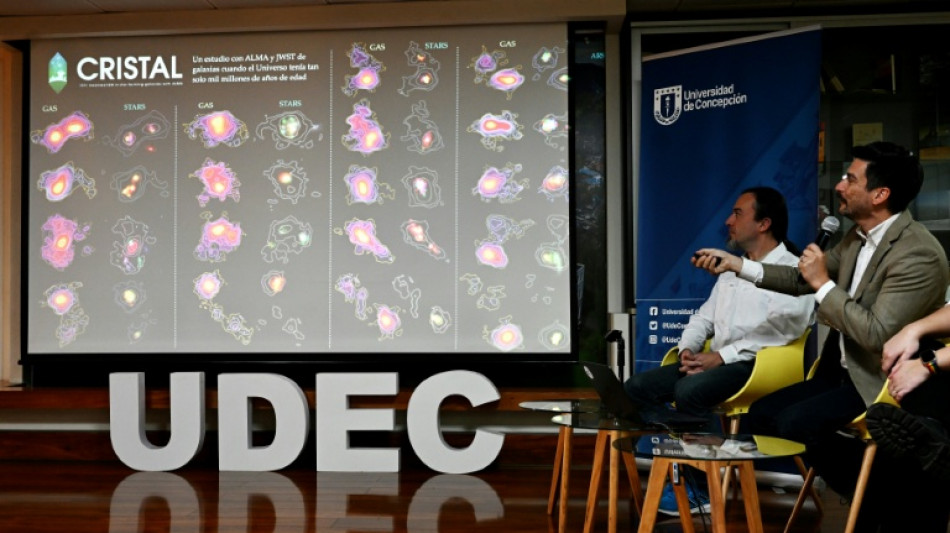
ALMA lets astronomers see building blocks of early galaxies / Photo: © AFP

 Repsol says profit more than triples on higher oil prices

 TotalEnergies says profit doubled on Mideast war

 Giant swing on Swiss peak aims to boost summer tourism as Alps warm

 ASEAN to call for open straits as US-Iran war casts shadow

 AI catches up with humans to score 100% at top maths contest

 South Korea election office raided in fake turnout figures probe: investigators

 Killer whales: orcas blow fish to bits 'for fun', study finds

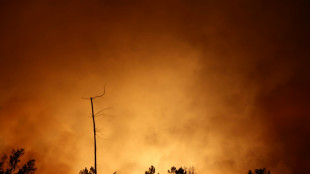 Deadly wildfires force thousands from homes in parts of Europe

 Tech bounce lifts Asia stocks, oil extends gains on US-Iran fears

 Surrounded by militias, Sudanese fear endless cycle of war

 Commonwealth Games 'where champions are made' despite slimmed down model, argues president

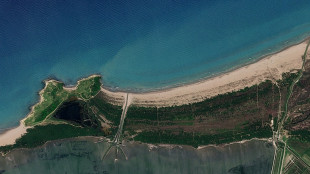 Trump family project in Albania has already caused 'irreparable' damage: NGOs

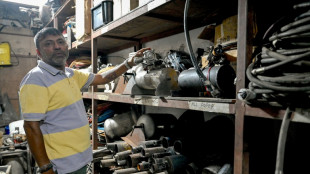 Bollywood blast master keeps it real with fire and fury

 Tearful fights, edible offerings: A glimpse into the Maradona trial

 What's the deal with peptides? The hyped market under US review

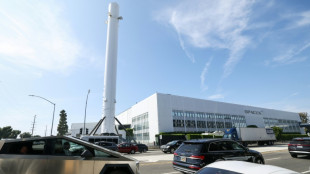 Tesla shares fall as Musk touts ambitious -- and costly -- plans
 Houthis claim Red Sea tanker strikes as US hits Iran again

 Wildfires ravage parts of southern France, Italy and Spain

 Alphabet beats expectations in second quarter, cloud revenue nearly doubles
 Trump threatens Iran infrastructure, Tehran vows 'eye for eye'

 US teen withdraws lawsuit against Meta over social media addiction

 Lebanon PM says Beirut working for 'complete Israeli withdrawal'

 EU conditionally clears Paramount bid for Warner Bros.

 Philipsen snaps 'horrible' drought with Tour de France stage 17 victory

 US trial of Venezuela's Maduro set for June 2027

Chile's ALMA observatory, which houses some of the world's most powerful telescopes, has captured its most detailed images to date of the building blocks of the early universe -- primarily cold gases, dust and stellar light in 39 galaxies.
"We've never achieved so much detail and depth in galaxies from the early universe," Sergio Martin, head of Scientific Operations at ALMA, told AFP during a presentation of the research at University of Concepcion in Santiago.
Due to its dark skies and clear air, Chile hosts the telescopes of more than 30 countries, including the Atacama Large Millimeter/submillimeter Array (ALMA) that was used in the findings.
The research was led by Rodrigo Herrera-Camus, director of the Millennium Nucleus of Galaxies (MINGAL) of Chile, who told AFP the new images provide "the opportunity to study how stars are born."
The survey also found that stars emerged in "giant clumps," Herrera-Camus said.
By combining ALMA's findings with images from the James Webb and Hubble telescopes, researchers were able to learn more about how galaxies evolve, interact, and form stars.
The ALMA telescope was developed by the European Southern Observatory, the US National Radio Astronomy Observatory and the National Astronomical Observatory of Japan.
P.Vogel--VB