Gender not main factor in attacks on Egyptian woman pharaoh: study / Photo: © AFP

 Repsol says profit more than triples on higher oil prices

 TotalEnergies says profit doubled on Mideast war

 Giant swing on Swiss peak aims to boost summer tourism as Alps warm

 ASEAN to call for open straits as US-Iran war casts shadow

 AI catches up with humans to score 100% at top maths contest

 South Korea election office raided in fake turnout figures probe: investigators

 Killer whales: orcas blow fish to bits 'for fun', study finds

 Deadly wildfires force thousands from homes in parts of Europe

 Tech bounce lifts Asia stocks, oil extends gains on US-Iran fears

 Surrounded by militias, Sudanese fear endless cycle of war

 Commonwealth Games 'where champions are made' despite slimmed down model, argues president

 Trump family project in Albania has already caused 'irreparable' damage: NGOs

 Bollywood blast master keeps it real with fire and fury

 Tearful fights, edible offerings: A glimpse into the Maradona trial
 What's the deal with peptides? The hyped market under US review

 Tesla shares fall as Musk touts ambitious -- and costly -- plans

 Houthis claim Red Sea tanker strikes as US hits Iran again

 Wildfires ravage parts of southern France, Italy and Spain

 Alphabet beats expectations in second quarter, cloud revenue nearly doubles

 Trump threatens Iran infrastructure, Tehran vows 'eye for eye'

 US teen withdraws lawsuit against Meta over social media addiction

 Lebanon PM says Beirut working for 'complete Israeli withdrawal'

 EU conditionally clears Paramount bid for Warner Bros.

 Philipsen snaps 'horrible' drought with Tour de France stage 17 victory

 US trial of Venezuela's Maduro set for June 2027

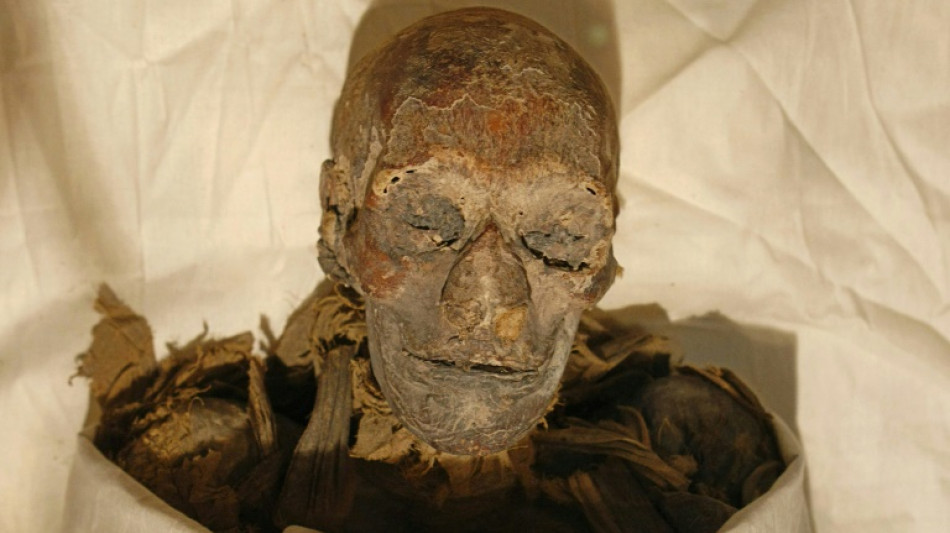
She was one of ancient Egypt's most successful rulers, a rare female pharaoh who preceded Cleopatra by 1,500 years, but Queen Hatshepsut's legacy was systematically erased by her stepson successor after her death.
The question of why her impressive reign was so methodically scrubbed has attracted significant debate, but in new research published Monday, University of Toronto scholar Jun Wong argues far too much emphasis has been placed on her gender.
"It's quite a romantic question: why was this pharaoh attacked after her death?" Wong told AFP, explaining his interest in a monarch who steered ancient Egypt through a period of extraordinary prosperity.
Earlier scholars believed Queen Hatshepsut's stepson Thutmose III unleashed a posthumous campaign of defilement against her out of revenge and hatred, including because he wanted to purge any notion that a woman could successfully rule.
"The way in which (Hatshepsut's) reign has been understood has always been colored by her gender," Wong said, referencing beliefs that Thutmose III may have viewed her as "a kind of an evil stepmother."
His research, which builds on other recent scholarship and is being published in the journal Antiquity, argues Thutmose III's motivations were far more nuanced, casting further doubt on the theory of backlash against a woman in charge.
Hatshepsut ruled Egypt roughly 3,500 years ago, taking over following the death of her husband Thutmose II.
She first served as regent to her stepson, the king-in-waiting, but successfully consolidated power in her own right, establishing herself as a female pharaoh.
Experts say she expanded trade routes and commissioned extraordinary structures, including an unparallelled mortuary in the Valley of the Kings on the Nile's west bank.
Wong reassessed a range of material from damaged statues uncovered during excavations from 1922 to 1928.
He said there is no doubt Thutmose III worked to eliminate evidence of Hatshepsut's achievements, but his efforts were "perhaps driven by ritual necessity rather than outright antipathy," Wong said.
Thutmose III may have been trying to neutralize the power of his predecessor in a practical and common way, not out of malice.
He also found that some of the statues depicting Hatshepsut were likely damaged because later generations wanted to reuse them as building materials.
"For a long time, it has been assumed that Hatshepsut's statuary sustained a vindictive attack," Wong said, arguing that a fresh look at the archives suggests "this is not the case."
H.Weber--VB