South Korea space rocket launch puts satellites in orbit / Photo: © YONHAP/AFP

 Evenepoel wins Tour de France individual time-trial

 Tropical Storm Bertha strengthens, threatening Gulf coast of US
 Microsoft strikes deal for Mistral's AI computing power

 Dutch students unveil 'world-first' solar-powered ambulance
 French lawmakers set to ban social media for under-15s in European first

 UK PM Burnham unveils energy tax cut, tells ministers to cut living costs

 Pharma heavyweights clash over anti-obesity drug ads

 Hungary raids Orban's Fidesz party servers in graft probe

 General Motors lifts 2026 outlook despite hit from electric retreat

 Uproar in France over reintroduction of bee-harming pesticides

 Kuwaitis ration electricity as Iran hits power grid

 Former Man Utd boss Ferguson salutes old rival Keegan

 UK PM Burnham's new cabinet to meet as he announces tax cut

 Former MotoGP champion Quartararo to make Honda switch

 Oleksandr Syrsky, Ukraine's under-fire commander-in-chief

 New UK govt tackles cost of living with energy tax cut

 China summons Philippine ambassador over clash in disputed waters

 Panama, China renew maritime port agreement

 De Gaulle returns to unite the French -- at the cinema

 North Korea reaffirms support for Moscow over Ukraine
 South China Sea rivalry looms over ASEAN meeting

 Arrogance or pride? Argentina grapples with World Cup villain label

 Fires in Brazil's Amazon dropped to historic low in 2025

 French youth social media ban meets age check conundrum

 Lebanon's Aoun to meet Trump as pressure builds to disarm Hezbollah

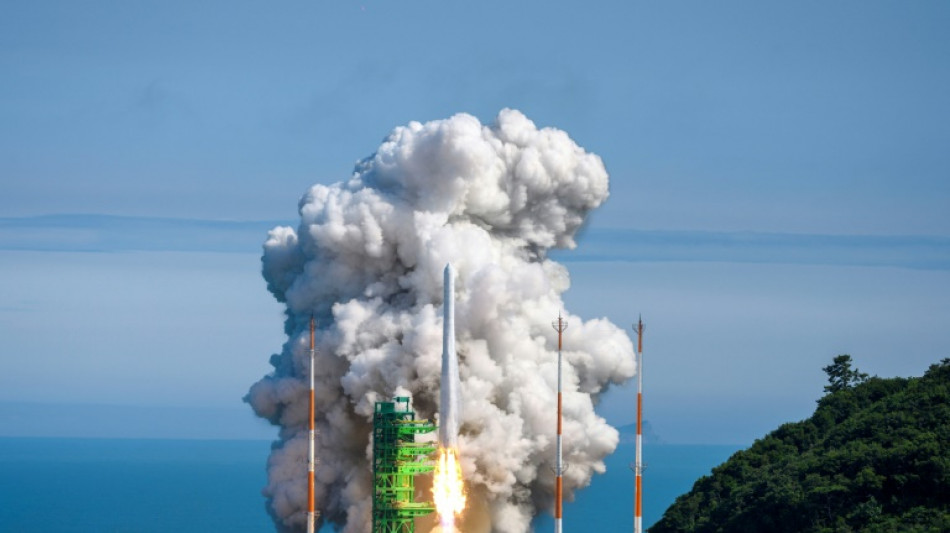
South Korea said Tuesday it had successfully launched its homegrown space rocket and placed a payload into orbit in a "giant leap" for the country's quest to become an advanced space-faring nation.
The Korea Satellite Launch Vehicle II, nicknamed Nuri and emblazoned with the South Korean flag, lifted off at 4:00pm (0700 GMT) from the launch site in Goheung on the southern coast, trailing a column of flame.
All three stages of the rocket worked, taking it to its target altitude of 700 kilometres (430 miles), and it successfully separated a performance verification satellite and put it into orbit, Seoul said.
South Korea's space program "has taken a giant leap forward," said Lee Jong-ho, minister of science and technology, adding he declared the mission a success.
"South Korea has now become the seventh nation in the world to launch a space vehicle with homegrown technology," he said, adding the government would continue its quest to become "an advanced space-faring nation".
South Korea will launch a Moon orbiter in August, Lee added.
The Tuesday test, South Korea's second test launch of its homegrown space rocket, comes eight months after the first test failed to put a dummy satellite into orbit.
In the first test last October, all three stages of the rocket worked with the vehicle reaching an altitude of 700 kilometres, and the 1.5-tonne payload separating successfully.
But it failed to put a dummy satellite into orbit after the third-stage engine stopped burning earlier than scheduled.
In Tuesday's test, in addition to a dummy satellite, Nuri carried a rocket performance verification satellite and four cube satellites developed by four local universities for research purposes.
The three-stage Nuri rocket has been a decade in development at a cost of 2 trillion won ($1.5 billion).
It weighs 200 tonnes and is 47.2 metres (155 feet) long, fitted with a total of six liquid-fuelled engines.
In Asia, China, Japan and India all have advanced space programmes, and the South's nuclear-armed neighbour North Korea was the most recent entrant to the club of countries with their own satellite launch capability.
- Lunar ambitions -
Ballistic missiles and space rockets use similar technology and Pyongyang put a 300-kilogram (660-pound) satellite into orbit in 2012 in what Washington condemned as a disguised missile test.
South Korea becomes the seventh nation -- not including North Korea -- to have successfully launched a one-tonne payload on their own rockets.
The South Korean space programme has a mixed record -- its first two launches in 2009 and 2010, which in part used Russian technology, both ended in failure.
The second one exploded two minutes into the flight, with Seoul and Moscow blaming each other.
Eventually a 2013 launch succeeded, but still relied on a Russian-developed engine for its first stage.
"The fact that we now have our own space rocket means we will be able to test and verify technologies needed for space exploration projects down the road," Bang Hyo-choong, professor of aerospace engineering at KAIST, told the Yonhap News Agency.
The satellite launch business is increasingly the preserve of private companies, notably Elon Musk's SpaceX, whose clients include the US space agency NASA and the South Korean military.
The Tuesday test looks set to bring South Korea closer to achieving its space ambitions, including a plan to land a probe on the Moon by 2030.
South Korea plans to conduct four more such test launches by 2027.
J.Fankhauser--BTB