Ancient reptile tracks rewrite when animals conquered land / Photo: © AFP/File

 ASEAN calls for open straits as US-Iran war casts shadow

 Ford and Geely to form joint venture at struggling Spain plant

 Russia warns US against Ukraine arms sales in Manila meeting

 New UK PM announces tax cut for struggling pubs

 Supporters flood India's 'cockroach' protesters with food

 Modi vows punishment for exam leaks fuelling India protests

 Norway set to make formal complaint to FIFA over Balogun red card saga

 Floods in northeast India kill at least 41

 Nestle siphons off bottled water business into joint venture

 Hundreds hospitalised in Japan heatwave 'disaster'

 Renault says sales stalled in first half

 EasyJet says profits nosedive on Mideast war
 Modi vows punishment for exam fraud fuelling India protests

 Six candidates in race to lead UN set for televised debate

 Comic-Con kicks off with Marvel's return

 Dutch riders dreaming of crazy party corner of Alpe d'Huez
 Houthis target Red Sea shipping as US hits Iran
 Record-equalling Red Sox streak halted at 15 wins

 Messi-less Miami beat Fire 3-2 to spoil Lewandowski's MLS debut

 Mercedes expect Hungary challenge from Hamilton and Ferrari

 In Ghana, one man's race to save critically endangered fish
 Wilson captain, Slipper absent in Kiss's first Wallabies squad

 New Mideast fighting puts eurozone rate-setters on alert

 Venezuelans search for animal companions lost in the quakes

 Argentine Football Association says US did not detain its president

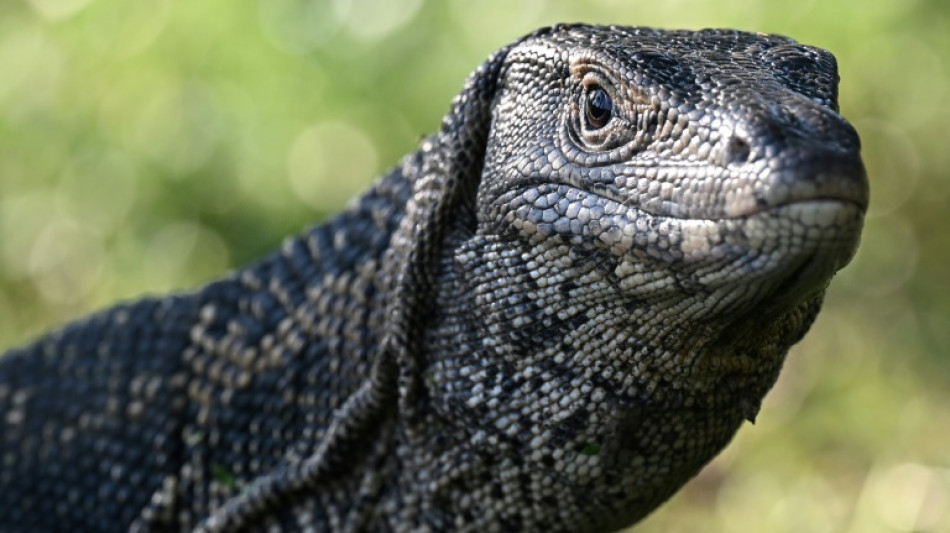
After a brief rain in part of the ancient supercontinent of Gondwana 350 million years ago, a reptile pressed its small claws into the still-wet ground.
Its tracks, which have been discovered in Australia, mean it is the oldest-known vertebrate animal to have permanently abandoned the oceans for dry land, a study suggested on Wednesday.
It also significantly pushes back the date for when these four-limbed pioneers made this important evolutionary step that would eventually lead to humans conquering the globe.
The tracks were found by amateur archaeologists on a 30-centimetre-wide sandstone slab in a mountainous area of the southeastern Australian state of Victoria.
First there was a single footprint of an unknown animal which has "raindrop pockmarks all over it," Per Ahlberg, a palaeontologist at Sweden's Uppsala University, told AFP.
This suggests it was made before the brief shower, said the senior author of a new Nature study describing the discovery.
Then there were two sets of tracks from after the rain.
The second set of tracks suggest this reptile ancestor "was in more of a hurry", he added.
"You see the claws making long scratches on the ground."
- 'Keyholes' into 'lost world' -
The researchers cannot determine whether both sets of tracks were made by the same individual animal, but Ahlberg thinks this is unlikely.
The animal was 60-80 centimetres long and would have looked "quite lizard-like", he added.
That the animal had claws is a clear sign it was an amniote, a group of animals which today includes mammals, birds and reptiles.
Its ancestor tetrapods -- notable for their four limbs -- split into two groups, amniotes and amphibians.
While amphibians had to return to water to lay their eggs, amniotes evolved to have eggs strong enough to survive on land, shedding its last connection to water life.
The discovery indicates that amniotes existed 35 to 40 million years earlier than previously thought, during the turn of the Devonian and Carboniferous periods, the study said.
This suggests the "water-to-land-dwelling transition" may have taken place in just 50 million years, much quicker than had been believed, Stuart Sumida of California State University commented in Nature.
That would be just the latest twist in the tale of how animals rose from the ocean to dominate the land.
"The only way to ever understand it is to look through these tiny little keyholes that we find into this strange, dark, lost world," Ahlberg said.
S.Spengler--VB